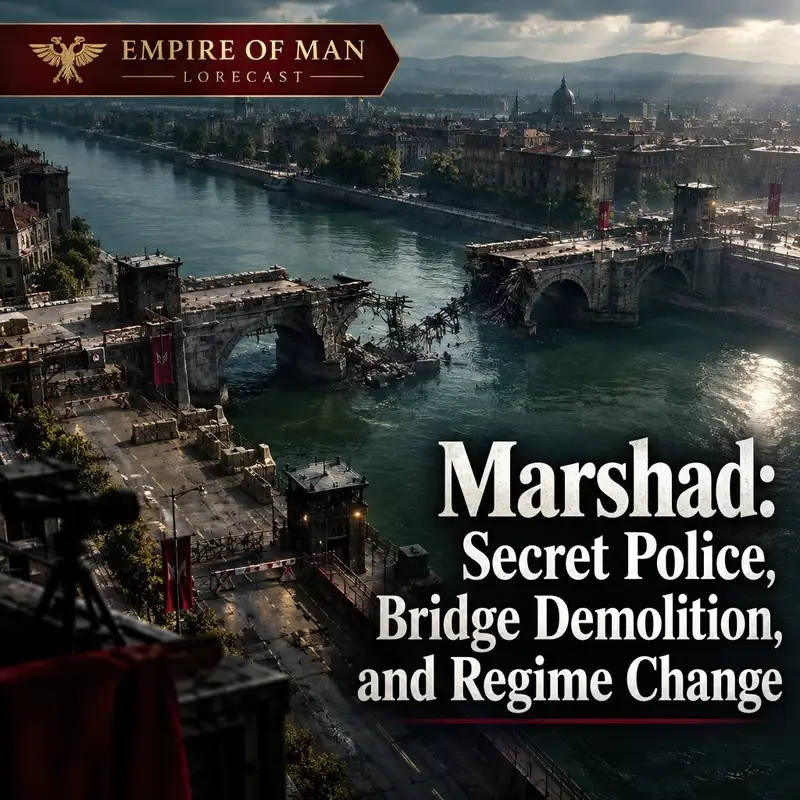
Marshad: Secret Police, Bridge Demolition, and Regime Change
Radj Hoomas’s army was moving toward Pasule when the Marines decided that the bridge behind it had become more important than the battle ahead of it. The crossing linked Marshad’s riverbank to the route of the king’s offensive. It carried soldiers, authority, supply, and the expectation that Prince Roger’s off-world guard would serve as the sharpest weapon in Radj’s campaign. Beneath that bridge, Denat had placed a charge. On higher ground, the Marines had moved their plasma cannon into a position from which it could strike the army they had supposedly come to support.
This was not a planned intervention in Marshad’s politics. Bravo Company had not arrived to choose a government, settle a regional war, or instruct a Mardukan city-state in better administration. It had arrived needing food, transport, shields, and a way onward. But Radj Hoomas had tried to turn a depleted expeditionary force into his private instrument of conquest. By the time his army crossed the river, the company had concluded that neutrality no longer meant staying out of the conflict. It meant refusing to be captured by one side of it.
The bridge was therefore more than a demolition target. It was the point where a local ruler’s coercive strategy met the limits of foreign military power. The Marines could destroy a crossing. They could isolate an army. They could kill guards, overawe a palace, and create an opening for allies inside the city. What they could not do was feed Marshad, govern it, repair its flood-damaged economy, or manufacture legitimacy at the muzzle of a plasma cannon. The crisis at the bridge would decide who lost power. It could not decide who deserved to hold it.
Bravo Company entered Marshad in poor condition for any ambitious political adventure. The company had already survived the destruction of the Kranolta at Voitan, a catastrophe that had cost it personnel, equipment, and margin for error. The force that emerged from the jungle was reduced to two platoons. It remained extraordinarily capable by local standards, but capability and independence are not the same thing. A company can dominate a short firefight and still be unable to sustain a campaign without food, animal transport, local guides, shelter, repair materials, and a route through hostile territory.
Its larger mission remained unchanged. Captain Armand Pahner had to get Prince Roger to the distant spaceport, preserve enough combat power to reach it, and avoid spending irreplaceable high-technology resources in every local dispute along the way. That meant conserving ammunition and power packs. It meant protecting specialists. It meant avoiding casualties that could not be replaced. It also meant recognizing that each day spent in a city-state’s internal quarrel was a day not spent moving toward the only practical route off Marduk.
Marshad appeared, at first, to offer relief. It was larger than Q’Nkok, and it had a more developed political structure, more trade, and more obvious material resources. Yet its size did not mean prosperity. The city and its surrounding region showed the effects of flooding, disrupted trade, neglect, and severe inequality. The fall of Voitan had damaged commercial connections that communities in the Hadur region depended upon. Marshad’s visible authority had not protected its population from scarcity. It had organized scarcity to favor the people nearest the throne.
That distinction mattered to the Marines because they could not buy what did not exist. If local fields produced cash crops for elite revenue rather than food for the population, then a royal promise of provisions was not simply a matter of goodwill. It rested on a damaged agricultural system. If trade routes had been disrupted, shields and transport animals were not items a ruler could summon by issuing an order. Marshad was a place where economic weakness had become a military weakness, and where military power was being used to conceal rather than solve the problem.
The company’s advanced weapons gave it enormous leverage in any immediate confrontation. Local guards could not match powered armor, disciplined infantry, precision firepower, or a plasma cannon. But that advantage came with political costs. The more openly the Marines demonstrated their strength, the more every local faction would try to acquire it, frighten it, bargain with it, or direct it against an enemy. Pahner understood the danger. A force carrying the most powerful weapons in a region becomes everyone’s potential ally, everyone’s potential hostage, and everyone’s potential excuse for war.
Radj Hoomas saw opportunity before he saw danger. In public, he presented himself as the secure ruler of a strong city-state. His court used ceremony, guards, wealth, and intimidation to make that claim credible. But the clearest evidence of his regime came not from the throne itself, but from the people forced to stand before it. A poor petitioner was executed during a public audience. The killing was not a mistake, an uncontrolled outburst, or an isolated act of cruelty. It was political theater.
Radj’s interest in Roger was therefore entirely practical. An off-world prince carried prestige. His guards carried weapons that could devastate local formations. If Radj could claim their support, he would gain more than a military advantage over Pasule. He would gain a political story. He could present himself as the ruler strong enough to command the allegiance of strangers from the stars. The Marines’ presence might frighten neighbors into submission even before the first shot was fired.
That ambition extended beyond a single border dispute. Radj’s strategy depended on converting external military strength into regional dominance. Pasule was the immediate target, but the larger prize was the balance of power across the Hadur region. A successful king could use conquest to acquire tribute, control routes, reward supporters, and conceal the internal failures of Marshad behind new victories. The expedition, from Radj’s point of view, was not a group of stranded travelers. It was an army waiting to be used.
Marshad, however, was not one political actor. The palace, the army, the guards, local merchants, farmers, dissatisfied elites, clandestine networks, Pasulian interests, and ordinary urban residents did not all want the same thing. Some benefited from Radj’s rule. Some feared him. Some wanted reform. Some wanted a new ruler. Some simply wanted to survive the next season without losing their food, land, or family members to the ambitions of people above them. The Marines entered that divided environment with incomplete information and very little time to acquire more.
Radj’s first serious effort to control them did not rely on battlefield force. It relied on separation, intimidation, and the assumption that foreign soldiers could be politically isolated. Roger and several senior members of the expedition were separated from the larger body of Bravo Company. At a royal meal, the king staged a demonstration of violence. A Pasulian representative was killed by a royal guard. The message was directed at the off-worlders as much as at the victim. Radj meant to show that he could kill before them, around them, and perhaps eventually through them.
It was an attempt to establish a hostage relationship without formally announcing one. The king had separated the principal from much of his protection. He controlled the setting. He controlled the local guards. He had demonstrated that he was willing to use sudden violence for political effect. The implied demand was obedience. Accept Marshad’s war as your war, or discover that a royal court can become a prison.
Roger’s response broke the performance. He shot the guard responsible for the killing and directly threatened Radj. The act mattered because it denied the king the emotional result he sought. The expedition did not freeze. It did not accept the court’s rules as binding. It did not permit the murder of a representative to become a successful lesson in submission. Radj had expected fear to create obedience. Instead, his own guard died in front of him.
That did not make the Marines free. It merely established that they could not be overawed by a single violent display. Radj still controlled access to supplies. He still had guards, an army, a palace, and a city organized around his authority. The company remained deep inside a foreign polity, far from its own support, and dependent upon local arrangements for much of what it needed. The king’s coercion had failed at the personal level, but the larger problem of political capture remained.
The figure who offered an apparent escape from Radj’s pressure first appeared to be almost harmless. Kheder Bijan presented himself as an itinerant tinker, a technically skilled wanderer who could move from place to place with tools, observations, and a plausible reason to ask questions. Such a role gave him access. People talk in front of someone they consider insignificant. They reveal needs to someone who repairs equipment. They allow movement to a tradesman that they might deny to a court official or armed guard.
Kheder’s disguise was effective because it rested on a real skill and a real social function. He was not pretending to be a creature from another world. He was performing a recognizable Mardukan role while concealing the political authority behind it. He knew too much about the region, about Pasule, and about the relationships among powerful people. He understood where information moved and where it could be intercepted. He had the manner of someone accustomed to entering rooms without being noticed and leaving them knowing more than when he arrived.
He was, in fact, the head of Marshad’s secret police. That title should not suggest a modern bureaucratic surveillance state with files, electronic databases, and universal technical monitoring. The evidence supports something more personal and more local: a coercive intelligence network built on informants, social access, concealment, fear, political reach, and the ability to distinguish useful knowledge from dangerous knowledge. Kheder’s authority depended on knowing who was discontented, who was vulnerable, who could be recruited, and which truths should not be spoken openly.
Eleanora O’Casey recognized that the tinker’s knowledge was selective. Kheder could speak fluently about Pasule and regional affairs, yet became evasive when the conversation turned toward Marshad itself. That pattern mattered. A genuine outsider might know less about the internal politics of the city than about its neighbors. Kheder seemed to know too much and too little at the same time. His omissions were not ignorance. They were concealment.
Kheder had information, but he made a common intelligence error. He assumed access gave him control. He knew Marshad better than the Marines did. He knew many of the local pressures around them. He understood Radj’s weaknesses. Yet he did not fully understand Bravo Company’s mission, its command relationships, or the degree to which Pahner and the others would resist becoming somebody’s hired army. Kheder believed the stranded humans needed him desperately. They did need local knowledge. They did not need his ambition.
The deeper political offer came through T’Leen Sena, whose covert communication reached the isolated Marines in coded form. The method mattered because it demonstrated that resistance to Radj existed below the level of public court ritual. A ruler who dominates a throne room may still face enemies in markets, workshops, households, religious spaces, military units, or the informal networks through which people carry songs, warnings, and news. Sena’s contact did not reveal a single unified underground. It revealed that Marshad’s politics extended well beyond the king’s visible institutions.
Kheder then made the proposal plain. Radj was preparing for war. The Marines possessed the weapons necessary to change the outcome of that war. If they turned those weapons against Radj’s army, the king could be removed. Kheder expected that removal to clear his own path to the throne. He presented himself as an alternative to Radj, a man who understood the city’s problems and could work with the off-worlders. But the offer was a coup disguised as an alliance.
The people around Kheder did not all share his purposes. Pasulian interests had obvious reasons to resist Radj’s offensive. Marshadan factions harmed by extraction, repression, and military adventurism had reasons to want him gone. Sena had her own covert political role. Some local figures may have wanted a change in policy rather than a change in rulers. Others may have hoped to survive whichever faction prevailed. The expedition did not possess a complete chart of these loyalties, and no serious commander would have pretended otherwise.
For Kheder, the Marines were a lever. Their weapons would break Radj’s field army. Their presence would give the coup a spectacle of inevitability. Their prestige might intimidate wavering supporters. Once the king fell, Kheder expected to inherit the state. This was not necessarily irrational from his perspective. In many coups, the person who controls information and access assumes that the people who provide force will leave politics to the local intermediary. He misjudged both the Marines’ caution and the instability of the power vacuum he hoped to exploit.
Roger did not agree to start a civil war merely because an ambitious intelligence chief asked him to. Pahner, Kosutic, O’Casey, and Roger understood that the company was being recruited as a political counterweight. They also understood that Radj’s war was already moving forward. The decision before them was not between perfect neutrality and intervention. It was between being used by Radj, being used by Kheder, or finding a narrow path that preserved their ability to leave Marshad alive.
Their cooperation with Kheder was conditional. They would use local information where it served the company’s immediate objectives. They would not accept Kheder’s political program as their mission. They would not become a permanent occupation force. They would not commit Bravo Company to conquering Pasule or ruling Marshad. Their objective was more limited and more difficult: prevent Radj from absorbing them into his offensive, secure the conditions necessary to move on, and preserve enough of the force for the distant spaceport.
The planned operation depended on a small number of assets used at the right moment. The plasma cannon could deliver force far beyond what local guards or infantry expected. The Marines’ weapons could engage specific targets with speed and discipline. Denat’s bridge charge could deny movement across the river. Local intelligence could identify vulnerabilities and timing. Radj’s own decision to commit his army toward Pasule created the opening. An army in motion is often more vulnerable than an army behind its own walls.
The constraints were just as important. The plasma cannon had to be moved, emplaced, protected, and supplied. A powerful weapon has little value if it cannot reach the correct firing position or if its crew is exposed before it can act. The Marines needed surprise, because they lacked the numbers for a prolonged conventional battle against an entire city-state. They had uncertain allies. They faced the risk that local conspirators would change sides once fighting began. And they had no ability to occupy Marshad indefinitely after the operation.
The bridge itself made the plan possible because it was an operational system, not just a piece of infrastructure. It governed movement between Marshad and Pasule. It affected reinforcement, retreat, supply, command, and morale. An army that crosses a river with its line of return intact may remain confident even when it meets resistance. An army that discovers the crossing behind it is threatened, guarded, or destroyed faces a different war. Its commanders must consider not only how to advance, but whether they can return.
The Marines used the plasma cannon to clear or suppress guards near the crossing and to shape the battlefield around it. The cannon was then repositioned to a hill, where it could threaten Radj’s force from an unexpected direction. The exact firing sequence is less important than the tactical principle. A smaller force with superior weapons cannot afford to trade blows evenly with a larger army. It must use terrain, surprise, timing, and mobility denial to create local superiority at the point where the enemy is least able to respond.
As Radj’s army committed itself toward Pasule, the Marines turned the assumptions of his campaign against him. The king had expected them to strengthen his offensive. Instead, their firepower disrupted it. The army’s advance became a trap because the crossing that connected it to Marshad also constrained its options. Directional mines and the demolition plan turned the bridge from a route of movement into a point of vulnerability. When the charge was used, the army’s connection to its base was broken or severely compromised.
The Marines’ objective was not to annihilate every soldier in Radj’s army. The available record does not support a precise casualty ledger or a complete reconstruction of every formation. What can be said is that the operation disrupted and isolated the field force enough to break its usefulness as the king’s instrument of conquest. That was the tactical result. At the operational level, it prevented Bravo Company from being absorbed into Marshad’s offensive. At the strategic level, it stripped Radj of the coercive force on which his regional ambition depended.
While the field army was being disrupted beyond the crossing, Pahner, Roger, and their immediate security element moved against the palace. The operation was synchronized because Radj’s authority rested on two visible coercive centers. One was the army he had sent toward Pasule. The other was the court, guards, and royal presence that maintained fear inside Marshad. Breaking one while leaving the other untouched would have allowed the surviving center to rally resistance, claim betrayal, or rebuild control.
Removing Radj collapsed the structure that had made him seem inevitable. His army was no longer advancing with the Marines at its side. His guards had already seen that the off-worlders could not be intimidated by court violence. His palace was no longer secure. The aura of personal invulnerability that had supported his rule disappeared at the same time as his military leverage. Regimes built heavily on fear can appear solid until several instruments of fear fail together.
That collapse did not mean Marshad had solved its political problem. It meant the old ruler could no longer solve it in his preferred way. The conspiracy that had helped create the opening now had to decide who would take authority, who would control the city’s institutions, how food would be distributed, how frightened guards and officials would be treated, and what the population would believe had happened. Those questions are harder than taking a bridge because they cannot be settled by a single detonation.
Kheder Bijan moved quickly to claim the throne. His accession confirmed the Marines’ original concern. He had not helped remove Radj because he wanted the expedition to travel peacefully through Marshad. He had helped remove Radj because he believed the crisis would elevate him. His intelligence network, political contacts, and understanding of local fears gave him real advantages. But his rise also depended on the assumption that Bravo Company would accept the new arrangement once the immediate fighting ended.
For three days, the new king appeared to have succeeded. Then he attempted to renegotiate the promises that had helped secure Marine cooperation. The company needed shields, supplies, and the practical means to continue its march. Kheder tried to use those needs as leverage. He claimed that poison administered during the expedition’s first night in Marshad required an antidote that only he could provide. The threat was intended to transform dependence into obedience.
It was a revealing act. Kheder had learned from Radj that the Marines could not be frightened by a theatrical killing. He had learned that their weapons gave them enormous tactical advantage. But he still believed there must be some pressure point that would make them accept his authority. Poison seemed more subtle than guards or hostages. It seemed to offer him a way to control the off-worlders without confronting them directly.
The flaw was in his premise. Kheder assumed that a toxin dangerous to Mardukan physiology would operate predictably on humans. He did not possess enough knowledge of human biology to make that assumption safe. Roger recognized that the threat relied on uncertainty and on Kheder’s confidence that the humans would not risk discovering whether he was bluffing. The confrontation became irreconcilable when Kheder attempted to use supposed medical knowledge as political blackmail.
Roger killed him. The act should not be mistaken for a routine legal succession, a judicial process, or a clean solution to Marshad’s political crisis. It was an improvised coercive act in a collapsing power structure, carried out by a royal expedition leader whose force had now removed two men seeking to rule the city through fear and manipulation. Kheder’s death ended his immediate bid for power. It did not establish a lawful political order by itself.
In some ways, the legitimacy problem became sharper. Radj had been removed with the support of local conspirators and foreign force. Kheder had used the resulting vacuum to claim kingship, then had been removed by that same foreign force when he threatened the expedition. To the people of Marshad, the sequence could not have looked simple. A city that sees rulers fall in quick succession may feel relief, fear, opportunity, or confusion. It may also wonder who really governs and whether the next ruler can survive.
The Marines needed an authority with local standing, practical judgment, and a program that addressed more than court intrigue. That authority was found in T’Leen Sul. Her elevation was not proof that Roger could simply appoint governments wherever he traveled. It was a choice made under pressure, based on the need for someone who could govern after the expedition left. Her role depended on Marshadan acceptance, local networks, administrative competence, and the ability to redirect the city-state away from the conditions that had made Radj and Kheder possible.
O’Casey’s contribution again mattered because Marshad’s crisis was not only military. It was agricultural, economic, and social. The city’s land and productive capacity had been organized around dianda, a cash crop whose value served elite extraction and trade. That arrangement had left too little emphasis on food production. Flood damage and disrupted routes made the imbalance more dangerous. A government can possess guards and a throne, but if its people are hungry, its economy is distorted, and its countryside is neglected, its authority rests on increasingly fragile ground.
T’Leen Sul’s reforms addressed that material basis of instability. Land redistribution and a shift toward food production were not ceremonial gestures. They were security policy. They affected farmers’ incentives, the availability of food in the city, the ability of households to survive disrupted trade, and the degree to which the state could continue extracting wealth from a population already under strain. A polity that cannot feed itself is vulnerable to coercion from rulers, merchants, armies, and neighbors.
For civilians, however, those practical changes mattered more than the drama of the palace. Farmers experienced regime change through land, labor obligations, crop choices, taxation, safety, and whether their harvest fed their families before it fed a ruler’s treasury. Urban residents experienced it through market supplies, public order, fear of guards, and the possibility that the city might survive the next disruption without hunger becoming a weapon. Traders cared about routes, stability, and whether new authorities could make agreements that held.
The surrounding region also responded to the fall of Radj. Communities that had feared his expansion had little reason to mourn the failure of his offensive. That did not make them subjects of T’Leen Sul or allies of the Empire of Man. It meant that the removal of an aggressive ruler changed the local calculation of risk. The expedition’s onward passage became easier because people no longer saw Bravo Company primarily as the spearhead of Marshadan conquest. The Marines had altered the political narrative attached to their presence.
That was an important operational gain. The company secured supplies, shields, and a route onward without becoming Radj’s auxiliary army. It preserved movement toward the spaceport. It did so at considerable risk and with consequences it could not fully control. Pahner’s larger problem remained unchanged. Bravo Company was still far from home. It was still depleted. It still faced hostile terrain, finite high-technology resources, and the need to negotiate with societies that had their own interests.
Institutionally, Radj’s system of palace fear and Kheder’s secret-police-centered manipulation had both been disrupted. Yet disruption is not administration. Someone still had to organize food production, manage land, deal with guards and officials, negotiate with neighboring powers, and persuade ordinary people that the new order offered more than another set of rulers. T’Leen Sul’s administration had a chance because it addressed those problems in practical terms. Its authority could not rest forever on the memory of foreign weapons.
The Marines did not remake Marshad industrially. They did not leave behind a complete program of modernization, a permanent military alliance, or an Imperial colonial structure. The immediate changes centered on governance, agricultural priorities, and the removal of rulers who had treated the city-state as a source of extraction and a base for war. That was significant enough. It did not need to be exaggerated into a transformation the evidence does not support.
The most enduring lesson from Marshad is that high technology gave Bravo Company influence, not ownership. The company could shift the balance among local factions very quickly because its weapons were unlike anything the city-state could field. But its survival still depended on food grown by Mardukan farmers, shields made and traded through Mardukan networks, routes controlled by Mardukan communities, and agreements interpreted through Mardukan politics. The Marines could not escape dependence by being stronger than everyone nearby.
Roger’s role in the crisis was real. He refused Radj’s intimidation, rejected Kheder’s blackmail, and used his authority decisively when the situation demanded it. Yet Marshad was not the story of one prince solving a city-state’s problems. Pahner preserved the mission. Kosutic preserved discipline. O’Casey read the political and economic structure beneath appearances. Denat made the bridge operation possible. Sena and other local actors opened channels the Marines could not create for themselves. T’Leen Sul offered a governing alternative that had to stand on local ground.
Marshad was not liberated by a plasma cannon or remade by a bridge demolition. Bravo Company broke two predatory bids for power because its own survival demanded freedom of movement, but the lasting test fell to Marshadans who had to turn a city organized for extraction and fear toward food, administration, and local consent.