The X’Intai and D’Nall Cord: First Contact Becomes an Alliance
The flar-ke was dead, and that should have been the end of it. A dangerous animal had pursued a lone Mardukan through exposed country. Prince Roger fired. The immediate threat stopped. A man who might have died remained alive. By the standards of a military patrol, it looked like a small tactical success.
But Bravo Company was no longer operating inside a familiar military environment. It had no secure base, no reliable map, no functioning chain of resupply, and almost no understanding of the people whose world it had entered. The company had been trying to avoid notice. Roger’s shot did the opposite. It announced the presence of armed strangers to a local survivor, and it did so at the exact moment when that survivor was engaged in an act with meanings the humans could not yet read.
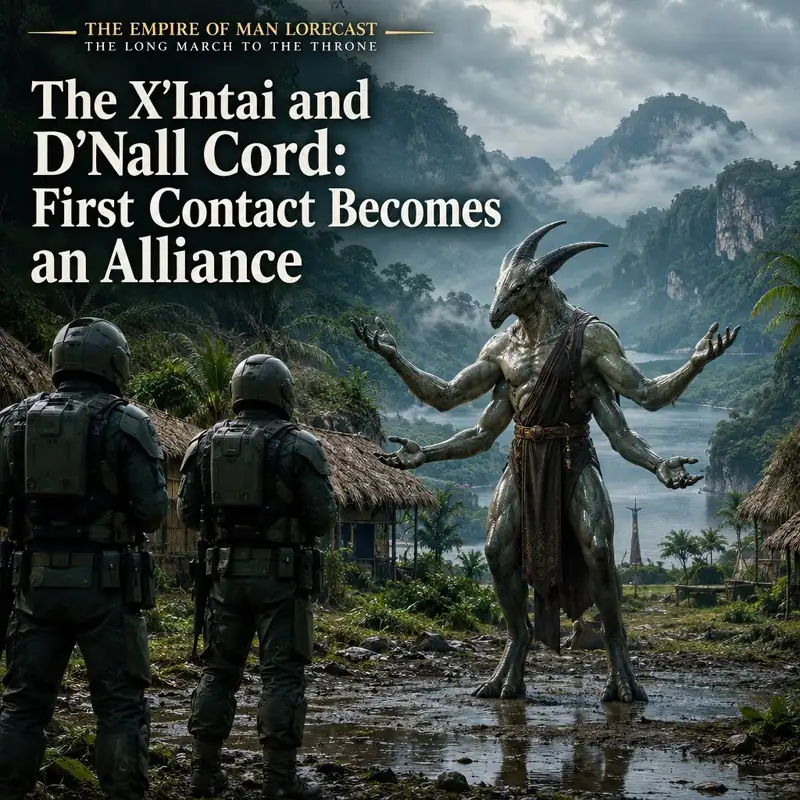
The Mardukan who emerged from concealment was D’Nal Cord. He was not simply a frightened traveler rescued by chance. He was a X’Intai shaman and warrior, a man whose identity connected religious duty, personal honor, kinship, and political responsibility. The humans could see that he had been in danger. They could not see the social world around that danger. They did not yet know what his journey meant, what obligations might follow from intervention, or how his people would understand a life saved by an armed alien prince.
That gap between action and meaning was the real first-contact crisis. The company could defeat a predator. It could not shoot its way into understanding an unfamiliar system of obligation. Roger had not fired in order to make an ally. He fired because someone was about to be killed. Yet on Marduk, saving a life could carry consequences far beyond the moment of rescue.
The incident also exposed a tension already present within the expedition. Bravo Company was an elite formation of the Empress’ Own Regiment, part of Bronze Battalion, assigned to protect Prince Roger MacClintock. Its Marines had advanced weapons, sophisticated armor, medical capabilities, and training built for threats most local forces could not match. None of that made them independent. Their equipment was finite. Their ammunition and power reserves could not be replaced. Their mission remained the survival of their royal principal.
The company’s strategic objective was brutally simple. It had to cross a hostile planet and reach a distant spaceport. From there, if enough of the expedition survived and the port could be seized or used, there might be a route back to human space. Everything between the landing site and that destination was uncertain. Terrain was uncertain. Food was uncertain. Local politics were uncertain. Even the language was uncertain.
Captain Armand Pahner understood the problem in professional terms. Roger was the prince, and his dynastic importance was immense. But Pahner retained operational command of the protection mission. He had to decide when the company moved, when it fought, what risks it accepted, and how much of its irreplaceable capability could be spent before the final objective came into view. A prince could create political obligations. A captain still had to decide whether a company could survive them.
That made first contact both necessary and dangerous. The company could not cross Marduk through isolation forever. It needed water, food, route information, transport, shelter, trade, interpreters, and warning about hazards that no human survey had identified. Yet every local contact brought the risk of misunderstanding, betrayal, panic, or escalation. A community that saw the Marines as invaders might become an enemy. A ruler who saw them as useful might try to control them. A local dispute could become a war before the humans understood who was fighting whom.
The first words between Cord and the company did not solve this problem. They made it visible. Eleanora O’Casey had translation tools and a trained analytical mind, but neither gave her instant access to Mardukan society. The expedition’s software had limited data. It could identify repeated sounds, correlate gestures, and begin constructing practical meaning. It could not immediately translate law, religion, kinship, or status.
Cord was trying to establish something urgent. He identified Roger as the person responsible for the flar-ke’s death. He made contact. He returned repeatedly to concepts the humans could only approximate through their incomplete translation: life, brother, obligation, debt. The company could see that Roger’s action had created a relationship. It could not yet define that relationship with confidence.
O’Casey’s best interpretation was that Cord had established an asi bond with Roger. The word did not translate cleanly into any human institution. It had elements of indebtedness, reciprocal duty, kinship, and lifelong connection. But it was not simply a debt in the commercial sense. It was not an enlistment contract, a political treaty, an adoption, a marriage, or a declaration that Cord had become Roger’s property. Each of those comparisons captured a fragment of the idea and distorted the whole.
For Cord, asi gave Roger’s intervention a meaning that could not be ignored. Roger had saved his life. Cord owed him, but the obligation did not run in only one direction. If Roger accepted the bond, he also accepted responsibilities toward Cord. The relationship made them connected in a way that other Mardukans could recognize. It transformed an accidental encounter into a matter of public identity.
For Roger, this was a difficult lesson because he had no time to learn it gradually. He had acted from instinct, perhaps from compassion, perhaps from the simple refusal to watch someone be killed. He had not intended to acquire a new obligation in an alien legal and spiritual system. Yet intent did not erase consequence. The humans could not reasonably demand that Cord treat the event as meaningless merely because they had not understood the rules before acting.
Pahner had to view the same moment from another angle. A personal bond between Roger and a local Mardukan might prove useful. It might provide a guide and an intermediary. It might also pull the prince, and therefore the company, into obligations that no Marine had authority to define. Cord was a stranger. His motives could not yet be known. His people might be friendly, hostile, divided, or desperate. The company could not simply trust him because he seemed grateful.
But neither could it simply walk away. Cord knew the country in ways the expedition did not. He understood the terrain, the routes, the settlements, and the threats that could turn a day’s movement into disaster. He warned the humans about yaden, nocturnal predators dangerous enough to shape how Mardukans traveled, sheltered, and guarded themselves. For the Marines, this was more than a wildlife report. It was an intelligence briefing from someone who had lived with the environment his entire life.
The warning also underscored how limited human technological superiority could be. Bravo Company could carry weapons that local fighters could not duplicate. It could deploy armor and medical systems beyond Mardukan manufacturing. But armor required power. Weapons required ammunition. Medical systems required supplies and skilled operators. The company’s equipment did not tell it where to camp safely, which route was passable, how local predators behaved, or which settlement might be willing to trade.
Cord’s value was not that he became a human auxiliary. He did not join the Imperial Marines. He did not enter Pahner’s chain of command. He remained a X’Intai man with his own obligations, loyalties, beliefs, and political concerns. What he offered was local competence, not subordination. That distinction would become essential to the expedition’s survival.
There was also a physical reality behind the relationship. Mardukans were adapted to Marduk, but adaptation did not mean immunity to every condition. In exposed, dry country, their protective bodily coating and need for moisture shaped what constituted danger. Human shelter, water, and medical attention could matter immediately. At the same time, Cord’s ability to move through his own environment did not mean he could make the company move at his pace.
Bravo Company carried a prince, equipment, weapons, wounded personnel, and the burden of maintaining unit cohesion under extraordinary conditions. A heavily equipped formation could not move like a lone local traveler. It needed security to the front, rear, and flanks. It needed to think about camp placement, food, water, heat, injury, and the pace of the slowest necessary member. Cord could guide them, but he could not remove the weight of the mission.
The early relationship therefore developed through shared exposure to risk. Cord needed the strangers to understand that their actions had consequences. The company needed him to understand that it could not casually surrender command decisions to an unfamiliar guide. Roger needed to learn that personal loyalty meant more than generosity in a moment of danger. And Pahner needed to preserve enough flexibility that a first contact did not become a binding commitment to an unknown war.
That larger war became visible when the humans reached Cord’s community. The X’Intai were not an abstract people waiting for human intervention. They had their own leadership, their own internal relationships, their own economy, and their own immediate crisis. Cord’s brother, Delkra, held the chief political authority in the community. Cord’s standing as shaman and warrior gave him influence, but influence was not the same as command. The humans had met one important man. They had not met all X’Intai opinion.
Delkra’s account revealed that the X’Intai problem was not simply an old feud dressed up in unfamiliar names. It was a political economy problem, rooted in land, timber, hunting territory, trade, and the enforcement of agreements. Q’Nkok, the nearby city-state, had expanded beyond established limits. Its woodcutters were taking trees where they should not have been cutting. That encroachment damaged territory on which the X’Intai depended.
The issue was not merely symbolic. Trees were material resources. Hunting territory supported families. Access to land influenced mobility, food, security, and status. Trade goods mattered, and the quality of the goods Q’Nkok offered had declined. A community can endure an insult. It has more difficulty enduring a steady erosion of the resources that allow it to feed itself, trade with neighbors, and maintain autonomy.
From Delkra’s perspective, the X’Intai faced a strategic trap. If they attacked the woodcutters, Q’Nkok might respond with force. The X’Intai could not assume that a limited strike would remain limited. Yet if they went to war with Q’Nkok, they risked exposure to pressure from other neighboring powers, including the Dutak and Arnat. A smaller community surrounded by stronger or opportunistic neighbors cannot choose its battlefield freely.
That was why the X’Intai could not be reduced to either helpless victims or uncomplicated warriors. They had grievances. Those grievances were substantial. But their leaders had to weigh more than justice. They had to consider what a conflict would cost, who might exploit it, and whether an immediate act of resistance would leave their people worse off a season later.
The civilians at the center of the dispute were not incidental. X’Intai hunters and families would lose access to territory. Q’Nkok’s woodcutters were not just symbols of expansion. They were laborers acting within an urban economy that demanded timber and land. Farmers, merchants, guards, and city residents all had interests shaped by the conflict. A war might begin with a boundary violation and end with burned fields, disrupted trade, frightened civilians, and a regional cycle of retaliation.
Roger saw an opportunity in the situation. His experience was limited, but he had begun to understand that the expedition could not remain merely a moving defensive perimeter. If several groups were threatened by Q’Nkok’s expansion, perhaps they could coordinate. Perhaps common pressure could force a larger power to change course. The thought showed an emerging awareness that Marduk’s politics could not be ignored.
It was not, however, a finished piece of statecraft. Roger was effectively suggesting that local groups align against a stronger city-state. Such coordination could deter aggression. It could also widen a dispute into a regional war. The fact that the proposal came from a prince with advanced weapons made the danger greater, not smaller. Even if Roger did not intend to dominate the conflict, others might interpret his involvement as a promise of human military support.
Pahner recognized that risk immediately. His duty was not to solve every injustice the company encountered. His duty was to get the expedition, and especially Roger, to the spaceport alive. That did not mean ignoring the X’Intai. It meant refusing to commit the company to a local war before it had intelligence, supplies, or a clear understanding of the political ground.
The captain’s response was restrained, but it was not indifferent. He proposed delay. The company would continue toward Q’Nkok, where it hoped to obtain supplies, transport, and better information. It would see conditions inside the city-state rather than accepting any single account as complete. It would search for an option other than immediate escalation. In military terms, Pahner was preserving freedom of action.
That choice also preserved the X’Intai’s agency. Delkra was not ordered to wait. He agreed to wait. He had to judge whether the risk of delay was acceptable for his community. He chose to send members of his family with the expedition. That was a practical decision, providing guides and messengers. It was also political. By putting relatives alongside the strangers, Delkra invested in the relationship while ensuring that the X’Intai had observers close to the developing situation.
This was the point at which the alliance began to take material form. An alliance is not made real because two leaders exchange favorable words. It becomes real through movement, risk, communication, access, and obligations that both sides are prepared to honor. Cord’s asi bond with Roger created a bridge. Delkra’s decision to cooperate gave that bridge communal weight. The company’s willingness to travel with X’Intai guides demonstrated that it was prepared to rely on local knowledge.
Trust remained limited. The X’Intai had not surrendered their independence. They had not handed their future to the humans. They were testing whether Roger’s new bond would produce action. The Marines, for their part, had not discovered a friendly rear area. They had gained guides and political access, but they had also become associated with one side in a local dispute.
The exchange was reciprocal, but it was asymmetrical. The humans had medicine, shelter, tools, weapons, and the capacity to make a frightening display of force. The X’Intai had local knowledge, cultural legitimacy, and access to a regional political system the humans could not otherwise enter. Neither side possessed everything it needed. Neither side could dictate every term to the other.
The company’s route toward Q’Nkok made that reality unavoidable. Guidance improved movement security. Cord and Delkra’s relatives could help identify hazards, settlements, and the meaning of local behavior. But the expedition still needed supplies that fieldcraft alone could not provide. It needed food suitable for sustained travel, transport, trade opportunities, information, and perhaps the chance to repair or adapt its logistics around local conditions.
The X’Intai did not become dependent clients simply because human equipment was impressive. Human shelter might ease an immediate hardship. Medical support might save lives. A weapon demonstration might deter an attacker. None of those things created a permanent social order. The X’Intai still had their own leaders, their own territory, their own regional enemies, and their own reasons for deciding how far cooperation should go.
Approaching Q’Nkok revealed the danger built into that association. Q’Nkok was not merely a hostile city beyond a gate. It was a city-state with agriculture, guards, local authorities, economic interests, flood-management systems, and internal tensions. Its residents were not required to share one view of the X’Intai, its expansion, or the sudden appearance of armed humans. Yet the hostility directed toward Cord’s party made one fact clear. The conflict was older than Bravo Company.
The humans had not created the regional dispute. They had entered it at an awkward and volatile point. Cord’s identity carried political consequences within Q’Nkok. To some people near the city, he was not a neutral guide traveling with strangers. He represented a community with unresolved claims, territorial grievances, and contested rights. The expedition’s association with him made the Marines visible inside that argument.
Cord responded by invoking asi. The bond between himself and Roger was not just a private emotional connection. It could be presented as a social category with public implications. If the humans were bonded to Cord, then they had a relationship to his people. That relationship could be used to argue for access, protection, or treatment that would not otherwise be available to unknown outsiders.
This was the practical power of a culturally recognized obligation. Asi gave the humans an identity. But that identity came at a cost. It did not allow them to stand above local politics. It placed them within local politics. They were no longer simply travelers seeking passage. They were travelers linked to the X’Intai, and anyone hostile to the X’Intai could interpret them accordingly.
At the gate, Pahner faced a classic rules-of-engagement problem. The company had overwhelming tactical capability compared with the immediate threat. It could have inflicted terrible damage if it chose to use its weapons freely. But an ability to destroy is not the same as a reason to destroy. The Marines needed access to Q’Nkok. They needed trade and information. They could not afford to make every frightened guard, farmer, or bystander into a permanent enemy.
The presence of civilians made restraint even more important. A panicked crowd is not a conventional military formation. It can become dangerous, especially when armed guards are trying to assert control. But mass firepower against a crowd would have transformed a tense entry into a political disaster. It would have confirmed the worst fears about the strangers and likely closed the very markets, authorities, and intelligence channels the expedition required.
Nimashet Despreaux provided a different answer. Her controlled display of plasma fire was not diplomacy in itself. It did not explain who the humans were. It did not persuade Q’Nkok that the X’Intai had been treated fairly. It did not settle the dispute over timber or territory. What it did was interrupt an immediate threat by making the Marines’ destructive capacity impossible to ignore.
Tactically, the demonstration created space. It stopped the confrontation from becoming a fight at the gate. Operationally, it allowed the company to enter without spending ammunition and lives in a battle it did not need. Politically, it delivered a warning. The strangers were not ordinary travelers, and they were not easy prey.
But deterrence has limits. A display of overwhelming power may prevent violence in the moment while deepening fear, resentment, or curiosity afterward. People who cannot understand a weapon may still understand that it can kill them. That is not the same as trust. The company gained access, but access remained fragile. Q’Nkok had not become an ally simply because its guards hesitated.
The gate encounter showed why Pahner’s earlier caution mattered. Had Bravo Company committed itself immediately to the X’Intai’s war, it might have arrived at Q’Nkok as an openly hostile force. Had it tried to remain completely detached, it might have lacked the social standing that Cord’s asi bond provided. Instead, it entered under conditions of ambiguity. That ambiguity was uncomfortable, but it kept options open.
For the humans, the gains from the relationship were considerable. Cord offered guidance through terrain that could kill an expedition as effectively as an army. He provided early language access, not perfect translation but a living connection to Mardukan speech and custom. He brought warnings about predators, routes, and local dangers. Through the X’Intai, the company gained a first point of entry into the political geography of the planet.
The humans also gained something less tangible and perhaps more important. They began to understand that survival would depend on being legible to Mardukans. Equipment could protect a perimeter. It could not create a place within a network of trade, kinship, obligation, and authority. The company needed people who could explain it, vouch for it, challenge it, and tell it when its assumptions were wrong.
Cord and the X’Intai gained as well. The asi bond connected Cord to a royal human principal, a relationship with immediate prestige and leverage. The strangers could offer medical care, shelter, tools, and protection against threats that might otherwise be beyond the X’Intai’s ability to deter. The company’s presence also created a possible new option in a dispute where Delkra’s people had been constrained by an unfavorable balance of power.
Yet neither side received everything it might have wanted. The humans did not gain sovereignty over the X’Intai. They could not direct the community’s future or demand obedience merely because Roger and Cord were bonded. Cord did not gain command over Bravo Company. He could not order Pahner into a war because asi created personal obligation. The X’Intai did not gain a guaranteed human intervention against Q’Nkok. And Q’Nkok’s underlying conflict with its neighbors remained unresolved.
Roger’s role mattered, but it should not be overstated. His shot saved Cord’s life. His willingness to take the bond seriously helped keep the relationship from collapsing into insult or misunderstanding. His instinct to seek wider cooperation showed that he was beginning to look beyond his immediate comfort and safety. But he did not create the alliance alone.
Cord gave the act its meaning. O’Casey helped the humans understand enough of that meaning to avoid a disastrous mistake. Delkra chose to involve the X’Intai community and to accept delay rather than begin a war at once. Pahner prevented a personal bond from turning into an uncontrolled military commitment. Despreaux and the Marines made restraint credible at Q’Nkok by demonstrating force without immediately applying it. The X’Intai themselves chose to work with the strangers rather than merely endure their presence.
Before Cord, Bravo Company was trying to cross Marduk as an isolated military survival force. It had weapons, discipline, and a mission, but it had no place in the planet’s human geography. After Cord, the expedition was moving within Mardukan networks of kinship, trade, territorial dispute, reputation, and obligation. That did not make the march safe. It made survival more complicated, and more possible.
The alliance with Cord began as an accident of survival, but it endured because both sides turned a culturally specific obligation into practical cooperation without surrendering their separate interests. Roger’s shot saved one life. Cord’s asi bond gave that act meaning. Pahner’s restraint prevented the bond from becoming an immediate war. And the X’Intai, by choosing to work with the strangers rather than merely receive them, taught Bravo Company the lesson that would define the march: on Marduk, survival required more than weapons. It required entering other peoples’ worlds without pretending to own them.