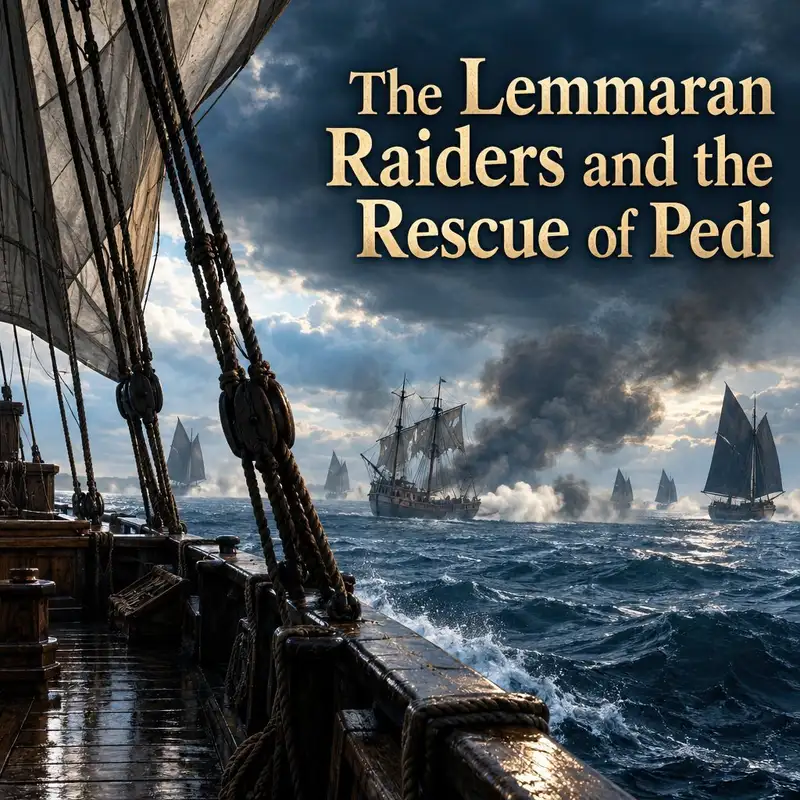
The Lemmaran Raiders and the Rescue of Pedi
The fight aboard the Rage of Lemmar had already ceased to be a question of prize money, maneuver, or even the destruction of one more hostile ship. The decisive fact was below the raiders’ weapons and above the blood-slick planking: prisoners were chained where their captors could kill them before anyone could free them. The Lemmarans were not merely resisting capture. They were trying to make capture meaningless by ensuring that their human cargo did not survive it.
That changed the character of the boarding action in an instant. A force that had intervened to protect a merchant vessel and break a pursuit now faced a rescue measured in seconds. The Marines could not simply clear the deck, secure the ship, and conduct an orderly search. Every delay gave desperate raiders another chance to murder captives who had already passed through more than one system of coercion. The people in chains were not incidental to the battle. They had become its central objective.
For Prince Roger MacClintock, Captain Armand Pahner, and the surviving force of Bravo Company, that created a problem with no clean answer. Their larger mission remained unchanged. They still had to reach the distant spaceport, preserve the prince, conserve scarce high-technology resources, and avoid being absorbed into every war along Marduk’s coast. Yet the people aboard the raider could not be treated as a future political concern. Their danger was immediate. If the expedition acted too cautiously, they died. If it acted too freely, it risked the prince, weakened the company, and spent resources that could not easily be replaced.
The rescue of Pedi Karuse emerged from that tension. It was not the result of a planned humanitarian mission. It began as an intervention in a maritime fight and became a test of what the expedition had become. By this point in the campaign, Roger’s party could no longer imagine Marduk as terrain to be crossed between one human-controlled point and another. The world had its own wars, prisoners, traders, rulers, religious authorities, and armed societies. The force could choose not to understand those realities. It could not choose to remain untouched by them.
The sea passage began after the expedition left K’Vaern’s Cove and moved into a phase of the campaign that looked easier only from a distance. Water promised mobility. Ships could carry people, supplies, weapons, wounded personnel, and equipment more efficiently than an overland column forcing its way through difficult country. A voyage also seemed to offer an escape from some of the jungle’s most punishing burdens. There were no endless route-clearance problems at every bend, no need to drag every load through mud, and fewer opportunities for a hostile force to block the path with a single fortified chokepoint.
The expedition did not possess an Imperial naval force waiting to carry it across Marduk’s oceans. It relied on K’Vaernian ships, K’Vaernian sailors, local pilots, local guns, and local understanding of wind, currents, harbors, and hostile waters. Those ships were not floating extensions of Bravo Company. Their crews had their own experience, interests, and risks. Their knowledge could not be replicated by a handful of Marines, however skilled those Marines might be on land.
There was also the problem of scarcity. The human force still possessed weapons and equipment that gave it a sharp edge in short, violent encounters. But every power pack, every round of specialized ammunition, every damaged component, and every technical specialist was part of a finite reserve. The spaceport remained the campaign’s strategic objective. It was not enough to win a fight today. The expedition had to arrive at the end of its route with enough capability left to survive the fight that would matter most.
The ships therefore gave the expedition movement, but they also placed it in a regional system it barely understood. Merchant traffic, raiding, captivity, local rivalries, and religious authority all moved along the same sea lanes. The voyage was not across empty water. It was through a political landscape whose boundaries were marked by ports, convoys, armed ships, and the reach of institutions that had their own reasons to fear or exploit strangers.
The immediate encounter came through the Rain Daughter, a merchant vessel commanded by Tob Kerr. The ship was part of a broader world of commerce and convoy movement, including traffic associated with the Krath-controlled region ahead. When it came under pursuit by Lemmaran raiders, the expedition did not receive a complete intelligence briefing. It received a crisis.
Kerr could explain enough to establish the danger. His ship had been caught up in an attack on convoy traffic bound toward Strem. The pursuing vessels were not an abstract rumor or a distant strategic concern. They were armed raiders, close enough to threaten a merchant vessel and anyone aboard it. But the expedition did not yet possess a complete account of who had been taken, how the convoy had been broken, or how the various local powers related to one another.
Language added another layer of uncertainty. Roger had acquired experience with Mardukan languages and customs during the long march, but experience was not mastery. A form of Krath speech, a local dialect, a translated title, or a phrase understood aboard one vessel did not automatically explain what another person meant by duty, captivity, religion, or ransom. Translation technology and Mardukan assistance could bridge words. They could not instantly bridge political history.
That uncertainty was strategically important. A force moving toward a fixed destination cannot afford to treat every distress call as its own war. Intervention could cost time, damage ships, consume ammunition, and create new enemies. It could also produce obligations that followed the expedition farther than any raider. The disciplined choice might have been to avoid the fight, continue the voyage, and preserve strength for the spaceport.
But avoiding the fight would also mean watching a merchant vessel and its people fall to pursuers whose conduct already suggested that surrender would offer little protection. It would leave the raiders in control of the immediate sea lane. And it would signal to the K’Vaernian allies carrying Roger’s force that the humans expected assistance in their own emergency but would not act when local partners faced an immediate threat.
Pahner had to weigh those facts against his first duty. The mission existed because Roger had to survive. Every action was supposed to be judged against that requirement. The captain could not assume that a sea fight would remain controlled, or that raiders would behave predictably, or that local allies could be protected without exposing the prince. He also had to consider the condition of his company. Bravo Company was no longer the fully equipped protective formation that had left human space. It had endured loss, exhaustion, adaptation, and a long series of commitments made under pressure.
Roger saw the problem from a related but not identical position. His royal status gave his presence political meaning that no ordinary officer possessed. His increasingly practical role in the expedition also gave him a responsibility he had not understood at the beginning of the march. A merchant vessel under attack was not merely a distraction. It was a civilian problem, an allied problem, and a security problem unfolding in front of him.
The resulting decision was a compromise of authority rather than a simple transfer of command. Pahner remained responsible for the protection mission and for the company’s survival. Roger was permitted practical scope in the operation. That arrangement reflected the expedition’s evolving reality. Roger was no longer only the principal being guarded. He had become a participant whose choices influenced morale, diplomacy, and operations. But Pahner did not stop being the officer who had to account for the consequences when the prince moved into danger.
Once the force committed, the fight was decided less by the glamour of human weapons than by the capabilities of the ships that carried them. The K’Vaernian flotilla had maritime experience, conventional artillery, crews accustomed to working sails and guns, and the local knowledge required to turn a collection of vessels into a fighting formation. The Marines added power, discipline, and shock effect. They did not replace the sailors.
The Lemmarans were dangerous because their method of war exploited hesitation. Their raiders used speed, aggression, shipboard weapons, and the confidence of people accustomed to making other crews afraid. Swivel guns and close-range fire could tear through exposed men on deck. The prospect of boarding could be as important as the boarding itself, because many merchant crews would rather surrender property than face a determined assault by fighters whose reputation promised no easy quarter.
That reputation was not only a matter of individual brutality. It was part of an observed operational pattern. The Lemmarans appeared willing to treat prisoners as expendable once the possibility of capture became real. Their resistance did not end simply because their ship was outgunned or outmaneuvered. A defeated vessel could remain dangerous because its crew might still fight to destroy evidence, preserve terror, or deny freedom to the people it had taken.
Cred Cies, captain of the Rage of Lemmar, was not an incompetent opponent. He commanded an armed raider in waters where aggressive seamanship and close combat could decide a pursuit. His error was more specific. He underestimated the effective combination of the K’Vaernian ships, their guns, the resolve of the people aboard them, and the Marine contingent able to reinforce a boarding action. It was a dangerous miscalculation, but it was not foolishness in the abstract. He had encountered an unusual coalition and read it too late.
The weather helped make that coalition difficult to read. A sudden deluge reduced visibility, disrupted formation control, and turned deck work into a struggle against water, noise, and confusion. Rain interfered with sight lines. It made it harder to judge distance, identify movement, and maintain the clean order that commanders prefer to imagine before a fight begins. Rigging could be damaged. Gun crews could be exposed. A ship that lost maneuver at the wrong moment might become a target, an obstacle, or a drifting liability to its own side.
But weather is rarely neutral. The same rain that obscured the enemy could provide cover for a repositioning. The same disruption that broke a formation could create an opening for a crew that reacted faster. Wind and sailing position mattered because ships could not simply point themselves wherever a commander wished. To bring guns into useful range, to preserve a broadside, or to prevent a hostile vessel from choosing the distance, required skill that belonged to the sailors and officers handling the ships.
The K’Vaernian vessels were able to make their artillery count. Heavier broadsides and conventional shipborne guns did much of the battle’s destructive work. Grapeshot was particularly deadly when crews and exposed fighters were caught on deck at close enough range. It did not need futuristic power systems to be terrifying. A cloud of lethal fragments sweeping a crowded deck could destroy gun crews, break an assault, and turn a ship’s working spaces into places where command became almost impossible.
Smaller shipboard weapons, including swivel guns, also mattered at closer distances. They were part of a naval fight in which the practical problem was not merely sinking an enemy but damaging his ability to maneuver, shoot, board, or escape. Rigging, decks, crews, and exposed positions all became targets. A ship could remain afloat while becoming militarily useless. It could be unable to bring its guns to bear, unable to flee, or too disordered to resist a determined boarding party.
The Marines’ advanced weapons contributed to the engagement, but they were not a substitute for this local naval system. Bead weapons and plasma weapons could provide decisive fire at particular moments. They could suppress positions, break resistance, or give a boarding party an advantage beyond what local opponents expected. But no individual weapon could set sails, manage a damaged hull, calculate a maneuver under shifting wind, or operate an artillery piece through rain and casualties. The battle was an allied operation from beginning to end.
The Lemmaran force was broken. Some vessels were sunk, others disabled or boarded, and the Rage of Lemmar remained the principal target because it still embodied the raiders’ ability to resist, escape, and retain control over prisoners and information. The fleet action had created an opportunity. It had not yet created security.
Boarding was necessary precisely because a damaged hostile ship was still a threat. If it escaped, it could warn others, regroup, continue raiding, or carry captives away. If it remained afloat and uncontrolled, it could still conceal prisoners, weapons, or intelligence. But boarding was one of the most hazardous forms of combat available to the expedition. The distances were short. Friendly and enemy fighters mixed quickly. Fields of fire narrowed. A weapon useful at range could become dangerous when allies were only a few steps beyond the target.
The K’Vaernian crews made contact and sustained the physical contest between ships. They brought vessels alongside, held position as best they could, and provided the maritime foundation without which no assault could cross from one deck to another. The Marines, including the personnel led by Krindi Fain, supplied disciplined close-assault capability. Their value lay not only in their weapons but in their ability to move under pressure, distinguish immediate threats, and continue operating when the fight became confused.
Even so, discipline could not erase the uncertainty of a crowded deck. Rigging, masts, broken equipment, wounded fighters, and the uneven surfaces of a ship all disrupted movement. Smoke, rain, noise, and the sudden appearance of noncombatants made target identification difficult. A Marine could not simply fire through a problem. The people in chains might be only a few paces from the raiders trying to kill them.
The Lemmarans’ resistance made every apparent success provisional. A crew that would not surrender could continue fighting after its guns were silenced, after its ship was trapped, or after its commander’s position had become hopeless. In that environment, the discovery of prisoners was not a side detail. It was the tactical turning point. The boarding party now had to prevent murder while still defeating armed resistance.
D’Nal Cord saw the danger and moved toward it.
Cord’s position within the expedition is often simplified because human language lacks an exact category for what he was to Roger. He was Roger’s asi, a warrior bound to him through an obligation formed earlier in the march. But asi should not be flattened into servant, slave, employee, or ordinary bodyguard. The relationship involved protection, honor, reciprocity, and social expectation. Cord was not a passive instrument carrying out a human command. He possessed his own judgment and his own obligations.
That mattered on the Rage of Lemmar. When Cord saw captives in immediate danger, he did not treat their fate as outside his concern. Roger had once saved him. In Cord’s moral world, that rescue had created an obligation with real weight. A person whose life had been preserved did not stand idle while others were about to be murdered in chains, especially when he possessed the ability to intervene.
From a narrow protection perspective, Cord’s movement was a problem. His duty included Roger’s safety. Moving toward the prisoners appeared to remove him from his assigned position during an unfinished close fight. Denat’s anger reflected that fact. Cord was not merely risking himself. He was risking the stability of a protective arrangement built around the prince.
Roger’s reaction created an even sharper problem. He followed Cord. Part of the reason was immediate and practical. Cord had moved away from his protective role, and Roger could not simply ignore the disappearance of a trusted warrior in the middle of a confused boarding action. Part of it was personal loyalty. Roger recognized what Cord was doing and why. And part of it reflected Roger’s emerging sense that command imposed obligations beyond preservation of his own person.
But this was not sound force-protection procedure. Pahner’s anger was justified. The royal principal had moved into a volatile close-quarters rescue while the fight was still active. The company had been formed around the principle that Roger was not expendable. His courage did not change that fact. His royal importance did not make it safer for him to enter a place where enemy fighters, prisoners, allies, and panicked movement were compressed together.
Dogzard followed as well, reinforcing the rescue effort and demonstrating how quickly personal action can create a chain of commitments in close combat. One person moves toward danger. Another refuses to leave that person unsupported. A third acts because leaving both of them alone would be worse. Such decisions can save lives. They can also cause a formation to lose cohesion at the moment cohesion matters most.
The argument between Pahner and Denat was therefore more than a clash of tempers. It expressed two systems of responsibility. Pahner had to protect a prince whose survival carried dynastic and strategic consequences. Denat had to confront the fact that Cord had accepted grave risk while acting according to an obligation that could not be dismissed as mere disobedience. Neither commander was wrong to see danger. Neither could undo the fact that the danger to the prisoners was also real.
Among the captives was Pedi Dorson Acos Lefan Karuse, generally called Pedi Karuse. She was a Shin woman, the daughter of the ruler of Mudh Hemh, and already far more than a frightened prisoner awaiting a rescuer. Her presence aboard the Lemmaran ship represented the collision of political power, religious coercion, maritime violence, and personal survival.
Pedi had first been taken by a Krath raiding party. Her intended destination was Strem, where she had been designated a Servant of God within a religious and political system that claimed authority over her fate. Before that transfer could be completed, the vessel carrying her and other captives had itself fallen prey to the Lemmarans. She had therefore passed from one coercive system into another. The Krath had seized her under a framework of religious authority. The Lemmarans had seized the transport through maritime predation.
That sequence matters because it prevents the rescue from becoming a simple tale of one helpless victim lifted from danger by outsiders. Pedi had a political identity before the expedition encountered her. She understood the forces that had taken her. She understood the likely meaning of her intended fate better than Roger’s party could at first. She had martial training, and during the fight she acted rather than simply waiting for others to decide whether she would live.
The rescue did not invent Pedi’s courage, political importance, or knowledge. It gave those qualities a new opportunity to matter. Once freed, she could speak, assess, choose, and participate in the difficult relationships forming around the expedition. Her survival altered not only her own future but the information available to a force approaching the Krath’s sphere of influence.
Her bond with Cord developed from the immediate circumstances of the rescue, but it should be described carefully. Pedi became Cord’s benan, a relationship that carried elements of debt, protection, obligation, and reciprocal social standing. No single human term captures it. It was not simply slavery, because it involved agency and mutual obligation rather than ownership. It was not merely military subordination, because its meaning was personal and cultural as well as practical. It was not a simple romance, and treating it that way would obscure the fact that it emerged from captivity, danger, honor, and a social system the expedition was still learning to understand.
The liberation of the prisoners had an immediate humanitarian result. People who were likely to be killed, enslaved, or delivered onward into a system of coercion survived because the boarding party acted before their captors could finish the work. That fact should not be softened by later analysis. The rescue mattered first because lives were at stake.
But it also produced costs. Every rescued prisoner required food, protection, transport space, medical attention, and careful political handling. A long-distance expedition does not add people without changing its logistics. More passengers meant more mouths to feed, more vulnerability in a fight, more demands on ships, and more reasons for local powers to notice the travelers. A force already balancing its resources against a distant strategic objective had accepted new dependents.
It also gained intelligence that could not have been acquired from a map, a rumor, or a translation database. Pedi understood the political geography ahead. She knew something of the Krath, of Strem, and of the religious language being used to justify the seizure of people like her. She could explain aspects of the system that human observers might otherwise misunderstand. Her knowledge came from experience, family position, training, and captivity.
That did not make her omniscient. Pedi could not speak for every Shin community, every Krath official, every Fire Priest, or every ruler along the route. Her perspective was situated. It carried the strengths and limits of someone who had suffered directly under the system being described. But situated knowledge is still knowledge, and for the expedition it was more valuable than the vague assumptions with which it had entered the region.
The political value of the rescue was equally significant. By freeing Pedi, the expedition acquired a personal connection to Mudh Hemh and to conflicts surrounding the Krath. That connection could not be treated as a free gift. It carried obligations. It made the expedition more visible. It also gave local actors reason to assess Roger’s force not simply as strangers passing through but as participants whose actions had altered the fate of an important person.
This was one of the central changes in the Marduk campaign. Bravo Company had begun as an Imperial protective unit. Its institutional identity remained tied to the Empress’ Own, Bronze Battalion, and the protection of the prince. Yet survival had forced it into roles that its original mission did not fully anticipate. It had become a marching force, a diplomatic presence, a training cadre, an allied combat element, and now a maritime rescue force embedded in Mardukan political relationships.
The company could not perform those roles alone. Its increasing effectiveness depended on Mardukan partners, from the K’Vaernian crews who fought the sea battle to the people who supplied local knowledge, labor, weapons, and political access. The rescue of Pedi made that dependence more visible. It showed that the expedition’s future would not be determined solely by whether Marines could defeat opponents in a direct fight. It would also depend on whether they could understand whom they had saved, what obligations had been created, and how those obligations would shape the route ahead.
The engagement therefore changed the meaning of mission discipline. At its narrowest, discipline might have meant refusing the fight. Preserve the prince. Preserve ammunition. Avoid commitments. Continue toward the spaceport. That logic was not irrational. It reflected real constraints, and Pahner’s caution existed for good reasons.
But discipline is not the same as passivity. A force that refuses every costly intervention may preserve its matériel while losing the allies, information, and moral standing needed to complete the larger mission. The question was not whether helping the Rain Daughter and the prisoners was free of risk. It plainly was not. The question was whether the expedition could afford to leave the raiders in control of the immediate situation and still expect to move through Mardukan society as if local suffering had no strategic meaning.
Tactically, the result was clear enough. The Lemmaran threat was neutralized in the immediate fight, and captives were freed from an urgent danger. Operationally, the outcome was more mixed. The expedition spent time, exposed personnel, and accepted greater involvement in a region it had hoped to transit. Its ships had fought. Its leaders had taken risks. Roger had entered danger in a way that confirmed both his developing sense of responsibility and the continuing need for professional restraint around him.
Strategically, the rescue drew Roger’s party more deeply into Marduk’s political landscape. The expedition could no longer pretend that the route to the spaceport was merely a line across a map. It was a passage through societies already shaped by war, slavery, trade, religion, and rivalry. Every alliance gained along that route would carry obligations. Every enemy defeated might have allies elsewhere. Every technology or military skill shared with local partners could change conditions after the humans moved on.
There was also a moral consequence that cannot be separated from the strategic one. By acting to save captives, the expedition demonstrated that Mardukan lives were not simply obstacles, guides, labor, or potential auxiliaries. That did not make the force innocent of all the burdens it brought to the planet. It did not end regional systems of raiding or religious coercion. But it established a standard that mattered to people watching what the strangers would do when their own safety and convenience were at stake.
The rescue also revealed a danger within Roger’s strengths. His willingness to act on behalf of others helped bind the expedition to allies who would become essential. His recognition of Cord’s obligation allowed him to see the prisoners as people rather than as an inconvenient complication. Yet the same impulse led him into an exposed position at the worst possible time. The prince was learning responsibility, but responsibility did not grant him immunity from command discipline.
Pahner’s role remained indispensable for that reason. A prince can inspire loyalty. He can make a morally important decision. He can even develop into an effective leader under pressure. But someone must still watch the perimeter, preserve the mission, account for scarce resources, and say that a brave act was also dangerous. The expedition survived because it contained both impulses: Roger’s growing willingness to take responsibility and Pahner’s refusal to let responsibility become reckless self-exposure.
The K’Vaernian ships and sailors made the naval victory possible. Their seamanship, guns, maneuver, and endurance under bad weather created the conditions in which the raiders could be broken. The Marines made the boarding action feasible by bringing disciplined close-combat capability to a confused and dangerous deck fight. Cord’s intervention made rescue immediate, because he recognized that the prisoners’ lives could not be postponed until the battle was tidier. Pedi’s own courage and knowledge ensured that her liberation would become more than a moment of survival.
Roger’s role captured the expedition’s larger transformation. He did not solve the crisis alone, and he did not enter it without creating risk. But he chose to stand with Cord and the captives at a moment when strict mission economy would have urged distance. That choice strengthened the expedition’s ties to the people of Marduk while reminding everyone why the company existed to protect him in the first place.
Pedi’s liberation marked the point at which the road to the spaceport became inseparable from the lives, obligations, and conflicts of the Mardukans traveling with the expedition.