The Kranolta Campaign and the Battle of Voitan
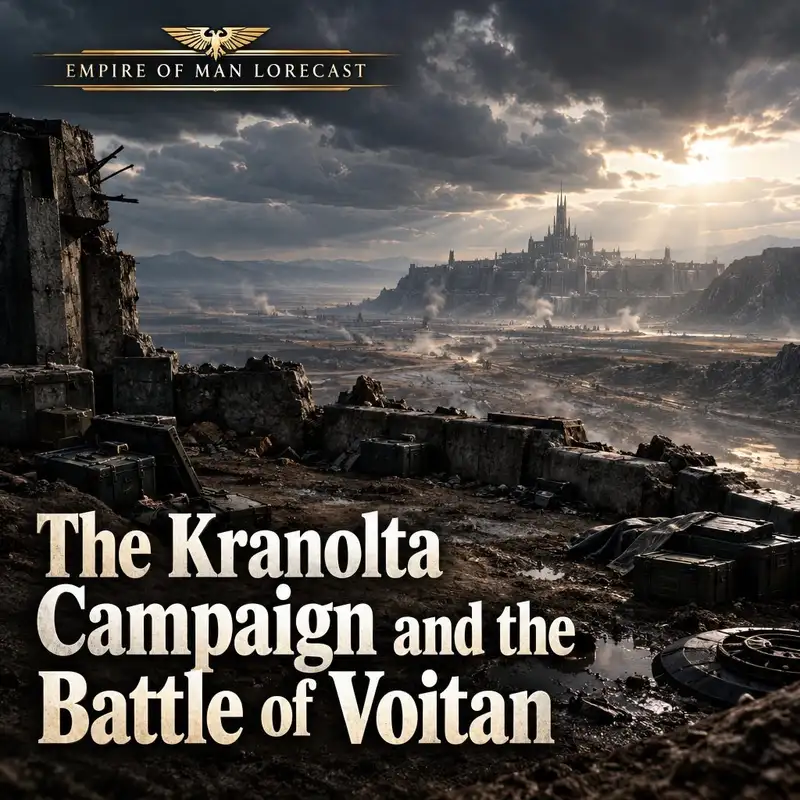
The walls of Voitan gave Bravo Company something it had not possessed for much of the march: a place where a small force could make an enemy pay for every step forward. They were broken walls around a ruined city, not a prepared Imperial position. The gates were imperfect. The fields of fire were constrained by jungle, rubble, and the uneven approaches to the citadel. But stone was stone, elevation mattered, and the Kranolta could no longer simply use the terrain to surround, stalk, and wear down the expedition.
That did not make the citadel safe. The company arrived with casualties, damaged equipment, exhausted personnel, finite ammunition, and a mission that had never required it to conquer a city or defeat a regional power. Its task was still to move Prince Roger toward the distant spaceport and a possible route home. Voitan was meant to be a waypoint. Instead, it became a defensive battle that the Marines could not avoid and could not afford to fight for long.
The immediate problem was therefore not how to destroy the Kranolta. No small force, however well trained, should make that its objective when it is deep in unfamiliar country, carrying its wounded, protecting a royal principal, and drawing down equipment that cannot be replaced. The problem was simpler and harder. Bravo Company had to remain intact long enough to escape an enemy that had learned it was vulnerable.
The Kranolta campaign began as an expeditionary movement problem. After leaving Q’Nkok, the company traveled with D’Len Pah’s caravan, local guides, and flar-ta transport. Those animals and caravaners were not decorative additions to a human military column. They carried loads that Marines could not carry indefinitely through heat, mud, jungle, and broken ground. They connected the expedition to local trade routes and practical knowledge. They also imposed their own pace, vulnerabilities, and requirements.
A company moving through Marduk without local transport and local advice would have moved more slowly, carried less, and understood less of the country ahead. But dependence on a caravan did not make the route secure. It meant that Bravo Company had acquired mobility only by accepting a larger logistical footprint. Pack animals had to be protected. Caravan personnel had to be considered. Loads had to be recovered after attacks. The wounded could not simply be left behind whenever the terrain became difficult.
The route through Kranolta territory was strategically necessary because there were no easy routes across Marduk. The expedition could not choose its path as though it were planning a peacetime survey. It needed passage toward Voitan and beyond it, toward the regions that might eventually offer a path to the spaceport. Each detour cost time, supplies, strength, and political opportunity. Avoiding the Kranolta altogether was not a practical option.
That did not mean the company understood the Kranolta well enough to predict their response. Marduk’s political geography was not a human staff map with clear boundaries, reliable force estimates, and a common language of command. The expedition had guides and allies, including D’Nall Cord and his X’Intai connections, but those relationships provided access and interpretation, not omniscience. Local knowledge was vital. It was also partial, shaped by older rivalries, trade links, fears, and the limits of what any traveler could know.
The Kranolta were not simply a collection of hunters who happened to attack a passing column. They were a powerful regional confederation with mobility, local familiarity, and the political confidence that came from earlier victories. Their conquest of Voitan had broken a commercial and industrial center, scattered its people, and left the region full of displaced interests. The humans were entering territory already marked by unfinished wars. Their presence could not remain politically neutral.
To the Kranolta, the expedition presented both danger and opportunity. The humans possessed strange weapons, armor, and equipment. They had demonstrated unusual tactical skill. But they were also a small force, tied to baggage, unfamiliar with the terrain, and obliged to protect a prince whose value was obvious even when the details of human politics were not. An enemy that could be pressured into slowing down, dispersing, or spending scarce ammunition was an enemy that might be defeated.
The Kranolta did not need to destroy Bravo Company in one dramatic clash. Repeated attacks could test the column, identify weaknesses, force costly reactions, and encourage local fear of association with the humans. Harassment had an operational logic. Every delay increased fatigue. Every casualty reduced the company’s ability to scout, guard its flanks, maintain equipment, treat wounds, and recover from the next crisis.
The route itself imposed losses before the Kranolta could concentrate their main force. Marduk’s environment was not a backdrop to the campaign. It was an active participant. The company moved through terrain that punished speed and punished carelessness. Dangerous wildlife, difficult water crossings, swamp ground, vegetation, heat, and humidity all turned ordinary military tasks into complicated ones. A march order that looked sound in the morning could become fragile by afternoon, simply because ground that appeared passable proved to be mud, water, or jungle.
Sergeant Cobedra’s death in an atul attack was one of the reminders that the company was not only fighting organized enemies. It was losing experienced people to a world whose dangers could not always be detected, deterred, or understood in time. Such a loss meant more than one fewer rifle. A sergeant carried memory, habits of command, confidence under pressure, and knowledge of the people nearby. Those things are hard to replace in a garrison. In a moving force with no replacement pool, they are almost impossible to replace.
The expedition also encountered yaden and other hazards that made every halt a security problem. Camps required guards. Water required caution. Vegetation and terrain restricted visibility. The Marines could not rely on a clear perimeter or a predictable line of approach. Their technology could improve awareness, but it could not make the jungle transparent, and it could not ensure that every sensor, suit, weapon, or power source remained reliable after prolonged exposure.
The failure of a plasma-weapon power pack was especially important because it stripped away one comforting assumption. Human high technology offered frightening tactical power when it worked. A plasma weapon could alter an engagement, and a powered suit could change the odds in a rescue or close defense. But a defective power pack was not merely a defective component. In the field, it became a loss of confidence, a loss of equipment, and, in this case, a disaster that destroyed trained personnel.
A plasma weapon without dependable power was not a reserve of infinite firepower. It was a scarce system whose use had to be calculated. A damaged suit was not armor waiting to be repaired at the next depot. It might be an irreplaceable loss. A dead specialist was not an empty position on an organizational chart. The company could reassign duties, but it could not produce another fully trained Marine technician from local materials and goodwill.
Swamp movement deepened those problems. Men, animals, equipment, and weapons all had to cross terrain that consumed time and energy. A swamp does not merely slow a column. It breaks formation, complicates security, separates people from loads, and makes recovery of the injured more difficult. Then came the river crossing, with the additional danger of predators and the ordinary confusion of trying to move a mixed force across water without allowing the enemy to strike it in pieces.
By the time Bravo Company approached Voitan, its original technological advantage had become selective and fragile. It still had powerful weapons. It still had trained Marines. It still had command discipline and access to knowledge few Mardukan forces possessed. But its margin for error had narrowed. It had fewer people to cover more responsibilities, less reliable equipment, and no safe rear area where losses could be absorbed.
That was the condition in which the Kranolta pursuit became an interception campaign. The company knew it was being pressed, but it did not possess an accurate and complete picture of Kranolta mobilization. Captain Armand Pahner understood that the hunters and raiders threatening the column were part of a larger danger. What he could not know with precision was how quickly that larger danger could gather, how many warriors might appear, or exactly where they would attempt to force a decisive engagement.
Later estimates put the Kranolta force at an immense scale for the small expedition facing it, perhaps around eighteen thousand fighters. That should be understood as an approximate campaign estimate, not a modern census or a verified order of battle. Its meaning lies in proportion. The Kranolta force was vastly larger than Bravo Company. It had enough depth to continue attacking after serious losses, enough local support to move through its own country, and enough confidence to believe that sheer pressure would eventually overcome the defenders.
Voitan offered the first serious chance to deny them that opportunity. The ruined city mattered militarily because its citadel provided walls, choke points, and cover. It mattered politically because it had once been far more than a collection of buildings. Before its fall, Voitan had been a center of trade, craftsmanship, and regional authority. Its metalworkers were particularly renowned. Its steelmaking traditions, including its prized water steel, reflected local skill, local materials, and accumulated experience. That expertise did not begin with the humans, and it did not vanish when the city was sacked.
Conquest had scattered Voitan’s people and weakened its institutions, but it had not erased them. Artisans survived. Families survived. Traders carried memories and connections beyond the ruined walls. Political claims survived in exile, in displaced communities, and in the ambitions of people who still considered the Kranolta occupation an injury that could be reversed. A fallen city can remain a political center long after its gates are broken.
T’Leen Targ, the Voitanese veteran and weapons trader, mattered because he linked the expedition to those surviving networks. He was not simply a colorful local contact or a supplier of unfamiliar weapons. He represented the fact that the city had an afterlife beyond its ruins. The company saw Voitan as defensible ground on a route. The Voitanese saw it as a damaged but recoverable center of their own world.
Before that coalition could intervene, though, Bravo Company had to reach the citadel. The approach through the ruins was confused and violent. Broken streets, walls, debris, pressure from pursuing Kranolta, and the need to move wounded and exhausted personnel made it difficult to maintain a cohesive perimeter. A force under pursuit is at its most vulnerable when it transitions from movement to defense. People are spread out. Units are trying to find positions. Rear guards become isolated. Orders must compete with noise, fear, terrain, and the simple fact that some people cannot move as fast as others.
It was in that confusion that Prince Roger became separated from the main force while trying to help an injured Marine. The episode should not be treated as a simple tale of a reckless prince wandering into danger because he wanted to prove himself. Roger’s decision reflected a developing sense that the people around him were not expendable pieces placed on the board for his protection. But courage is not the same thing as command control. A person who breaks from a shrinking defensive movement, however well intentioned, can create a crisis for everyone else.
Roger had learned enough by then to understand that casualties mattered. He had not yet learned every hard limit imposed by a protection mission under enemy pressure. The desire to aid an injured Marine was human and morally comprehensible. It was also tactically dangerous. The company did not have spare personnel to launch a broad rescue effort outside the citadel while Kranolta forces were closing in.
Pahner’s dilemma was brutal because his responsibilities were not symmetrical. He was commander of Bravo Company, responsible for its Marines and for its ability to continue the mission. But he was also the officer charged with protecting Prince Roger. That protection mission was not an honorific assignment to be set aside when conditions became difficult. It was the reason the company existed in that place.
In the worst case, Pahner had to accept that the prince’s survival outweighed the survival of individual Marines and even the survival of the company as an institution. That is not a comfortable calculation, and it does not become less painful because it is legally or strategically required. Every professional officer understands that missions create priorities. The hard part comes when those priorities demand choices that violate the instinct to save every person within reach.
Roger’s isolation therefore tested the entire command relationship. Pahner could not simply order the company into a rescue that might destroy the defensive force before it reached the citadel. At the same time, abandoning Roger would mean failure at the core of the mission. The company needed the prince to regain the defenses, and it needed him to do so without consuming the force’s remaining capacity.
Roger survived that separation through a combination of personal combat skill, determination, and the remaining weight of human firepower. The specific details matter less than the larger point. He was not saved by royal title alone. Nor did he solve the crisis alone. He reached the citadel because he could fight, because he had learned from the people around him, and because the Kranolta had to confront capabilities they did not fully understand. But his return did not erase the danger created by his separation.
Once Roger was inside, Pahner made the protection mission plain. The prince’s importance was not a privilege that allowed him to demand sacrifices without consequence. It was a burden borne by the people who had been sent to keep him alive. Roger’s survival represented dynastic, political, and strategic stakes far larger than his own immediate wishes. That reality was becoming impossible for him to ignore.
Pahner’s decision to give Roger practical work in the defenses was part of that education, but it was also a matter of military necessity. A defensive position under pressure requires every capable person to carry a real task. Responsibility could not remain ceremonial. The company had lost people. Its officers and senior enlisted leaders had to distribute work, preserve cohesion, and make use of available skill. Roger could contribute, provided that contribution was tied to the command system rather than personal impulse.
Sergeant Major Eva Kosutic’s role in this wider process was essential even when the narrative focus falls on Pahner and Roger. A company under repeated attrition survives through the work of enlisted leadership: standards held when people are exhausted, positions manned when casualties create gaps, weapons maintained under miserable conditions, and discipline preserved when fear offers a dozen reasons to break it. The citadel defense depended on that practical professionalism as much as it depended on the decisions of its captain.
Eleanora O’Casey’s contribution was different but equally necessary. The battle could not be understood solely through weapons and walls because the forces approaching Voitan had political meanings the Marines only partly grasped. O’Casey’s cultural and linguistic work helped the expedition navigate Mardukan relationships that no infantry drill could solve. Communication did not guarantee agreement, but without it the company would have been even more isolated inside a city whose history it barely knew.
The Kranolta main assault began after the company had reached the citadel and made what preparations it could. The battle was a defensive action fought over successive attempts to reach the walls, force the gates, and overwhelm a small garrison through sustained pressure. It was not a clean demonstration of human technology against helpless attackers. The Kranolta knew that the defenders were few. They knew the fortifications were damaged. They knew that a small force could be worn down even when it carried weapons of extraordinary power.
The walls multiplied Bravo Company’s remaining combat strength. A wall channels attackers. A gate concentrates their efforts. Elevated positions improve observation and fields of fire. Rubble can become cover. A narrow approach can prevent a larger enemy from bringing all its numbers to bear at once. These advantages allowed the Marines to turn discipline and fire control into a temporary answer to mass.
But a wall is not a source of ammunition. It cannot replace the dead. It cannot repair a damaged weapon or restore the sleep lost to days of marching and nights of alarm. A fortified position can make a smaller force more efficient, but it cannot make it immortal. The defenders had to conserve what they had because every shot fired at Voitan competed with unknown dangers still waiting along the road to the spaceport.
The company used bead weapons, grenades, remaining armored capability, and the surviving plasma cannon as parts of a defensive system. The plasma cannon had a psychological and physical impact that local forces could not ignore. Yet it was not something Pahner could use with the confidence of a commander supplied from orbit. It was a strategic reserve with a limited future. Its presence strengthened the defense. Its scarcity shaped every decision about when and where to employ it.
Fire discipline was therefore not merely an expression of Marine professionalism. It was logistics in action. A defender who shoots at every movement in the jungle may feel safer for a moment, but he also burns through a resource he cannot replace. Officers and noncommissioned officers had to decide where a threat was real, where an assault was developing, and where the defenders could accept risk rather than expend their future.
The Kranolta, for their part, had reason to keep pressing. Their assaults were costly, but they were not meaningless. Repeated pressure could force the defenders to reveal firing positions, exhaust grenades, damage weapons, and move scarce personnel from one threatened point to another. Even failed attacks could measure the rhythm of the defense. An attacker with numbers can use time as a weapon, particularly against a force already weakened by a long march.
The strain on Bravo Company was physical as well as tactical. Wounded personnel required care. Positions required relief. Communications became harder as noise, smoke, damage, and fatigue accumulated. Every gap created by a casualty had to be filled by someone already carrying another responsibility. Marines who had spent days moving through hostile terrain now had to stand, watch, fire, reload, and decide whether the next approaching figure was an attacker, an ally, or a civilian caught in a battlefield.
No account of the defense should pretend that the company independently destroyed the whole Kranolta force. It held. It inflicted losses. It used its advantages with skill and discipline. But it was approaching the limits of what a small isolated force could do. The Kranolta remained numerous, determined, and capable of continuing the fight. Without a change in the wider situation, the citadel risked becoming a place where Bravo Company merely prolonged its defeat.
That change came from beyond the walls. Forces bearing the banners of fallen Voitan and T’an K’tass emerged from the jungle and struck the Kranolta from the rear. Their appearance was not a miraculous rescue from nowhere. It was the military expression of political networks that had survived the fall of Voitan. The city’s people had not forgotten their loss, and the Kranolta’s success had created enemies whose interests now converged with those of the trapped expedition.
T’Kal Vlan, the last ruler of T’an K’tass, was a principal figure in that restoration effort. His presence underscored that the relieving force was not simply a collection of opportunists drawn by the noise of battle. It represented organized political purpose. T’an K’tass and the emerging New Voitan coalition had reasons of honor, power, survival, and regional influence to challenge the Kranolta.
The operational effect was immediate. The Kranolta had concentrated against the citadel because that was where the humans were fixed. Now they were caught between a stubborn defense in front of them and a hostile force behind them. Their numerical strength became harder to employ. Units oriented toward the walls had to reconsider their rear. Momentum became confusion. A force that had expected to crush a small garrison now faced the danger of encirclement.
Bravo Company’s role in this turning point was crucial, but it was not command of the relief force. The Marines had held long enough to fix the Kranolta in place. Their defense gave the Voitanese and T’an K’tass forces an opportunity to strike an enemy committed to an assault. The Mardukan coalition, in turn, converted a desperate Marine defense into an operational reversal. Neither side simply rescued the other. Their actions created a temporary convergence of interests.
This was coalition warfare without a unified chain of command. The humans had their route, their prince, and their dwindling supplies. The Mardukan restoration force had its city, its political claims, and its own future after the humans moved on. Their enemy was shared. Their final objectives were not. That distinction mattered because it prevented the company from mistaking battlefield cooperation for permanent control.
The Kranolta were checked and bloodied, but they were not erased from Marduk’s political map. Pahner understood that the expedition had neither the mandate nor the strength to pursue a campaign of extermination or occupation. The company needed to survive the battle, recover, and continue moving. It could not afford to confuse the possession of a ruined citadel with the solution to the regional conflict.
The ceasefire Pahner negotiated after the battle reflected that reality. It allowed the Kranolta to recover and bury their dead, while giving the expedition room to remain in Voitan without immediately renewing the fight. This was not sentimental softness, and it was not a declaration that the political conflict had been settled. It was an act of operational economy and cultural recognition.
For the Kranolta, burial mattered. For the Marines, avoiding another unnecessary engagement mattered. A commander on a long expedition cannot spend lives and ammunition simply to impose a theatrical finality on an enemy. The company had achieved what it needed in the immediate sense. It had survived. The pursuit was broken long enough to create space. A ceasefire preserved that space better than another round of combat likely could.
The weeks after the battle were as important as the battle itself. Bravo Company remained in Voitan while wounds were treated, exhausted personnel recovered what rest they could, equipment was assessed, and the company tried to rebuild enough internal order to continue the march. Recovery was not passive. It involved repair, reorganization, training, negotiation, and the difficult work of deciding what could still be carried, used, or trusted.
The Marines’ dead were interred in Voitan’s catacombs alongside honored local dead. That burial was not evidence that the company had been annihilated there. It was an act of shared recognition between a battered expedition and a society that understood conquest, loss, and the cost of defending a homeland. The catacombs joined Marine sacrifice to the city’s own memory of violence without pretending that their histories were identical.
For surviving Marines, the burial also clarified the human cost of the march. The company had not simply lost numbers. It had lost friends, leaders, specialists, and people whose absence would shape every later decision. Survival did not restore the force to its original condition. It required the survivors to assume duties they had not expected to carry and to continue while carrying grief that could not be set aside by an order.
Voitan’s recovery began with Mardukan agency, not human invention. The city’s artisans, workers, political families, traders, and displaced communities were the people who could restore workshops, reopen connections, revive agriculture, and rebuild local authority. The humans could share knowledge, demand material support, and demonstrate techniques. They could not manufacture the social trust, skilled labor, or political legitimacy needed to make a ruined city function again.
The city’s steelworking tradition was especially significant because the expedition increasingly needed sustainable local capacity. Local weapons could not duplicate every function of a bead rifle or plasma cannon. But a weapon that could be produced, repaired, supplied with ammunition, and understood by local troops might be more useful over time than an advanced weapon whose last power pack had failed. That was not a rejection of human technology. It was an adaptation to reality.
The beginning of industrial recovery at Voitan therefore had military consequences. Restored forges and workshops could support local forces. Trade links could move materials. Skilled workers could preserve and adapt techniques. The city’s future steel production belonged to Voitanese knowledge and labor, even when human needs and ideas influenced the work. Technology transfer was becoming a partnership shaped by local interests, not a one-way process in which humans simply bestowed progress.
Civilian recovery mattered just as much. A city is not restored because its walls are occupied or its banners return. People need food, fields, trade, security, work, and some reason to believe that the next army will not scatter them again. The battle gave Voitan a chance to reemerge. It did not erase the damage of the Kranolta conquest or the new risks created by renewed warfare.
For Bravo Company, Voitan offered a temporary operational base and a new reputation. The Marines had demonstrated that they could defend themselves, fight beside Mardukan allies, and contribute to a regional reversal. But reputation was not food, ammunition, or a functioning route to orbit. The spaceport remained distant. The company still had to leave a place where it had found shelter because staying too long would mean turning an expedition into a permanent local commitment it could not sustain.
Operationally, the battle broke the immediate pursuit long enough for the expedition to continue. Politically, it helped restore Voitan as a center around which displaced Mardukan power could gather. Industrially, it strengthened the case for relying on sustainable local production alongside dwindling human systems. For civilians, it created an opening for recovery while leaving the scars of conquest and war intact.
Voitan ceased to be merely a ruin on the route home. It became proof that Bravo Company’s future depended on alliances with people whose wars, industries, and political futures were never subordinate to the expedition’s own.