The Flooding of the Shin Valley and the Defeat of the Krath
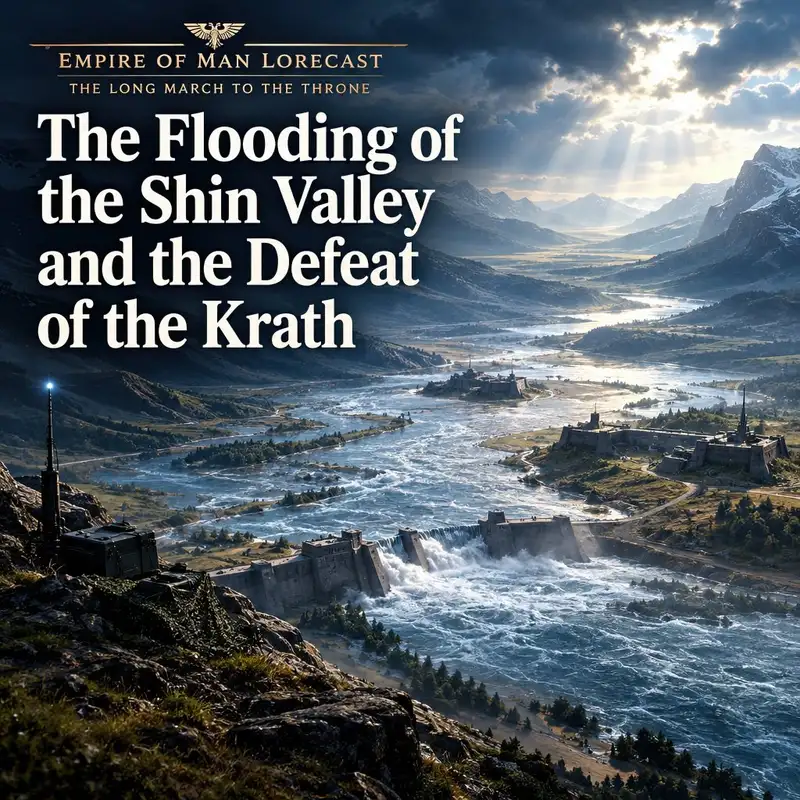
The mountain did not fall on an empty valley. Below it, the Krath army was already committed against the Shin defenses at Nopet Nujam. Its fighters were facing forward. Its camps, stores, command arrangements, and routes of withdrawal lay behind the assault. Then the charges detonated, stone collapsed across the valley, and water began to reclaim ground that local history said had once been a lake.
At a distance, the idea sounds almost simple. Block a valley. Flood an army. Win the war. In practice, it was one of the most demanding operations of the Marduk campaign. It required an alliance that could hold its own walls under attack, explosives the expedition could not replace, access to a hostile spaceport it did not yet control, technical skill to place the charges, and timing precise enough to catch the Krath when movement mattered most.
And even that was not enough. While the Krath army began to lose its position in the Shin Valley, another enemy force struck at Mudh Hemh. Sor Teb, a Krath and Shadem leader facing the collapse of his own position, attempted to turn defeat into destruction. If he could break the Shin political center, kill the humans, or shatter confidence in the alliance, then flooding one army camp would not settle the larger campaign.
The Shin Valley operation was therefore not a single clever stratagem. It was a coalition campaign fought at two linked points. At Nopet Nujam, the objective was to make the Krath field army unable to continue its offensive. At Mudh Hemh, the objective was to preserve the political partnership that made the first operation possible. The flood mattered because it attacked the enemy’s operational coherence. The defense mattered because military success without an alliance would have been temporary.
By this stage of the march, Prince Roger’s expedition could no longer think like a fresh, fully equipped Imperial force. The survivors of Bravo Company, part of the Empress’ Own Regiment, still possessed skills, discipline, and some formidable technology. But none of those things could be treated as unlimited. Every bead round, power pack, spare part, medical supply, and working weapon had to be counted against the distance still remaining.
The expedition’s strategic objective had not changed. Roger had to reach the Mardukan spaceport, seize a route off the planet, and return to human space. But the methods available had changed repeatedly. The original protection mission had become a planetary crossing. The crossing had become a sequence of local wars, negotiations, improvised industries, and alliances. Every success solved one immediate problem while consuming the resources needed for the next.
A direct route through the Valley of the Krath might have looked attractive on a map. It was also dangerous. The Krath possessed defenses, local knowledge, and the ability to concentrate against any force attempting to force passage. The expedition was not in a position to spend its remaining high-technology advantage in a prolonged frontal campaign. It had crossed too much of Marduk, and lost too much along the way, to mistake speed for simplicity.
The movement through the Shesul Pass toward Mudh Hemh was therefore more than a detour. It was an operational choice. It placed the expedition among people threatened by the Krath, created the possibility of a local alliance, and gave Roger’s force access to a stronger political base. It also accepted delay, uncertainty, and the risk of being drawn into a war that was not originally theirs.
Captain Armand Pahner had to judge that problem as a commander. His responsibility was not to reward bold ideas merely because they were bold. He had to preserve the remnant of his command, protect Roger, keep the force coherent, and weigh every local commitment against the ultimate objective. The fact that the expedition needed Shin support did not mean it could afford every battle the Shin might want.
Sergeant Major Eva Kosutic represented another part of the same reality. The strategic argument could concern valleys, alliances, and spaceports. The enlisted reality concerned tired troops, weapons that required maintenance, casualties who could not simply be replaced, and the constant work of keeping a battered organization disciplined. A plan that looked elegant from a command table still had to be carried out by people who had marched, fought, and buried comrades across half a world.
Roger’s role had changed as well. He remained a prince, and his dynastic identity mattered in negotiations. But he was no longer merely a royal passenger protected by professionals. Experience had given him a sharper sense of the relationship between tactical action and strategic purpose. That did not make him the sole commander, or an engineer, or an expert in every field. It meant that he could recognize when another incremental victory would not be enough.
The Krath presented precisely that kind of problem. Raids could hurt them. Defensive fights could delay them. Advanced human weapons could produce local advantages. Yet a larger organized force, operating on familiar ground and able to threaten Shin territory, could absorb a great deal of punishment without losing its ability to fight. The expedition did not need another costly proof that its Marines were dangerous. It needed to change the campaign.
Mudh Hemh offered the possibility of doing so, but it was not a human base waiting to be occupied. It was a Shin political center, defended by Shin people, governed by Shin authority, and threatened by a Krath enemy whose pressure had already imposed real losses. The expedition arrived as a potential ally, but also as an unpredictable outside force carrying its own dangers and ambitions.
The Gastan of Mudh Hemh had little reason to greet the humans with uncomplicated gratitude. The war against the Krath had already cost him his son, Thertik, and many Shin warriors. Grief and political responsibility were intertwined. A ruler who had lost family and fighters could not simply accept a stranger’s promise because that stranger happened to be royal by the standards of another world.
Roger’s identity did matter. The revelation that he was a prince of the Empire of Man gave his mission a scale and a credibility that an ordinary stranded officer could not provide. It explained why the humans were so determined to reach the spaceport. It suggested that their struggle was connected to a wider political crisis beyond Marduk. But royal status did not compel Shin obedience, and it did not restore the Gastan’s dead.
The alliance formed because interests converged. The Shin needed help against the Krath. Roger needed a defensible partner, local knowledge, access to routes, and a political foundation from which to continue toward the spaceport. The Gastan could see that the humans had capabilities his enemies did not expect. Roger could see that the Shin possessed something the expedition could never manufacture on its own: a place in the local political world.
Pedi stood within that relationship as more than an interpreter of human intentions. Her loyalties, losses, and understanding of Shin society gave the alliance a human face, but also a Mardukan one. She had reasons to want the Krath defeated that did not depend on Roger’s mission. Her people’s survival, the authority of their leaders, and the future of their homes were not side issues in a human campaign. They were the reasons the coalition could exist at all.
For the Shin, the Krath threat was not an abstract military problem. It concerned homes, food stores, routes of travel, political authority, and the future of communities that had already lived through war. A defeated army might mean relief. It might also mean flooded land, disrupted trade, damaged camps, and uncertain consequences for everyone living near the valley. The expedition could not separate military planning from those realities simply because its own destination lay elsewhere.
The Krath, meanwhile, were not an undifferentiated mass of enemies. They were a substantial hostile power with military, religious, and political dimensions. Their concentration against Shin positions reflected confidence that pressure applied at the right point could break Shin resistance. Their army could threaten Nopet Nujam, tie down defenders, and exploit numbers in a conventional assault.
That offensive posture also created a vulnerability. An army gathered for battle depends on more than courage and weapons. It needs a camp. It needs stores. It needs routes for reinforcement, command, recovery, and withdrawal. Its leaders need to know where their units are, what orders still apply, and whether the ground behind them remains usable. An army can survive losses. It has far more difficulty surviving the sudden destruction of its ability to organize itself.
Roger’s insight came from the valley itself. The Shin Valley had not always looked as it did during the Krath campaign. Its geological history indicated that it had once been blocked, holding back water and creating a lake. That history did not provide a precise modern survey. It did not guarantee exactly how much rock had to fall, how the water would move, or what every consequence would be.
But it suggested a possibility. If a suitable section of the mountainside could be collapsed into the valley, the blockage might be recreated. Water would rise. Ground used by the Krath for camp and movement could become impassable. An army assembled for an assault might find its rear transformed into mud, floodwater, wrecked stores, broken routes, and panic.
The purpose was not to kill every Krath soldier. That would have been both an unrealistic standard and the wrong operational question. The objective was to destroy the conditions that allowed the Krath force to act as a force. Flood its camp. Break its communications. Scatter its supplies. Disrupt its command. Make orderly movement impossible. Force units to save themselves rather than continue the offensive. Turn numerical superiority into a burden.
It was a dangerous idea because flooding is not a clean weapon. Water does not distinguish between military ground and the wider landscape around it. It affects camps, roads, stores, animals, and the people whose lives are organized around a valley. The record does not provide a complete account of civilian losses or the flood’s long-term environmental effects. That absence should not be mistaken for proof that there were none.
Nor was the proposal a feat of solitary genius. Roger recognized the opportunity. The operation depended on the Shin understanding the ground and accepting the political risk. It depended on Pahner judging whether the expedition could afford the plan. It depended on Marines who could turn an idea about geology into a controlled demolition. And it depended on matériel that the expedition did not possess in any comfortable reserve.
The real supply line for the operation ran through the spaceport. Temu Jin’s access and intelligence created an opening before the installation itself had been taken. Through that connection, the expedition obtained heavy explosives, additional ammunition, and spare parts for weapons and equipment that had survived the march. This was not the same as controlling the spaceport. It was an opportunity created by access, information, and assistance from within a system still beyond Roger’s direct power.
Using the explosives in the Shin Valley was therefore a reserve-management decision. They might be useful in the later assault on the spaceport. They might solve another unforeseen problem. Once expended, they were gone. Pahner and the other professionals had to consider whether the immediate gain justified spending an asset that might never be replaced.
The answer lay in the scale of the Krath problem. A surviving Krath offensive would continue to consume time, ammunition, and allied manpower. It could weaken or destroy the Shin coalition. It could leave the expedition trapped in a regional war while the larger strategic situation beyond Marduk continued to evolve without them. Spending rare explosives was costly. Allowing the Krath to dictate the campaign might have cost far more.
Once the explosives were available, the operation moved from strategic conception to technical execution. Sergeant Adib Julian, Despreaux, and the technical team faced the practical work. They had to identify the relevant section of the mountainside, emplace charges where they could produce the desired collapse, manage the hazards of working with scarce material, and prepare for detonation under the pressure of an approaching battle.
That work demanded precision, but not the impossible precision of a fully instrumented engineering project. The expedition was operating under field conditions, with limited time, incomplete information, and an enemy that could observe activity on the slopes. The goal was not to build a permanent dam to a specified standard. It was to cause enough of a collapse to block the valley at the moment when the Krath were least able to respond.
Despreaux’s presence in the operation mattered because she was a professional Marine. Her relationship with Roger gave the broader campaign an additional personal dimension, but it did not define her function on the mountainside. The demolition effort required trained personnel who could work under risk, manage equipment, and carry out a plan whose failure might leave them exposed to a large enemy force.
Pahner’s role remained what it had to be. He assessed risk, coordinated the larger operation, protected the expedition’s core mission, and made sure that a dramatic plan did not dissolve the chain of command. The prince’s strategic insight did not erase the professional structure around him. A prince could identify the need for decisive action. A captain had to decide how to employ a shrinking force without sacrificing it to one gamble.
Kosutic’s contribution was less theatrical, but no less important. Someone had to ensure that the remnant of Bravo Company could still perform as a unit while specialists prepared the demolition, Shin forces held their defenses, and the possibility of simultaneous attack grew. Discipline in such circumstances is not parade-ground formality. It is the ability to keep people moving, equipped, alert, and responsive when every part of the plan depends on another part holding.
The Krath saw enough to know that something was happening on the mountain. That did not mean they understood the full purpose of the work, or that they could neutralize it in time. Military history is full of forces that recognize enemy activity without correctly identifying its significance. Observation is not comprehension. A commander who sees labor on a slope may think of fortification, concealment, artillery, or a diversion before imagining that the valley itself is about to become a weapon.
The decisive element was timing. The charges were not set off at some safe, isolated moment when the Krath could calmly examine the new terrain and find another route. They detonated while the Krath were attacking Nopet Nujam. Their attention was fixed on the Shin defenses. Their troops were committed forward. Their logistical and command arrangements were under pressure even before the landscape changed behind them.
The Shin defenders had to hold long enough for that timing to matter. If Nopet Nujam had fallen before the collapse produced its effects, the Krath might have converted a disrupted rear area into a costly but survivable inconvenience. The defenders’ resistance gave the demolition its operational value. The flood was not a substitute for the Shin army. It was an extension of what the Shin defenders were already doing.
When the mountain came down, the effects were broader than simple destruction. Movement became uncertain. Units separated from their camps and supplies had to make immediate choices. Commanders struggled to understand which routes remained open and which orders could still be carried out. Equipment and stores became vulnerable. Fear spread faster than information. Fighters who had expected to press an assault now faced a crisis behind them.
A concentrated force can be very powerful when it is moving in one direction under a coherent plan. It can become fragile when that plan is suddenly reversed. The Krath’s advantage in mass depended on maintaining enough cohesion to employ that mass. Floodwater, blocked ground, disrupted camps, and confused movement did not have to eliminate every soldier to break the force’s immediate offensive capacity.
This was the operational meaning of the flood. The expedition did not seek a conventional battle of annihilation because it could not safely afford one. Instead, it attacked the conditions that made a larger army dangerous. The Krath had assembled to overwhelm the Shin. The coalition made that assembly impossible to sustain. The enemy’s own concentration became the reason the collapse mattered.
Yet the operation still faced a second danger. Sor Teb’s attack on Mudh Hemh threatened to turn the moment of Krath disarray into a political defeat. Sor Teb was not the whole Krath cause, and his actions should not be treated as the will of every Krath leader or every Shadem fighter. But he was a dangerous leader with followers, weapons, and strong reasons to strike before his position vanished.
His attack had a clear operational logic. If the Krath field force near Nopet Nujam was collapsing, then a blow against Mudh Hemh could still inflict damage, kill important leaders, undermine Shin morale, and perhaps break the partnership between the Shin and the humans. A coalition can survive battlefield losses. It is less likely to survive if its political center is seized, its ruler discredited, and its allies shown to be unable to defend it.
Mudh Hemh was therefore not a rear area in the comfortable sense. It was a center of authority, a place of refuge, a base for allied operations, and a symbol of whether the Gastan’s decision to work with Roger had been wise. Its defense mattered as much as the valley flood because it protected the political result the flood was intended to produce.
Roger fought in that defense wearing powered armor and carrying a bead cannon. The equipment gave him a degree of protection and firepower unavailable to most Mardukan fighters. It also marked the seriousness of the threat. Advanced equipment had been saved, carried, maintained, and preserved through a long campaign. Bringing it into the fight was a decision to commit scarce capability at a critical point.
Sor Teb possessed an off-world anti-armor weapon known as the one-shot. Its presence was a reminder that the humans were not the only participants capable of introducing advanced tools into Mardukan conflicts. The weapon did not lock onto Roger’s armor correctly, and that failure saved him. The episode should not be read as proof that armor is invulnerable, or that superior equipment always decides a fight. It was a near failure with consequences that could easily have been different.
Roger’s survival did not end the danger. Combat in and around Mudh Hemh remained a struggle over whether the enemy could break the Shin center before the wider Krath collapse became politically decisive. The defenders had to keep fighting amid confusion, damage, and the knowledge that the other half of the operation was still unfolding elsewhere in the valley.
Pedi’s role in the final confrontation with Sor Teb belongs in that context. He wounded her, and she killed him. The act was personal, but it was not merely personal. It came from her place within Shin society, her losses, her loyalties, and the immediate need to stop a leader whose attack threatened her people and the coalition on which their survival now depended.
Sor Teb’s death did not erase the Krath as a people, a society, or a religious-political tradition. It did not mean that every Krath fighter suddenly ceased to resist, or that every grievance and rivalry in the region disappeared. The defeat concerned the concentrated force and the offensive it had attempted to carry out. It was a severe operational and political setback, not the extinction of an entire enemy civilization.
That distinction matters because the coalition’s victory depended on what it achieved after the battle. The Shin did not need every Krath person destroyed. They needed the immediate threat to their territory reduced. Roger did not need to occupy every Krath community. He needed the route toward the spaceport opened and the alliance behind him preserved. The operation succeeded because it aligned those needs closely enough for the moment.
Tactically, the flood disrupted the Krath assault and deprived the enemy of the organized camp and movement system needed to continue fighting effectively. The defense of Mudh Hemh prevented Sor Teb from producing a compensating success. Together, those actions broke the immediate Krath offensive in the Shin theater.
Operationally, the result spared the expedition a conventional campaign against a larger enemy force. Such a campaign would have demanded ammunition, power, medical resources, and personnel the survivors could not readily replace. It would have delayed movement toward the spaceport and placed the Shin under continuing pressure. The flood exchanged a scarce stock of explosives for freedom of movement and a stronger chance of reaching the larger objective.
Politically, the outcome strengthened the Gastan and the Shin alliance. Roger’s promise of support now had demonstrated military weight. The Gastan’s decision to cooperate with the humans could be defended as a choice that had helped preserve Shin territory. But this did not transform the Shin into Imperial subjects, or Mudh Hemh into a colonial outpost. Their relationship with Roger remained a negotiated partnership shaped by shared interests.
The victory also strengthened the expedition in a less visible way. It confirmed that Mardukan allies were not a temporary convenience attached to a human force. Shin defenders had held key positions. Shin leadership had accepted risk. Shin knowledge of the valley had given Roger’s idea a foundation in local history and geography. Pedi’s actions had helped decide the defense of Mudh Hemh. The coalition worked because its members contributed different capabilities and pursued overlapping goals.
Temu Jin’s assistance had similar importance. The explosives, ammunition, and spare parts obtained through his access demonstrated that the spaceport was not an entirely sealed enemy stronghold. It could be influenced from within. That did not mean the expedition controlled it, knew all its defenses, or could count on an easy seizure. It meant that intelligence and personal connections had already begun to shape the next phase of the campaign.
The cost of the operation remained real. The explosives expended in the valley could not be recalled for later use. The flood disrupted a lived environment, even if the complete human and Mardukan cost cannot be reconstructed from the available record. War had again solved an immediate military problem by imposing burdens on people who would remain in the region after Roger’s force moved on.
That was one of the harsher facts of the Marduk campaign. The expedition had no secure homeland on the planet and no spare capacity for clean, distant solutions. Its survival required alliances and interventions that changed local balances of power. Some of those changes protected communities from immediate threats. Some also left those communities to live with the altered political and material conditions afterward.
For the Empress’ Own, the Shin Valley was another demonstration that elite training alone could not carry the mission. The Marines’ professionalism mattered. Their technical competence mattered. Their ability to fight under extreme conditions mattered. But those strengths only became decisive when joined to local institutions, local fighters, local knowledge, and the willingness of Mardukan allies to take risks for purposes of their own.
Roger’s insight mattered. He saw the military value in the valley’s history and insisted on a result large enough to change the campaign. But the success did not belong to him alone. Temu Jin made scarce material available. Julian, Despreaux, and the technical team turned a concept into demolition work. Pahner held together command, risk, and mission discipline. Kosutic helped keep a depleted force functioning. The Gastan, Pedi, and the Shin supplied the political will, defenses, knowledge, and fighters without which the plan would have failed.
The Krath were defeated not because every opponent was annihilated, but because their army lost the things that made it an army: position, camp, mobility, command coherence, and confidence in its offensive. The Shin Valley was cleared because a coalition turned terrain into a weapon at the moment the enemy was most committed, then defended the alliance that gave that weapon its meaning.