The Eastern Ocean: Building a Fleet and Crossing an Unknown Sea
The transport Snarleyow was not built for comfort, elegance, or a long service life. Its timbers were green, its construction rushed, and its decks crowded with troops, guns, stores, technical equipment, and civan mounts belonging to the Vashin cavalry. It existed because the expedition’s original sealift calculation had failed. Roger’s coalition had grown during the campaign across Marduk, and that growth was proof of political success. It was also a transportation problem with hooves, artillery wheels, food requirements, and a great many armed people who could not simply be left behind. The sea ahead had a reputation for defeating anyone who tried to cross it. Roger later called it the Eastern Ocean, though the surviving accounts do not establish a single, definitive planetary convention for that name. What mattered to the expedition was simpler. Water now blocked the route to the spaceport, and the force had to cross it without arriving too weak to fight.
By the time the expedition reached K’Vaern’s Cove, the long overland march had already demonstrated the limits of being technologically superior but strategically isolated. The surviving Marines of Bravo Company still possessed equipment no Mardukan power could duplicate. Yet their power packs, ammunition, specialist skills, and medical resources were finite. They could not afford to solve every obstacle with advanced weapons, and they could not march indefinitely through terrain, societies, and wars that lay outside their original mission plan. The spaceport remained the practical route home, but reaching it required access to the far mainland. Going around the ocean was not treated as a serious alternative. It would have imposed further delays, further losses, and further exposure on a force already living on borrowed supplies and accumulated alliances. The sea crossing was not an exploratory voyage. It was an operational movement. Its purpose was to carry a coalition army, its surviving human core, and its irreplaceable technical capacity into the next phase of the campaign.
K’Vaern’s Cove was essential because it was already a maritime society with workers, sailors, guns, workshops, materials, and practical knowledge of coastal water. It was not an empty stage on which humans arrived to demonstrate shipbuilding. The Cove’s people understood local timber, local tools, local weather, local vessels, and the hard reality that ships were built by labor organized over time. The human contribution was not an industrial miracle. It was design knowledge, new tactical ideas, and an urgent appreciation of what the expedition needed from its ships. Poertena, whose technical experience included seafaring knowledge, became central to translating those ideas into forms that Mardukan shipbuilders and crews could use. That translation was as important as the drawings or the rigging plan. A vessel must fit the materials, skills, and maintenance practices of the people who build it. A clever design that cannot be repaired at sea is less useful than a rougher design whose weaknesses the crew understands.
The scale of the effort also reveals the political cost. Roughly a quarter of K’Vaern’s Cove’s shipbuilding labor was committed to the emergency construction program. That was not a minor favor. It redirected skilled workers, workshop capacity, materials, and local attention toward the strategic needs of a foreign expedition. The Cove was not creating a permanent ocean-going service with established training schools, reserve hulls, dockyards, supply chains, and generations of accumulated doctrine. It was helping assemble a fleet for an immediate purpose. The alliance offered opportunity, status, and military leverage to its Mardukan participants, but it also imposed burdens. Workers who built hulls for Roger’s coalition were not building other ships. Sailors assigned to an uncertain crossing were not serving ordinary commerce or local defense. The industrial effort was therefore part of the alliance itself. It tied K’Vaernian interests to the expedition’s success, while also making clear that Roger’s route home had consequences for the people whose labor made that route possible.
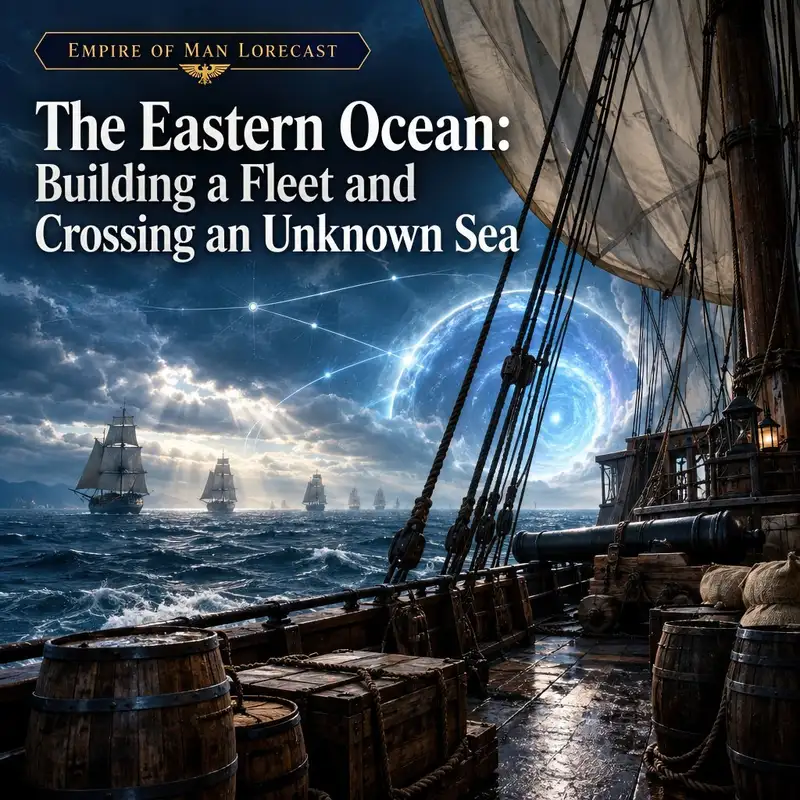
The most important technical change was the adoption of topsail schooner rigs with fore-and-aft sails. The principle is straightforward enough. A square-rigged vessel depends heavily on wind from behind or from favorable angles. A fore-and-aft rig can work closer to the wind, allowing a ship to make progress when the wind is coming more nearly from the direction it wants to travel. Against the prevailing northeast wind, that ability expanded the fleet’s choices. It did not make wind irrelevant, and it did not turn the ocean into a predictable road. It gave the ships a better chance to choose a route instead of waiting passively for the weather to grant one. For a military convoy, that difference affected timing, formation, response to threats, and the ability to avoid being pushed toward danger.
But calling the schooner rig a superior sail would miss the point. A rig is not a gadget bolted onto an existing institution. It is a system. The hull must handle differently. The masts, spars, lines, and sails must be built, fitted, and maintained correctly. Crews must understand how to trim sail, coordinate maneuvers, take in canvas under stress, and keep vessels from fouling one another in close waters. Officers and sailors need a common vocabulary. Gunners require a stable enough platform to fight from. Signal procedures must account for ships moving independently rather than in a simple line driven by the same wind. None of that could be imported fully formed from human civilization. It had to be taught, adapted, and practiced by people working with Mardukan materials and under Mardukan conditions.
Local square-rigged practice was not evidence of incompetence. It reflected different established routes, different maritime habits, and different operational needs. K’Vaernian sailors knew watercraft. What the expedition introduced was a design better suited to a specific strategic problem: crossing into wind and operating with more maneuver freedom than local practice normally required. That advantage became meaningful only because Mardukan shipbuilders could construct the vessels, Mardukan crews could learn their handling, and local gunners could put artillery to use. The fleet was neither purely human nor simply Mardukan. It was a coalition system built under pressure, and it had to prove itself before anyone could call it a success.
Six smaller schooners formed the core of the force. They had fighting value, carrying short-barreled side cannon and heavier bow-mounted guns. Yet the coalition’s growth quickly showed that six hulls did not provide enough lift. The added Vashin cavalry, their civan mounts, supporting infantry, artillerymen, sailors, and logistical personnel could not be compressed into the original plan without sacrificing supplies or creating conditions too dangerous for a long passage. The answer was Snarleyow. It was larger than the schooners, slower, less refined, and never intended to be a model vessel. Its purpose was volume. It created enough additional capacity to move people and matériel that the expedition needed on the far shore.
Snarleyow’s armament could make it formidable in a fight. It mounted fifteen side cannon per broadside, about one quarter more than each of its smaller consorts. But its guns should not obscure its primary role. It was an emergency transport, and its greatest value lay in what it carried. The vessel was built from timber that had not been properly seasoned, a practical compromise forced by time. Green timber can work, warp, and strain as a hull moves through rough water. A ship built that way may survive a single urgent voyage, but it is not a foundation for an enduring navy. Snarleyow was a calculated risk. The expedition accepted a weaker, less reliable hull because leaving behind cavalry, mounts, guns, or specialized personnel would have created an immediate and perhaps fatal weakness once the force reached the far shore.
Every item loaded aboard represented a choice about the campaign to come. Food and water sustained the passengers. Powder and shot sustained the guns. Artillery could shape a landing or a later siege, but only if it arrived with crews and ammunition. Technical gear mattered because the expedition’s remaining advanced equipment could not maintain itself. The Marines could not simply preserve their high technology by refusing to use it. They needed to preserve the people who understood it. That made specialists as important as weapons. A damaged cannon might be repaired from local material. A lost technician, medic, or experienced leader could not be replaced so easily. The crossing was therefore not only a movement of troops. It was the movement of a fragile concentration of knowledge, experience, and political relationships.
The people operating this force were not a mature navy. Pahner commanded the broader expedition and remained responsible for the protection mission, the allocation of risk, and the preservation of enough strength for the spaceport objective. He was an experienced land commander, but he did not pretend to be a naval officer. That honesty mattered. Command is not the claim that one person knows every profession. It is the ability to recognize which expertise must guide a decision and to keep that expertise aligned with the mission. Local captains and sailors retained practical authority over their ships. Poertena supplied vital knowledge of the new rigging and the maritime terms needed to make human concepts useful aboard Mardukan vessels. Roger had recreational sailing experience and, by this stage, considerable field judgment. But neither royal status nor familiarity with a sailboat turned him automatically into an admiral.
The training program was necessarily narrow. Marines had to learn enough shipboard procedure to move safely, assist in emergencies, understand signals, and fight when necessary. They could not become professional sailors during a single expeditionary movement. Mardukan crews had to learn new sail handling, new artillery procedures, and the discipline required to maneuver a convoy under threat. They learned through work, drills, correction, and repetition. That is how improvised institutions are built. Not through a single lecture, but through shared routines that hold when fatigue, weather, and fear begin to strip away improvisation. The fleet’s capability rested on procedures that were still new, crews who had not trained together for years, and ships that had been built under exceptional pressure. Its margins were thin from the beginning.
That fragility became unmistakable when the sea itself attacked. The giant coll fish that struck Sea Skimmer was not an enemy commander making a rational tactical choice. It was an environmental threat on a scale for which the expedition had no settled doctrine. The attack nearly split the schooner and endangered not only the ship but the embarked troops, stores, and nearby vessels attempting to help. The response showed the coalition at its best and its most desperate. Human rifles contributed fire. Roger took part in the effort. A sixty-five-millimeter Mardukan weapon was brought to bear. Harpoons and depth charges were used. Several ships maneuvered to engage and support the threatened vessel. The fight was not an elegant naval action. It was a crisis in which every available weapon and every available crew had to be used against a threat that had no reason to respect the fleet’s plans.
The coll fish was killed. That was the tactical result. But Sea Skimmer was lost, along with much of the force it carried and three Marines. The exact total human and Mardukan loss is not established in the available account, and the lack of a neat roster should not soften the operational damage. A transport convoy cannot casually absorb the loss of a ship. The expedition lost lift capacity, stores, trained personnel, and the resilience that comes from having spare space and spare hulls. It also lost confidence in the assumption that the crossing’s main danger would come from hostile sailors or bad weather. An army operating at sea is constrained by hazards it cannot outshoot, negotiate with, or predict from incomplete charts.
The dead coll fish did provide a grim logistical opportunity. Its oil could be processed through the Marines’ nanite systems to produce lipid-based vitamins and amino acids that were otherwise becoming scarce. In an expedition dependent on uncertain food sources, that mattered. A nutritional windfall could reduce one of the risks of prolonged operations. But it did not make the engagement favorable. Pahner judged the exchange as a net loss, and that judgment reflects the difference between finding a useful byproduct and recovering strategic capacity. Food can help keep survivors alive. It cannot restore a destroyed hull, replace lost troops, or recreate the experience carried by those who died. The episode is a useful corrective to the temptation to treat every battlefield salvage opportunity as compensation for loss. The coalition continued because it had no better option, not because the ocean had become safe.
As the fleet approached the region of the spaceport, communications became another problem of survival. Radios offered speed and coordination, but they also created a danger. Transmissions could reveal the expedition’s presence through radio bounce, allowing hostile human forces or other observers to detect activity that the fleet needed to conceal. Pahner therefore ordered the radios shut down. The decision reduced the force’s ability to coordinate instantly, but it protected operational security. This was not an abandonment of communications. It was a shift to more limited methods: communications lasers, flags, guns, flashing lights, and other visual signals. Each method had advantages and weaknesses. A laser can be precise but depends on line of sight. Flags can be seen by friends and enemies alike. Gun signals carry over distance but can be misunderstood or mistaken for combat. Flashing lights work only under the right conditions and may compromise concealment.
Radio silence increased the importance of preparation. Ships had to maintain station without constant correction. Captains needed to understand the broader plan. Crews had to know what to do when visibility dropped, when a vessel fell behind, or when an unexpected hazard appeared. Subordinate initiative became more valuable because the senior commander could not manage every movement in real time. That is a familiar military problem, but the sea made it especially unforgiving. A delayed order ashore may cost ground. A delayed correction between ships can produce collision, separation, or a vessel driven into unknown water. The fleet had gained mobility through its new rigs. It had also gained a command-and-control problem that no amount of artillery could solve.
The charts offered little comfort. Near landfall, the flotilla encountered volcanic islands and passages that were not clearly represented in the data available to the expedition. The islands were not scenic confirmation that the journey was nearly over. They were a navigational crisis. Unknown channels can conceal shoals, reefs, shallow water, currents, and hazards that a deep or heavily loaded vessel cannot easily avoid. A convoy with different ship types must move at the pace of caution. The schooners may maneuver better than local vessels, but Snarleyow could not be treated as though it handled the same way. A loss in constricted water could block a passage, destroy cargo, scatter survivors, and expose the fleet to whatever forces waited beyond the islands.
The answer was seamanship rather than heroics. Depth soundings became vital. Ships had to move carefully, assess water before committing the whole formation, and preserve enough spacing to maneuver without losing mutual support. The crews had to work while fatigued from the crossing, conscious of the fate of Sea Skimmer, and limited by the communications discipline necessary to remain hidden. The episode illustrates a point that armies often learn painfully when they move onto water. The decisive weapon may not be the heaviest gun. It may be the lead line, the lookout, the crew that recognizes a changing current, or the captain willing to slow down when haste would feel more satisfying. The expedition’s naval advantage gave it options. Caution kept those options from becoming wreckage.
The far shore brought an intelligence shock. The flotilla encountered the Rain Daughter, a Krath-associated merchant vessel pursued by six Lemmar raiders. Her master, Tob Kerr, provided the expedition’s first direct account of the political and maritime order on the other side of the ocean. His information confirmed that the sea was regarded as effectively impassable and that previous crossings had failed. For Roger’s coalition, that fact was both encouraging and dangerous. It meant their arrival was extraordinary. It also meant that no established framework existed for explaining who they were, what they wanted, or whether they represented an opportunity, an invasion, or a threat.
Tob Kerr could identify immediate facts. He knew of Krath interests, the position of Strem, the Lemmar raiders, and the recent destruction or capture of a convoy that included merchant vessels and escort galleys. He could explain why Rain Daughter was in danger. But intelligence from an endangered merchant captain is not a complete regional briefing. His knowledge was shaped by his profession, his loyalties, his immediate fear, and the information available to him. He could not provide a neutral map of every faction, religious division, social hierarchy, and military capacity on the mainland. O’Casey understood the limitation immediately. The expedition had almost no social or political intelligence about the continent it had worked so hard to reach. A military intervention might earn friends. It might also create commitments, enemies, and misunderstandings that would follow the coalition all the way to the spaceport.
The decision was therefore larger than whether to rescue one merchant vessel. Roger and Pahner could avoid the fight and preserve strength. They could divert toward Strem and seek information through more conventional contact. Or they could intervene against the Lemmar and announce themselves through action. Intervention offered an obvious immediate benefit. It could save Rain Daughter, punish raiders, and demonstrate that the strange arriving fleet possessed unusual military power. It also carried political consequences. The Lemmar were not merely targets floating on the water. They were part of a local contest over trade, security, influence, and access. Defeating them would affect merchant crews, captured sailors, coastal communities, Krath supply lines, and the reputation of any power associated with the rescuers.
The engagement that followed showed a more mature distribution of command than a simple story of royal leadership would suggest. Pahner retained overall command of the operation. He remained responsible for the expedition’s mission and for the consequences of committing its scarce force. But he recognized that maritime maneuver was not his specialty. Roger had relevant sailing experience and a practical understanding of the flotilla’s new capabilities. Pahner allowed him to direct the maritime tactics of the fight within the broader operational framework. That was not a surrender of command. It was command functioning properly. A leader who insists on personally controlling a profession he does not understand may preserve his pride and lose the battle. Pahner instead matched authority to competence while keeping responsibility for the mission.
The Lemmar possessed their own strengths. Their ships had larger crews, they knew the local waters, and they carried swivel guns and bow-mounted bombards. Their experience made them dangerous opponents, especially in an action that could close rapidly into boarding range. Roger’s flotilla, however, could maneuver more effectively and bring its artillery to bear with greater flexibility. The advantage came from the system built at K’Vaern’s Cove: the rigs, the crews trained to handle them, the guns, the gunners, and the willingness to use a mixed fleet aggressively despite the risks of damage. Windward ability created tactical openings. Artillery could exploit them. Yet neither mattered if crews failed to execute the maneuvers or if the convoy’s commanders treated the ships as isolated platforms rather than as parts of a fighting formation.
The battle moved beyond a simple rescue. Ships were damaged, some were dismasted or sunk, and the action developed into a broader contest for control of vessels and crews. It is tempting to describe such an engagement as a triumph of advanced methods over primitive opponents. That would be inaccurate. The expedition did not win because humans arrived with an abstract concept called technology. It won because Mardukan sailors and gunners could use the new ships, because local weapons had been adapted into a more effective naval system, and because the coalition brought enough discipline to coordinate maneuver and fire under pressure. The Lemmar were not harmless simply because their equipment differed. Their crews, numbers, local experience, and willingness to close for combat made them a serious threat.
The final phase depended heavily on boarding and capture. Once ships come together, naval combat becomes close combat conducted on unstable ground, among rigging, guns, wounded personnel, cargo, smoke, and the danger of fire or sinking. Here the Mardukan allies were indispensable. Their manpower, courage, and experience with direct fighting transformed tactical openings into seized decks and recaptured vessels. They were not passengers protected by the Marines. They were partners whose participation made the operation possible. At the same time, their success in shipboard combat did not mean they could be assumed ready for every later objective. Boarding a local merchantman or raider was not the same task as assaulting a human spaceport or seizing a spacecraft. The coalition’s strength came from combining capabilities without pretending that every capability was interchangeable.
The rescue also created political capital, but capital is not the same as control. By acting against the Lemmar, Roger’s coalition gained credibility with people endangered by the raids and with interests connected to Krath commerce. It demonstrated that the newcomers could fight at sea, protect shipping, and disrupt a local enemy. That could open doors, provide information, and make future negotiation possible. It could also create expectations. A force that rescues a merchant vessel may be asked to protect more shipping, support a town, settle a dispute, or join a war it does not understand. O’Casey’s warning remained valid after the guns fell silent. The expedition had earned an introduction to the far continent, not a reliable guide to its politics.
The civilian stakes were substantial. The destruction of convoys and escorts affected more than armed men. Merchant crews depended on safe passage. Captured sailors and passengers faced the immediate consequences of raiding. Towns such as Strem depended on maritime connections for trade, supply, and security. Raiding could redistribute wealth, empower local armed factions, and undermine the authorities expected to protect commerce. Roger’s intervention therefore entered an existing political economy. It did not begin that conflict, but it altered the balance within it. The expedition’s need for a route to the spaceport became entangled with the needs of people who had never asked to become part of an Imperial prince’s campaign.
By the end of the crossing, the coalition had achieved something remarkable. It had assembled a flotilla from local labor and materials, learned enough seamanship to operate it, crossed water regarded as uncrossable, survived the destruction of one of its ships, navigated incomplete coastal approaches, and fought its first major naval engagement on the far side. Tactically, it had defeated the coll fish and overcome the Lemmar raiders. Operationally, it had solved the immediate route problem and gained access to the mainland beyond the ocean. Strategically, it had restored a path toward the spaceport. Politically, it had acquired visibility and potential allies, while also taking on obligations in a region it scarcely understood.
The costs remained visible in the empty space left by Sea Skimmer. The coll fish’s oil eased a nutritional problem, but it did not restore the lost vessel, personnel, stores, or margin for error. Snarleyow still represented the expedition’s dependence on hurried construction and overloaded transport. The newly built schooners had proven useful, but their performance did not create a durable K’Vaernian navy or solve the larger industrial challenge of maintaining a fleet across time. What K’Vaern’s Cove had produced was a narrowly sufficient capability for a single strategic need. It was an achievement of local labor, Mardukan skill, human technical knowledge, disciplined adaptation, and political partnership. It was not a miracle, and no one should mistake it for one.
The ocean crossing was the clearest proof that survival on Marduk depended on building systems rather than preserving an illusion of technological superiority. K’Vaernian workers, Mardukan crews and soldiers, Poertena’s maritime knowledge, Roger’s developing judgment, Pahner’s disciplined command, and hard choices about risk created a fleet just capable of one crossing. But the loss of Sea Skimmer, the uncertainty beyond the horizon, and the immediate pull of local war showed what that achievement really meant. The flotilla had not carried Roger’s coalition out of danger. It had carried the campaign into a larger and less understood war.