The Battle of Sindi: Deception, Rockets, and the Destruction of the Boman Host
Kny Camsan could see the bait. Outside Sindi, a few hundred Vasin riders had come close enough to be insulting, loud enough to be heard, and mobile enough to be difficult to catch. Their provocation was almost theatrical. That was precisely what made it dangerous. A serious commander does not lead a large army into broken country merely because cavalrymen shout at him. Camsan suspected that the raiders wanted him to pursue them. What he could not know was where the trap began, how far it extended, or how many enemies waited beyond the next curtain of rain and vegetation.
His difficulty was not simply military. The Boman host was a coalition, held together by chieftains, war bands, expectations of plunder, and the authority of a paramount leader who had to demonstrate that he could protect their prestige as well as direct their campaigns. To ignore the Vasin challenge might have been tactically prudent. It also risked looking weak before the chiefs whose support made him paramount. Mnb Trag, one of Camsan’s closest political supporters, argued that the insult could not go unanswered. Camsan chose pursuit. The Battle of Sindi began with that decision.
Sindi was worth that risk because it was more than a walled city. It had become a political center of Boman power in the south, a place where food, wealth, authority, and the material rewards of conquest had accumulated. The Boman campaign had not merely moved armies across a map. It had damaged communities, disrupted cultivation, displaced people, and redirected supplies toward the forces that could seize and hold them. Whoever controlled Sindi possessed a base from which to influence the surrounding region.
For Prince Roger’s expedition and its Mardukan allies, Sindi mattered for equally practical reasons. The humans still needed to reach the distant spaceport, but an overland march and a later ocean crossing required more than courage. They needed food, workshops, transport, political partners, and a secure enough rear area that every new crisis would not become a fight for immediate survival. The coalition did not have the resources to continue indefinitely as a small armed column depending on whatever it could carry.
That made the struggle for Sindi a campaign within the larger campaign. The objective was not simply to punish the Boman or demonstrate the value of human weapons. The coalition needed to break the field army threatening the southern cities, recover access to resources, and make it possible for K’Vaern’s Cove and its partners to support the next stage of the expedition. A victory that left the Boman host intact would be incomplete. A victory that destroyed the host but ruined the city’s supplies would also carry a cost.
The Boman themselves were not a single, mechanically obedient national army. Their host contained allied tribal forces under Camsan’s paramount leadership. That gave them numbers, military experience, and considerable momentum. It also gave them internal politics. Different chiefs could disagree about risk, honor, plunder, and command. A paramount leader had to manage those differences in public, under pressure, and often in front of armed men whose loyalty was never entirely abstract.
The coalition facing them had its own divisions, interests, and limits. Diaspra wanted survival and freedom from Boman domination. The Vasin had their own military traditions, leaders, and reasons to oppose the enemy. K’Vaern’s Cove had commercial and maritime interests. Local artisans wanted work, protection, and influence over the changes arriving with the humans. The surviving Imperial Marines wanted to preserve Prince Roger and reach the spaceport. These interests overlapped, but they were not identical.
The army that fought at Sindi had not existed at the beginning of the march. It had grown out of necessity. At Diaspra, the city had faced the Boman threat with inadequate preparation, divided priorities, and a population that had good reasons to fear battle. Pahner’s response was not to promise that the Marines would save the city alone. It was to impose hard choices about food, discipline, training, and the use of local manpower.
The New Model Army that emerged from that effort was Mardukan in personnel and political purpose, even when its drill and tactical ideas reflected Marine experience. Diaspran infantry learned to hold formation under pressure. Shield troops, pikemen, and cavalry were organized in ways that allowed them to support one another instead of fighting as disconnected bodies. The Vasin provided mobile forces with the ability to scout, raid, pursue, and withdraw through country they understood far better than the humans did.
The Battle of Diaspra had tested those arrangements under combat conditions. It proved that disciplined local troops could stand against a Boman attack, and that a combined response by infantry, cavalry, and Marines could change the course of a battle. It did not make the coalition invincible. It did, however, give commanders and ordinary soldiers experience. They had seen formations hold. They had seen firepower used in support of maneuver. They had learned that cooperation with the humans could produce results beyond a single desperate defense.
Local leaders remained indispensable. Gratar’s decision to resist gave Diaspra a chance to become an ally rather than a defeated client. Bogess helped organize the city’s military resources. Rastar and Honal led Vasin forces whose mobility made the later deception possible. Rus From, Dell Mir, and other craftsmen transformed workshops into sources of weapons and equipment. Their work was not background activity. It was one of the reasons the coalition could fight at Sindi with something other than its remaining Imperial ammunition.
The Marines had begun the march with advanced weapons and armor, but those systems were never a bottomless reservoir of combat power. Bead weapons required ammunition that could not simply be replaced in a Mardukan workshop. Plasma weapons required power, maintenance, trained operators, and components beyond local manufacture. Armor protected its wearer, but it also consumed energy, accumulated damage, and demanded technical attention. Every use had to be weighed against what might be needed later at the spaceport.
That constraint forced an uncomfortable but strategically sound decision. The humans could not use their best equipment as routine battlefield tools merely because it was better than local weapons. They had to conserve what could not be replaced and build up what could. The answer was not instant industrial transformation. It was the gradual adaptation of Mardukan skills, materials, and workshop practices to produce firearms that the coalition could actually maintain in war.
The resulting rifles and pistols were not Imperial bead weapons in cheaper packaging. They were black-powder firearms, built around the practical realities of Mardukan production. Their performance involved compromises. Their trajectory and range were inferior to advanced human weapons. They fouled. They required powder, shot, maintenance, and trained users. Wet conditions remained a problem for any gunpowder system, and Marduk’s weather was not generous to weapons that depended on dry powder and clean mechanisms.
Yet their limitations were part of their value. A weapon does not have to be the best weapon imaginable to be strategically decisive. It has to be available when needed, usable by the troops who carry it, repairable by the society that fields it, and sustainable after the first stock of imported equipment is gone. The coalition’s new firearms could be produced locally in meaningful numbers. Their ammunition could be made from resources available to allied cities. Their users could train together and develop their own methods of fire control.
The work depended on Mardukan capability already present in the region. Metalworkers, gunsmiths, toolmakers, laborers, and organizers did not become skilled because a Marine explained the concept of a rifle. They adapted existing knowledge to new requirements. Human advice accelerated the process, but workshops, raw materials, labor discipline, and political support made it real. A prototype proves an idea. A stock of weapons ready for a campaign proves that people, institutions, and supply systems have begun to carry that idea forward.
The firearms also mattered because of the rain. The Boman possessed firearms of their own, but the coalition’s newer weapons were better suited to the conditions and more reliable in the wet. That did not mean rain ceased to affect the battle. Mud slowed movement. vegetation cut visibility. dampness complicated powder handling. Wet ground exhausted troops and animals. But a modest advantage in reliability can become decisive when it appears suddenly against an enemy already committed to a difficult pursuit.
The Vasin riders gave Camsan the reason to commit. Once the pursuit began, they did not flee in disorder. They withdrew according to plan. Several hundred riders drew attention near Sindi, then fell back toward a larger Vasin force. Accounts of the battle place that force at roughly four thousand riders and troops equipped with the newly manufactured pistols and rifles. The exact figure is less important than the operational fact. The decoy did not lead the Boman into empty country. It led them toward a prepared force.
A cavalry withdrawal is difficult to distinguish from a rout when the enemy wants to believe it is one. The Vasin exploited that temptation. They remained visible enough to sustain the pursuit, but they controlled the pace. They knew the ground. They used local scouts and the coalition’s limited communications to coordinate movement. To the leading Boman elements, the enemy appeared to be giving way. In reality, the coalition was deciding where contact would occur and how much of the host could be drawn into it.
The Boman host was large, reportedly more than thirty-two thousand warriors, though such a figure should be treated as a narrative estimate rather than a precise census. Size gave Camsan strength, but only if he could bring that strength to bear in a coherent fashion. In close jungle country, with rain, uneven ground, and an enemy refusing to stand still, a large force can become stretched out. The front sees one battle. The rear sees another. Orders take time to travel. Rumor travels faster.
When the Vasin force opened fire, the effect was not simply that better weapons killed more men. The first volleys changed the Boman understanding of the pursuit. Troops expecting mounted raiders encountered coordinated fire from weapons they had not expected to meet in those numbers. The leading elements were hit before the rest of the host could clearly understand what was happening. Confusion in such circumstances is not cowardice. It is the normal consequence of limited visibility, disrupted formations, and sudden casualties.
The Vasin then withdrew again. That was the critical point. A force that holds its ground after surprising an enemy may win a firefight. A force that disengages in a controlled manner can keep shaping the enemy’s decisions. The Boman had been shocked, but they were not yet destroyed. Camsan still had the option to slow down, gather information, and reconsider. The coalition’s next task was to make that option increasingly difficult.
The jungle route selected for the retreat did much of the work. Dense terrain did not allow the Boman to deploy freely. Paths and clearings created natural channels. Troops moved along the routes available to them, often in compressed formations and with limited room to turn, scout, or spread out. That was where the coalition placed improvised directional charges. These were not magical devices and not autonomous weapons. Their effectiveness depended on preparation, concealment, timing, and an enemy entering the right ground.
When the charges detonated, the immediate destruction was severe. The narrative reports more than six hundred Boman killed in this phase, though no battlefield record allows a cleaner accounting. The number matters less than the disruption. A sudden blast in a crowded column produces casualties, but it also creates blocked movement, wounded men, frightened animals, separated units, and a spreading fear that the next patch of jungle may hold another trap.
The Boman had now received stronger evidence that Camsan’s suspicion had been correct. The Vasin had not been fleeing. They had been drawing his army through a designed sequence of contacts. But recognition did not restore freedom of action. To halt could invite accusations of weakness. To withdraw could make the retreat itself vulnerable, especially if the enemy had prepared more obstacles behind them. To continue risked additional traps. The coalition had created momentum, then turned that momentum into a burden.
While the Boman were being drawn away from Sindi, the coalition moved against the city itself. This was the actual operational objective of the deception. The Vasin pursuit was not a raid conducted for its own sake. It was the screen behind which allied forces could attack Sindi while its principal field army was absent, extended, and increasingly uncertain about the ground ahead.
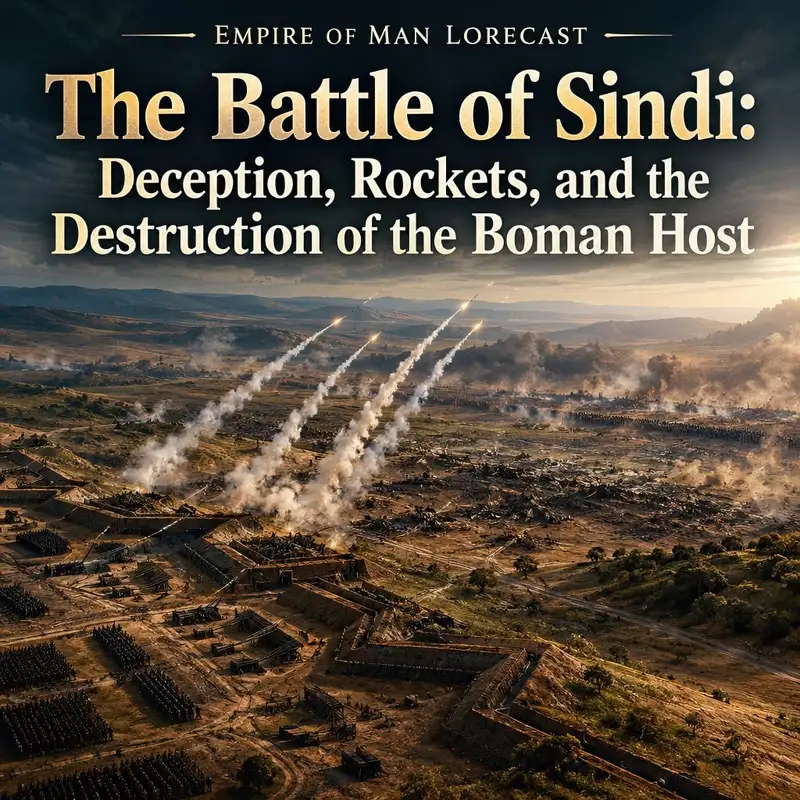
The assault on Sindi used a mixture of local and human capabilities. The most dramatic local weapon was the bombardment rocket. Thousands of crude rockets were employed against the city’s defenders. Reports often give a figure of roughly twelve thousand, but the exact total is less secure than the broader point. The rockets came in sufficient mass to produce a sustained bombardment effect against troops and positions that had never faced anything like them.
The bombardment also demonstrated the difference between possessing a new weapon and integrating it into an operation. Rockets alone did not capture Sindi. They created confusion and weakened the defense at the moment allied troops needed to close with the city. Their use depended on local production, transport, preparation, and crews willing to handle a dangerous and imperfect weapon. The coalition had turned workshops and raw materials into battlefield effect, but that effect still required a plan around it.
Mnb Trag died during the assault on Sindi. His death mattered because he had been one of the figures helping sustain Camsan’s political position within the Boman coalition. The Boman did not yet know the full consequences of that loss while they were still pursuing the Vasin, but the removal of a senior political ally made Camsan’s later command crisis more severe. Battles can destroy a chain of command without every commander knowing it has happened.
At a decisive access point, Sergeant Adib Julian’s armored squad used plasma fire to open the way through the defenses. This was an example of high technology being used sparingly rather than extravagantly. The Marines had capabilities that local forces could not duplicate, and a plasma weapon could solve a problem that might otherwise cost time and lives. But the value of that capability came precisely from its rarity. Pahner could not afford to treat irreplaceable power and weapons as though they were ordinary siege tools.
Julian’s action helped create the breach or access the allies required. It did not mean a handful of armored Marines conquered the city by themselves. Once a defense was disrupted, someone still had to enter, clear positions, hold ground, manage confusion, and establish control among a population already living under occupation and wartime deprivation. The city’s residents were not simply spectators. They were people caught between collapsing authority, bombardment, armed entry, and uncertainty about who would govern when the shooting stopped.
The coalition took Sindi, but the campaign remained unfinished. The Boman host still existed. It had been hurt, deceived, and drawn away from the city, but it retained enormous numbers and a leadership structure, however strained. The moment Camsan’s force returned and saw that Sindi had fallen, the battle became a contest over recovery. Could the Boman regroup, encircle the city, and turn the coalition’s success into a siege? Or would the loss of Sindi break their ability to act as a unified field army?
But Camsan’s political position had become even weaker than it had been when he chose to pursue the Vasin. Sindi was gone. Mnb Trag was dead. His army had suffered casualties and humiliation. A paramount leader who called for caution after those reverses could be accused of failing to avenge the losses. Tar Tin, a rival chief with a more aggressive view of what honor required, challenged Camsan’s restraint.
The challenge ended in murder. Tar Tin killed Camsan and took command. That act did not solve the Boman army’s tactical problems. It made them worse. Camsan had understood that the coalition was manipulating the battle and that the city could not simply be retaken by force of will. Tar Tin inherited the same exhausted troops, the same damaged cohesion, the same unfamiliar weapons, and the same enemy defenses. What changed was the willingness to acknowledge those realities.
Tar Tin ordered an immediate attack. In doing so, he converted an internal political victory into an external military disaster. His decision gave the coalition what it needed: an enemy willing to enter the prepared ground before it could recover its balance. The Boman host had been drawn outward by a false retreat, deprived of its city, and now pushed forward again by a struggle for leadership. Its movements were no longer shaped primarily by tactical judgment.
The defenders inside Sindi did not respond with a simple stand at the walls. They withdrew in a controlled manner, drawing the Boman assault toward a killing ground shaped by the city’s geography. The Tam River bridge, a widened plaza, a bastion, and restricted approaches turned the urban landscape into a tactical system. The coalition understood that it could not merely absorb the weight of the attack. It had to compress that weight where numbers became difficult to use.
A controlled withdrawal is one of the most demanding actions a force can perform. Troops must give ground without allowing the enemy to recognize panic. They must communicate under pressure. Units have to know when to fire, when to move, and where the next defensive position lies. They must trust that the people beside them will not abandon the line. In a coalition force with different languages, traditions, and command structures, that requires preparation well before the first attacker reaches the street.
The Boman entered the trap because the attack appeared to be working. Defenders fell back. Space opened ahead. The instinct of assault troops is to exploit visible movement, especially after a leader has demanded immediate action. But every step forward carried more Boman into a confined area. The bridge and surrounding routes constrained their approach. The plaza concentrated them. The bastion and prepared positions allowed the defenders to bring fire into the same ground from more than one direction.
Riflemen contributed sustained fire from positions where their locally made weapons could be used to best effect. Their role was not to conduct an elegant demonstration of marksmanship. It was to disrupt advancing troops, punish concentrations, and make it harder for leaders to restore order. The weapons were sustainable because Mardukan workshops could produce and support them. At Sindi, that mattered as much as their individual performance.
Mines added another layer. The attackers could not assume that a route left open was safe. Charges placed in the urban approaches and killing ground turned movement into risk. Artillery contributed force against concentrated troops. Cavalry remained available to exploit confusion, strike exposed elements, and prevent the Boman from easily reorganizing outside the city. None of these systems operated in isolation. The point was to make each Boman response expose the host to another threat.
The battle’s geometry transformed numerical superiority into congestion. A large army can be powerful when it has space to deploy, room to maneuver, and a command system capable of directing separate elements. It can become vulnerable when it is forced through narrow approaches into a prepared zone while under fire from weapons it cannot easily locate or answer. At Sindi, the coalition did not defeat the Boman by meeting their mass with equal mass. It made their mass difficult to control.
The final phase began when the Boman attempted to retreat. An assault can become a withdrawal for many reasons. Units run short of momentum. Commanders recognize that the objective cannot be reached. Casualties create gaps. Rumor spreads that the route behind is threatened. Once troops begin moving back through the same restricted spaces that carried them forward, a disciplined retreat is possible only if leaders still possess control and the routes remain open.
That was where Julian’s armored squad returned to the battle. Striking from the opposite side, the armored Marines denied the Boman a clean escape route. Their advanced armor and plasma weapons had a disproportionate effect because they appeared at a point where the enemy’s movement was already collapsing. The squad did not have to destroy the entire host by itself. It only had to make clear that the rear was no longer safe.
The result was encirclement in practical terms, even if not every Boman warrior was physically surrounded. Men in the killing ground faced fire from the city. Men trying to withdraw faced new danger from behind. Officers could not easily pass orders through the confusion. Groups separated from their leaders made local decisions. Some tried to push forward. Some tried to pull back. Some froze. The host ceased to act as a coordinated field force.
Tar Tin recognized what had happened. The immediate assault he had demanded had not recovered Sindi. It had destroyed the army’s ability to contest it. His death in the Tam River was not a moment of battlefield spectacle. It was the final acknowledgment that the political choice he had made, killing Camsan and forcing the attack, had produced a defeat beyond recovery. The leader who had rejected caution found no route left through the consequences of his own command decision.
To say that the Boman host was destroyed does not mean that every Boman fighter died on the plaza, at the bridge, or in the streets around Sindi. It means that the host ceased to function as an effective regional field army. Its command structure had ruptured. Its political center had fallen. Its troops had been hit in stages, first by deception, then by jungle ambush, then by the loss of the city, then by a failed assault into prepared ground. Survivors could remain dangerous without restoring the army that had entered the campaign.
The strategic result was more limited, but still essential. The expedition had not reached the spaceport. It had not restored its original strength. It had not recovered the Marines and specialists lost during the long march. Men and women who had carried irreplaceable experience were gone, including Kostas Matsugae during the wider Sindi phase. Victory did not reverse attrition. It did not refill Imperial power packs or bead-rifle magazines. It did not make Marduk’s oceans less dangerous.
What Sindi did provide was an opening. It gave the expedition and its allies the resources, political leverage, and security necessary to attempt the sea crossing. That was a major achievement, but it was not the end of their strategic problem. Every success on Marduk had to be measured against the continuing requirement to get Roger home. A captured city was useful only if the coalition could turn its gains into movement, supply, and renewed capability.
The political consequences would also outlast the battle. Boman central authority in the region had been broken. Cities and leaders who had lived under the threat of conquest now had new room to bargain, reorganize, and pursue their own interests. The earlier manipulation and miscalculation associated with Tor Cant had helped create the conditions for this wider war, and Sindi showed how catastrophically local political schemes could escape their originator’s control.
For civilians, however, the fall of Sindi was not simply liberation expressed in military terms. The city had been occupied, supplied by conquest, bombarded, stormed, and then subjected to a collapse of its ruling order. Food stores changed hands. Armed men moved through streets and gates. Families who had already endured displacement or loss faced another uncertain transition. The coalition had sound reasons to fight for Sindi, but the people living there would bear consequences long after the battlefield was cleared.
Pahner and the allied commanders understood that weakness. Their achievement was not possession of a single decisive weapon. It was the construction of a layered operation in which each phase prepared the next. Vasin riders made pursuit politically necessary. Locally produced rifles and pistols shocked the advancing force. Jungle terrain and directional charges disrupted the host. The absence of the field army opened Sindi to assault. Rockets shattered defensive confidence. Selective plasma fire opened a critical access point. The city then became a prepared battlefield for the enemy’s return.
Every element depended on the others. The rockets would have been less useful if the Boman field army had remained in the city. The mines would have been less decisive if the Vasin had not controlled the pursuit route. The urban trap would have failed if local infantry could not hold their positions and withdraw on command. Julian’s armored squad could not have trapped the retreating Boman if the coalition had not first compressed them into the killing ground. High technology mattered, but it mattered because it was employed at moments where it could change a larger system.
The same is true of the Mardukan contribution. Sindi was not a human victory imposed on passive allies. The Vasin supplied the lure, the cavalry skill, and the knowledge of the ground. Diaspran forces supplied trained infantry and the discipline to make the city defense work. Mardukan craftsmen made firearms and rockets available in numbers the Marines could never have supplied from their own stores. Local commanders carried the political responsibility of committing their people to the fight. Ordinary soldiers and civilians paid the price of the war.
Roger’s presence had significance, both political and personal. By this stage of the march, he had become a combatant and a leader in ways that few at the beginning would have expected. But Sindi was not his solitary triumph. The battle demonstrates the opposite of the simple heroic legend. A prince could help symbolize a coalition, but he depended on Pahner’s operational design, Kosutic’s discipline, Julian’s small-unit leadership, allied commanders’ judgment, artisans’ labor, and the courage of thousands of Mardukans fighting for reasons of their own.
The Boman host was destroyed because it was never allowed to fight the battle it expected. Its leaders were forced into decisions shaped by prestige as much as strategy. Its pursuit became a march through ground chosen by the enemy. Its city fell while its main force was absent. Its command collapsed at the moment caution was most necessary. Its final assault entered streets, bridges, plazas, and bastions prepared to turn momentum into confinement. At Sindi, the decisive weapon was the coalition’s ability to make every Boman choice lead deeper into a battle designed by its enemies.