The Battle of Diaspra: Pikes, Plasma, and Political Survival
At dawn outside Diaspra, exhausted laborers stood behind a hedge of sharpened stakes that they had built through the night. Beyond them lay a shallow valley, the ground chosen because it gave the defenders something rare in this campaign: limits. A canal secured one flank. Dense forest constrained the other. Behind the line stood the fields, dikes, canals, and flood-control works that made Diaspra possible in the first place. Farther back stood the city walls. But those walls were not a solution. Diaspra had food for a battle, perhaps, but not for a long siege. If the Boman army closed the countryside and waited, the city’s engineering would become a trap. Its people would still need grain.
For Prince Roger MacClintock and the surviving members of Bravo Company, the crisis had an additional meaning. Their strategic destination remained the distant sea and, beyond it, the route toward the spaceport that offered their only path home. Diaspra was not merely a place on their map. It was a city whose roads, markets, political authority, and surviving strength could determine whether the expedition moved onward at all. Yet the city was not fighting simply to assist stranded humans. Its people were fighting because the Boman threat had reached the point where accommodation looked less like prudence and more like surrender by installments.
That was the immediate problem at Diaspra. The city had walls but insufficient food. It had population but not enough trained soldiers. It had workshops, guilds, labor institutions, and formidable waterworks, but those were not automatically an army. And it had access to a few human weapons whose power was extraordinary by local standards, but whose ammunition, power supplies, and spare parts could not be replaced. The battle would be decided not by choosing between Mardukan and human methods, but by combining the capabilities that existed before the enemy arrived.
The political decision to fight belonged first to Diaspra. Priest-king Gratar held the city’s formal religious and civil authority. General Bogess commanded its military forces. Captain Armand Pahner advised, organized, and supplied the practical military design, while still carrying his original duty: keep Roger alive and get him home. Those responsibilities overlapped, but they were not identical. Pahner was not the ruler of Diaspra, and Roger was not the battle’s field commander merely because he was an Imperial prince.
Gratar understood the danger in accepting a tributary arrangement with the Boman. Tribute is sometimes a way for a weak state to buy time. It can also become evidence of weakness, an invitation for demands that increase every season. Diaspra could hand over grain, goods, labor, or political concessions and hope the Boman would be satisfied. But the city had already seen enough of the surrounding military balance to know that satisfaction was unlikely. A payment made under coercion would not guarantee security. It would demonstrate that coercion worked.
The choice for resistance was therefore political as much as military. Gratar had to preserve Diaspra’s independence, but he also had to preserve the credibility of the institutions through which he ruled. A priest-king who could not protect the granaries, the canals, or the people who worked them would retain ceremony without authority. The city’s survival required an army. Its existing military establishment could provide some of that army, but not enough. The answer was to mobilize the Laborers of God.
The Laborers of God were not a reserve force waiting in barracks. They were the people who built and maintained the practical systems of Diaspran life. They worked the canals and dikes. They supported temple and public construction. They carried out organized labor on which the city’s agriculture, transport, and flood control depended. Removing them from those tasks carried real risk. A city dependent on water management cannot casually pull its engineering workforce away from the water.
But the laborers also possessed capabilities that mattered in war. They knew how to work in teams. They understood organized effort under supervision. They could dig, carry, build, measure, and follow a sequence of tasks that depended on everyone doing his part. In another society, those qualities might have remained invisible behind the word laborer. At Diaspra, they became the foundation for emergency military training. Pahner and Bogess did not need to create discipline from nothing. They needed to redirect an existing disciplined institution toward a new and more dangerous purpose.
Approximately four thousand laborers formed the core of the new force. That number mattered because Diaspra did not have the luxury of training a small elite cadre and expanding gradually. The Boman were already in the field. The city needed bodies who could carry weapons now. Yet raw numbers would not make the laborers effective. A mass of frightened recruits with hand weapons would merely offer the Boman a larger target. The new army needed a system that reduced the demand for individual brilliance and increased the value of mutual support.
The answer was the pike. A pike formation is not elegant in the way a skilled sword fighter is elegant. It is a collective weapon. Its power comes from reach, overlap, density, and the difficulty of attacking it head-on. An enemy facing a line of properly held pikes cannot simply strike the nearest defender. To reach him, the attacker must enter the range of several points at once. The pike makes an ordinary soldier more dangerous because his weapon is protected by the people around him.
For Diaspra, that made practical sense. The Boman relied heavily on massed infantry, throwing axes, and the momentum of close assault. They were dangerous opponents. Their courage and cohesion in attack could not be dismissed merely because their battlefield system differed from Pahner’s preferred doctrine. But a deep charge of axe-armed troops was precisely the kind of attack that pikes, shields, stakes, and disciplined spacing could disrupt. The objective was not to make the Laborers of God better fighters than the Boman in every circumstance. It was to make the Boman fight on terms that favored Diaspra.
The new force had three major elements. The surviving Guard of God provided shieldmen armed with short assegais. They had more experience than the laborers and could protect vulnerable points in the line. The Laborers of God became the pike formations. Northern cavalry, mounted on civans and led by Rastar and Honal, supplied mobility, shock, reconnaissance, and the ability to exploit disorder once it appeared. The cavalry were allies, not Imperial troops. Their participation rested on their own interests, their own leaders, and their own judgment about the Boman threat.
Diaspra’s artisans and merchants became part of the army-building process. Woodworkers produced shafts. Metalworkers shaped pikeheads and spear points. Guilds redirected labor and materials toward shields, javelins, and the unglamorous but essential work of fitting parts together in large numbers. Men such as Med Non and Chal Thai mattered because military production is not an abstract command decision. Someone must obtain wood, preserve metal stocks, assign skilled hands, settle disputes between workshops, and decide which shortages can be endured.
The city could not manufacture every weapon it might have wanted. Time, material, weather, and training all imposed limits. Rain made some gunpowder systems unreliable. More complex firearms would require a production base and a doctrine that Diaspra did not yet possess. A pikehead and shaft were simpler. A shield could be produced in quantity. A javelin did not need precision machining. The emergency program chose what could be made, taught, and employed before the Boman attack arrived, rather than what would have looked most impressive in a theoretical arsenal.
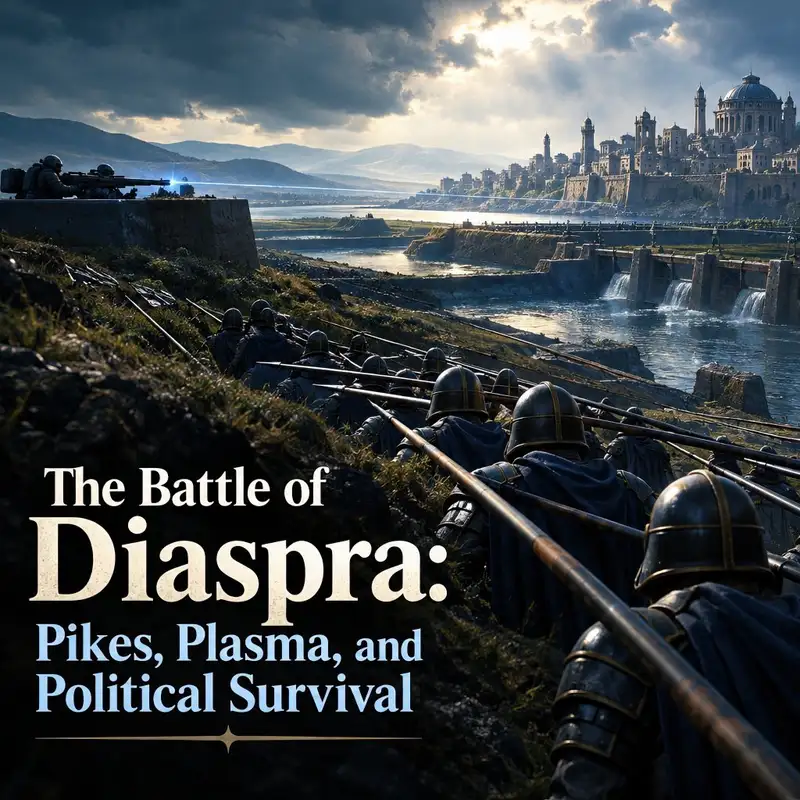
The battlefield itself became an engineering project. Diaspra’s planners chose ground where the canal and forest reduced the enemy’s room to maneuver. They built a central redoubt for the Marines and part of the cavalry. In front of the pike regiments, they planted a hedge of stakes. Gaps remained for mounted movement, because a fixed line that cannot release its cavalry can become a cage. But those gaps were dangerous, so steadier formations and regulars were positioned to guard them.
The stakes were not intended to win the battle by themselves. They slowed an assault. They disrupted the order of men trying to move through them. They forced attackers to bunch, pause, climb, or find openings while under missile fire and in reach of the pikes. They also helped prevent the first shock of a charge from directly reaching the inexperienced laborers. In effect, Diaspra used field fortification to give its new soldiers extra seconds. In battle, seconds can be the difference between a line holding and a line becoming a crowd.
The laborers’ existing knowledge made those defenses possible. The same people who understood dikes, canals, trenches, and controlled water knew how to move earth and timber efficiently. Human advice helped turn that skill toward a battlefield problem, but the capacity already existed in Diaspra. The city was not militarily useful because outsiders had discovered it. It was militarily useful because its civil institutions could be reorganized under pressure.
There was a cost. Every ditch dug for defense was labor not spent maintaining the city’s ordinary systems. Every worker making pike shafts was not making other necessary goods. Every granary guarded against panic or profiteering reflected the reality that food was now as decisive as weapons. Diaspra’s defense was a whole-city effort. The battlefield began in the workshops, the canals, the grain stores, and the political meetings that allocated labor before a single pike met an enemy.
Across the valley stood the Boman force, identified in this campaign as a Wespar or southern Boman formation rather than as some single army representing all Boman peoples. Pahner estimated its strength at around fifteen thousand. The estimate gave the defenders an approximate three-to-one numerical disadvantage. It was not a census. Battlefield intelligence rarely offers that kind of precision. What mattered was the visible depth of the Boman formation. Their line was narrower than Diaspra’s but extended far back, a mass capable of absorbing losses and sustaining pressure.
The Boman did not charge immediately. They used drums, shouting, ritual display, and delay. This was not theatrical decoration. It was a weapon against inexperienced troops. The Diaspran laborers had marched, built defenses, prepared weapons, and slept poorly. Many had never faced a hostile army. Their commanders had taught them where to stand, but no instructor can fully reproduce the sight of thousands of enemies gathering across an open field and waiting for fear to do part of their work.
Pahner understood that his own visible composure had become an operational requirement. Veteran troops can sometimes judge a plan for themselves. New troops often judge it through the body language of the leaders near them. If the commander appears uncertain, the uncertainty spreads faster than any order. Pahner could not promise the pike regiments that they would not be afraid. He could demonstrate that the situation remained under control, even when control was a narrow margin maintained by preparation and nerve.
Roger faced the morning differently. By this point in the march, he had learned enough about command and loss to understand what another battle could take from the people around him. His anger was not abstract royal indignation. It was personal. The Marines had become comrades, teachers, protectors, and friends. Nimashet Despreaux’s reconnaissance team would operate in danger. The armored Marines would be held back for the moment when the line was most likely to fail. Roger could see the burden, and he did not always possess the patience to leave it in other hands.
When a Boman chieftain came forward to taunt the Diaspran line, Roger answered in the worst possible way from a strict command perspective. He rode out on Patty and accepted single combat. Pahner had not designed this as part of the defense. No staff officer had calculated the risk to the protected principal. If Roger had been killed, wounded, captured, or simply unhorsed in front of both armies, the consequences could have reached far beyond Diaspra.
The duel was reckless. It was also effective in the immediate and limited way that battlefield symbols can be effective. Roger killed the chieftain. The Diasprans saw the prince they had known in courtly and diplomatic settings ride alone into danger. Their cheers were not just admiration for a weapon skill. They were relief. A powerful enemy had challenged them, and the challenge had been answered in public.
The Boman suffered a moment of shock and delay. Their formation had to absorb the death of a visible leader. That pause gave the defenders more time to settle themselves. It did not defeat the enemy army. It did not protect the gaps in the line. It did not make the laborers experienced. It did not reduce the need for cavalry, reconnaissance, or Marine firepower. The duel was a morale event, not a battle plan. Its usefulness did not make it wise.
It did, however, reveal something important about Roger’s development. He was no longer the insulated young royal who could dismiss danger as someone else’s responsibility. He was willing to expose himself for the people beside him. But courage without discipline can still endanger the mission. Pahner’s problem was not teaching Roger to care. It was teaching him that command requires a person to recognize when his own anger, grief, or pride is becoming another risk his troops must manage.
Once the Boman attack began in earnest, Diaspra’s system was tested in the sequence for which it had been built. Javelins flew first. Shieldmen absorbed or deflected the incoming weapons they could. The stakes disrupted the enemy’s approach. Then the pikes met the pressure. The Boman came forward in mass, seeking to close the distance where axes and personal strength would matter. The Diasprans held out their weapons in layers, each man’s reach supported by those beside him.
The pike wall worked because it distributed courage. A laborer did not need to defeat the entire enemy. He needed to keep his place long enough for the men beside him to keep theirs. He needed to trust that the shieldman ahead would not abandon the gap, that the pike beside him would remain level, and that the formation behind him would provide pressure rather than flight. The whole system depended on thousands of small acts of obedience performed while men were tired, frightened, and watching others die.
For soldiers like Krindi Fain, the battle marked the moment when drill became reality. Training can explain where to strike. It cannot prepare a person for the fact that the opponent is alive, close enough to see, and trying just as hard to survive. The first kill is not merely a tactical achievement. It changes a person’s understanding of what military service means. Diaspra needed its laborers to become soldiers quickly. It could not protect them from the price of that transformation.
The pike line did not hold because every man was fearless. It held because enough frightened men remained in formation. That is one of the central truths of disciplined infantry. Fear is expected. Panic is contagious, but so is steadiness. A soldier can be terrified and still function. He becomes dangerous not by feeling no fear, but by allowing the formation, the drill, and the men around him to govern what he does next.
The danger lay in the fact that a formation is only as strong as its local connections. When Bail Crom died and a gap opened, the consequences were immediate. A single point of disruption could expose men who had trained to face forward, not sideways or backward. The Boman were not mindless attackers throwing themselves against the strongest part of the defense forever. They watched. They pressed weak points. They looked for places where obstacles, regular troops, or pikes did not align perfectly.
Eventually they found one. An isolated group of Diaspran regulars was overwhelmed. The loss opened a breach roughly seventy meters wide, large enough to become more than a local emergency. The Boman poured through the opening toward the rear of the pike positions. The defenders who had been trained to brace their weapons against a frontal charge found themselves threatened from the flank and behind, where long pikes became awkward and alignment became hard to recover.
One Diaspran regiment broke. That was not evidence that the laborers were cowards. It was evidence that compressed training has limits. A soldier can learn to hold a line against a threat he expects. It takes much more time and experience to reorganize under shock, reverse weapons, rebuild command, and remain coherent when the enemy appears where the doctrine did not intend him to be. Diaspra had created a functioning defensive army. It had not created a mature maneuver force in a few weeks.
The breach threatened more than a section of ground. If it widened, the Boman could roll up the remaining pike units from the rear. The carefully prepared field would become a killing ground for the defenders. Diaspra’s ability to force a decisive battle would collapse, and the city would return to the original problem: an enemy army in its countryside and too little food to outwait it. This was the point at which human high technology mattered most, not because it replaced the Diaspran army, but because it could serve as a scarce reaction force.
Sergeant Adib Julian’s armored Marines moved toward the breach. Only a handful of powered suits remained functional enough to be committed in this role. Their armor gave them protection and shock value no local formation could easily match. Their weapons gave them firepower that could cut through tightly packed troops. But those advantages were finite. Every use consumed ammunition, power, maintenance capacity, and equipment that the expedition might later need for its own survival.
The plasma cannon had been positioned centrally for a reason. Plasma was not simply a larger rifle. Its effects could be dangerous to friend and foe alike, especially when used near friendly troops or in confined terrain. It was most valuable where the enemy was concentrated, where a local collapse had to be stopped immediately, and where the Marines could use its destructive force without turning their own defense into the target. This was not casual firepower. It was reserved emergency capability.
Julian’s group struck into the breach as bead-cannon flechettes and plasma fire tore through the Boman concentration. The effect was devastating at close range, but it was not magical. The Marines did not erase the entire Boman army from the field. They stopped the local momentum of the penetration. They imposed enough shock, enough casualties, and enough confusion to keep the breach from expanding before the rest of the defense disintegrated.
The next decisive action came from reconnaissance. Despreaux and her Marine team had moved behind the Boman formation. Their mission depended on camouflage, terrain, timing, and the enemy’s assumption that the principal danger lay in front of its massed ranks. They were few in number. Their value did not come from holding ground or defeating the Boman outright. It came from appearing where the Boman had failed to prepare for them.
When the reconnaissance team opened fire into the enemy rear, the Boman formation began to lose coherence. Rear ranks turned toward the unexpected threat. Men farther forward saw movement behind them and could not immediately tell whether their own people were withdrawing, repositioning, or being attacked. In a dense formation, confusion can move faster than orders. The Boman had mass. What they lacked at that moment was a rear-security system capable of absorbing a sudden strike without disrupting the whole body.
Pahner recognized the opening. Until that moment, Diaspra had been fighting to survive the enemy’s pressure. Now the enemy’s cohesion had become more important than its total numbers. Pahner ordered the pikes forward. That order represented a difficult transition for inexperienced infantry. Holding behind stakes is one task. Advancing toward a still dangerous enemy is another. But the pike units did not need to chase individual opponents. They needed to move together while the Boman formation was divided in attention and direction.
The advance converted defensive discipline into offensive pressure. The Boman who had expected to force a weak, improvised line now faced a reorganizing pike mass coming forward, armored Marines operating near the breach, and fire from an unexpected direction. Their deeper formation became a liability because units could not easily understand what was happening elsewhere. The essential battlefield question was no longer whether the Boman had more men. It was whether they could restore order before Diaspra’s combined system exploited the disorder.
Julian’s armored group pushed through the opening and struck the Boman flank. The Northern cavalry then joined the exploitation. Rastar and Honal’s mounted troops were critical because fleeing infantry is vulnerable when it loses formation and faces a mobile enemy. Cavalry could pursue, cut off movement, and turn retreat into a more costly defeat. Yet their role was their own. They were not simply extensions of Pahner’s command. Their leaders judged the opportunity through Mardukan political and military interests as well as through the immediate battlefield.
Pahner had to distinguish between Boman elements turning toward Despreaux’s team near the canal and the main body pulling back across the field. That distinction was practical, not academic. A commander who sends pursuit in the wrong direction can lose control of his own victory. The enemy’s movement had become chaotic, but Diaspra’s forces could not assume that every cluster of retreating troops represented the same threat.
The Boman suffered severe losses in the defeat and during the pursuit. The exact total is not established with enough certainty to turn it into a neat number. What is clear is that the field army’s attack failed. Its assault had been stopped, its penetration contained, its rear disrupted, and its retreat exploited. Diaspra had forced the decisive engagement it needed. The city had survived the immediate danger of being shut up behind its walls and starved into submission.
The greatest immediate consequence of the battle may have been inside Diaspra itself. Thousands of laborers had been armed, drilled, marched, and exposed to battle. Many would recover from wounds. Many had watched the old military establishment depend on them. They had defended the city’s walls and fields with their own hands. It would be difficult to ask them afterward to forget what they had done or to return unquestioningly to the exact social position they had held before the emergency.
Pahner understood the problem and warned Gratar accordingly. Veterans have expectations. They expect recognition, support, employment, and a voice in how they are used. They know one another. They have shared danger, learned who can lead, and discovered that organized people carrying weapons can become a political force. A government that mobilizes its laboring population for survival gains an army. It also acquires a constituency that may no longer accept being treated only as labor.
The political consequences did not point in only one direction. Some veterans might want permanent military employment. Some might wish to return to their former work, but with better status or compensation. Some could become allies of merchants, artisans, or reformers who had also gained influence through the emergency production system. Others might be recruited by ambitious figures who saw the new army as an instrument for personal advancement. The Laborers of God were not politically uniform merely because they had stood in the same ranks.
The battle also strengthened the people who had organized production. Workshops and guilds had learned that their work could shape state survival. Merchants had seen grain controls, supply decisions, and military demand reach directly into the city’s economy. Artisans had helped produce the weapons with which the old order defended itself. That did not make every craftsman a revolutionary. It did mean that political authority could no longer pretend that military power belonged only to inherited offices, religious institutions, or an established guard.
Rus From and other reform-minded figures operated within this changing environment, but their motives should not be reduced to a single conspiracy or simple ideology. Diaspra contained genuine reformers, men seeking greater influence, defenders of the old hierarchy, opportunists, and people whose first concern was simply keeping the city fed. Victory gave all of them new arguments. A city that could mobilize laborers and defeat a larger army had demonstrated both the strength of its institutions and the inadequacy of leaving those institutions unchanged.
Gratar’s position was therefore both preserved and endangered by the result. He had chosen resistance. The city had lived. That victory protected his legitimacy in the immediate sense. But he now had to govern a population whose political imagination had widened under arms. The priest-king could not simply declare the emergency over and expect the social arrangements of the previous year to reassemble themselves. The men who had held pikes knew that the city had needed them.
There was also a civil cost that victory could not erase. The workers who maintained canals, dikes, temples, and public works had been diverted into military service. The city’s production had been redirected toward weapons and defensive construction. Families had lost labor, income, and security. Wounded men required care. Grain had been controlled under emergency rules. Even people who never entered the valley had paid for the defense through disrupted work, shortages, fear, and the uncertainty of what the new army would demand next.
The humans did not save Diaspra by replacing its people. Diaspra saved itself by using its own labor institutions, engineers, artisans, cavalry, political authority, and civilian resources in a new military system. Pahner and the Marines supplied doctrine, training, reconnaissance, and carefully rationed high-technology firepower. But the mass of the defense, the production that sustained it, and the political decision to accept its costs belonged to the city.
The Battle of Diaspra was therefore a victory in pikes, plasma, and political survival. Its defenders defeated a larger enemy force because they made a combined-arms system from what they actually possessed, rather than waiting for weapons or training they could never acquire in time. But the same battle armed and politically awakened the people whose labor had sustained the older order. Diaspra survived the field because its citizens became soldiers, and from that day forward, the city’s struggle was no longer only over how to defend itself, but over who had earned the right to shape it.