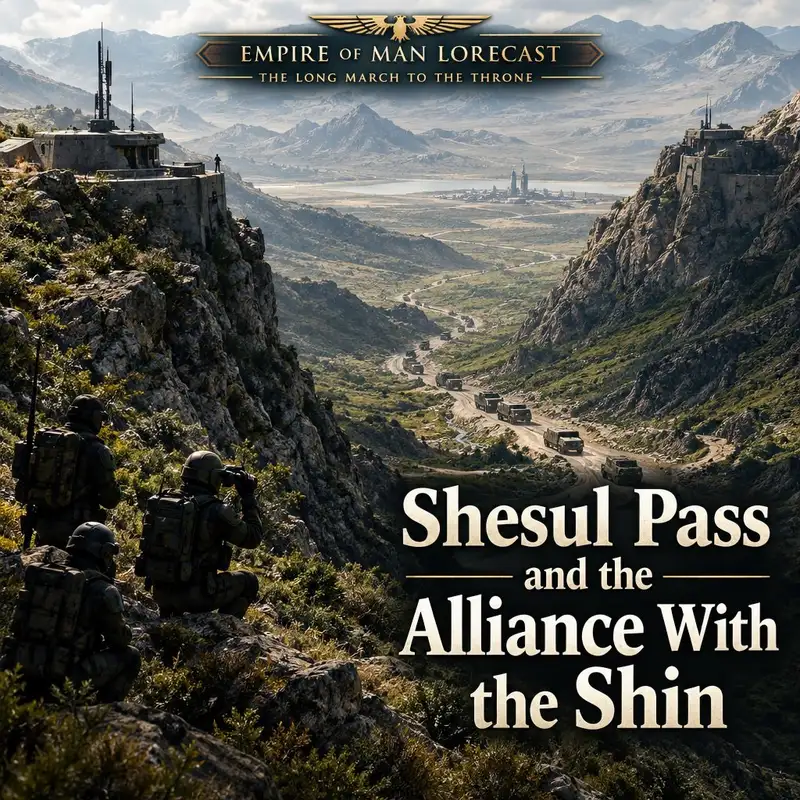
Shesul Pass and the Alliance With the Shin
Rain had turned the paving of the mountain road into a moving stream. Carts skidded sideways on wet stone. Turom lost their footing, panicked, and had to be steadied or dragged clear before they pulled other animals and vehicles with them. Lightning struck across the heights, and a landslide reminded everyone that the road was not merely difficult. It was temporary. Human Marines and Mardukan allies put their shoulders to cart wheels and pushed. After a long day of effort, the column had advanced less than twenty kilometers.
That was the reality behind the decision to take Shesul Pass. Roger’s expedition had avoided the obvious Krath defenses on the more direct route toward Shin country. It had not found an easy road. It had exchanged prepared enemy fortifications for a mountain route that could destroy its transport, exhaust its wounded, and expose its people to cold, weather, and predators. The walls had been avoided. The mountain had become the next defensive system.
The pass mattered because it was never simply a shortcut. It was an operational gamble made under pursuit, with incomplete intelligence and a force already worn down by months of campaigning. Its capture became a tactical success, but the fortress mattered even more as shelter, supply point, intelligence source, and political doorway. By the time the expedition emerged from Shesul, its survival was tied to the Shin’s own struggle against Krath expansion.
The immediate pressure came from the expedition’s escape from Kirsti. The humans and their allies could not settle into the city or treat their recent success as the end of a local campaign. The Krath had suffered a setback, but they remained capable of organizing a serious response. Their leaders gave General Lorak broad authority to pursue the expedition, while threatening Shin communities that might assist it.
Bravo Company understood that pressure was building, but it did not possess a clear picture of the Krath timetable, force strength, or full pursuit plan. Pahner could estimate the danger. He could not see the whole enemy disposition over the next ridge, much less across the region. That uncertainty was one reason speed mattered. It was also one reason simply fighting through every obstacle was not a viable plan.
The expedition’s objective remained the distant spaceport. That goal imposed a hard strategic discipline. Every battle had to be judged not only by whether it could be won, but by what it would cost in ammunition, power, medical supplies, trained personnel, and time. The force had already learned that advanced weapons were not a bottomless advantage. Every bead round fired, every damaged suit component, and every exhausted specialist narrowed the margin for the final objective.
Pedi Karuse provided the essential route intelligence. The obvious route toward the Shin country passed through Thirlot and then the citadel of Queicuf. Both were fortified. The Mardukan customs surrounding surrender and limited breaches could sometimes restrain the destruction of a city after a defense had failed. That did not make either position easy to take. It meant only that warfare had rules and expectations which could shape what happened after a wall was breached.
For Pahner, the military calculation was blunt. Even a successful attack on one fortified position could leave the expedition depleted before it reached the second. A siege or assault would consume time. It would expose irreplaceable Marines and allied troops to casualties. It would require ammunition and medical treatment that could not be replenished from a secure rear area. And victory at the first fortress would not remove the second fortress from the route.
The alternative was Shesul Pass, a lightly used mountain route that bypassed the obvious defenses. It was not an unmapped wilderness, but neither was it a route Pedi knew from personal travel. Her knowledge came through traders, raiders, and the accumulated practical information of people who moved goods or violence across the region. That was useful intelligence. It was not reconnaissance.
The mountain track offered another advantage. It could reduce the Krath’s ability to predict the expedition’s movement. A fortified road channelized traffic. It established where defenders expected an enemy to appear, where they could stock supplies, and where they could prepare fields of fire or obstacles. A marginal route through high country was less convenient, but it also offered the possibility of appearing where the enemy was not prepared to meet them.
That possibility did not remove the route’s material problems. The road was maintained for turom carts only as far as the pass itself. Beyond the fortress, it degraded into a track. That meant the expedition had to think not only about getting men over the heights, but about what it could carry, what it could pull, and what it might have to leave behind later. A route is never just a line on a map. It is a system of surfaces, gradients, animals, loads, weather, and labor.
Pedi also warned of local predators. Nashul burrowers and ralthak fliers were hazards to high-turom, the large beasts that gave the column much of its carrying capacity. The expedition did not need every predator to become a battle. What mattered was that the animals were not interchangeable equipment. A lost turom meant lost transport. Lost transport meant food, weapons, wounded personnel, or tools could no longer move at the same pace.
The pass therefore imposed a familiar expeditionary problem in an unfamiliar environment. The column could not travel faster than its slowest essential element. That might be a wounded Marine, a cart axle, a frightened animal, a guide who understood the trail, or a Mardukan ally struggling in conditions hostile to his physiology. A company can sprint. A mixed force carrying its future cannot.
The decision also reflected force preservation. The Marines could have used their superior weapons to solve some immediate problems. But high-technology weapons were most valuable when they were held in reserve for problems local resources could not solve. Repeatedly storming fortified positions with elite troops would spend precisely the capability the expedition could least afford to lose. Shesul was dangerous because it was difficult. It was attractive because difficulty was not the same as an enemy prepared to kill them.
Before the main column began its ascent, the expedition needed food, carts, and information. That requirement brought Rastar Komas forward to Sran. Rastar did not act as a passive scout waiting for human officers to decide every local question. He used Vashin mobility, reputation, and intimidation to compel the town to provide what the force needed.
His success reveals one of the harder truths of the march. The expedition had no protected depot, no dependable supply convoy, and no rear headquarters that could dispatch replacement animals or fresh provisions. It lived through procurement. Food, transport, guides, repairs, and local intelligence had to be acquired where they could be found. Sometimes that acquisition took the form of trade. Sometimes it rested on alliance. Sometimes, as at Sran, it operated in the shadow of armed coercion.
The town’s cooperation should not be treated as uncomplicated consent. Sran had its own reasons to fear both the column and the Krath. Supplying Roger’s force placed economic pressure on the community. It could also expose local people to retaliation if Krath forces later regained control of the area. A military column may describe carts and grain as supplies. To the settlement providing them, they may represent next season’s survival, political risk, or the loss of scarce transport capacity.
Rastar’s role also shows why the expedition’s alliances mattered. Human Marines possessed weapons, training, and equipment that local forces could not duplicate quickly. But they did not possess the social reach to obtain everything needed on an unfamiliar world. Rastar understood the language of regional power. He knew what his reputation meant, how to press a demand, and how to make a small town take the danger seriously.
That did not make his methods gentle. It made them intelligible within the emergency created by the campaign. The expedition was moving through inhabited territory while pursued by a stronger regional opponent. It had to obtain resources without turning every community on its route into an enemy. That balance between necessity and restraint was never clean, and it grew harder as the column became more desperate.
Once the force began the climb in earnest, Shesul disproved any idea that avoiding enemy walls meant avoiding combat conditions. The road was steep, slick, and vulnerable to weather. Rain did not merely make everyone miserable. It reduced traction, damaged visibility, increased exhaustion, and threatened the carts that carried critical supplies. A wheel slipping on stone could halt a column. A frightened turom could spread panic through a team. A blocked road could turn a march schedule into a survival problem.
Lightning and landslides added another layer of danger. The terrain itself could close the route or kill people without regard for rank, training, or political importance. In a conventional defensive position, commanders can often identify the enemy’s weapons and likely avenues of attack. In the mountains, the enemy was gravity, water, fatigue, and the possibility that the route ahead would simply cease to support the weight placed upon it.
The slow progress was strategically meaningful. Less than twenty kilometers in a long day was not merely disappointing. It meant food consumption continued while the force barely moved. It meant wounded personnel remained exposed for another night. It meant the Krath had more time to organize pursuit. It meant the animals and carts suffered more wear. And it meant that any plan dependent on a quick transit through the mountains was no longer a plan. It was an aspiration.
Pahner had to judge movement against preservation. Driving the force harder might gain distance in the short term, but it could break animals, worsen wounds, and strip discipline from already exhausted personnel. Moving too cautiously invited pursuit and reduced the strategic value of choosing the pass. There was no formula that solved the problem. Command meant deciding where exhaustion became more dangerous than delay.
Sergeant Major Kosutic’s role was equally important, even when it was less visible than a route decision or an assault. Discipline in such conditions is not ceremonial. It is the ability to keep people moving carefully when every step becomes work, to keep equipment from being abandoned casually, to maintain enough security that exhaustion does not become vulnerability, and to prevent frustration from breaking down the relationships that keep a column functioning.
Roger was present in the hardship, and that mattered politically and personally. But he did not replace Pahner’s professional command or Kosutic’s practical authority. A prince can share the burden. He can observe, advise, and make political decisions. He cannot make terrain less steep or grant himself the experience of a commander who has spent a career measuring risk against mission. The strength of the expedition lay partly in recognizing those distinctions.
The climb also placed a particular burden on casualties and transport. A healthy fighter can scramble over bad ground. A wounded person requires assistance, time, and often a vehicle or animal that could otherwise carry food or ammunition. A cart that carries supplies cannot simultaneously carry every exhausted marcher. The expedition’s operational strength was therefore shrinking in ways that simple headcount could not measure.
Mardukan allies faced the same route through different physical conditions. Their bodies and their equipment were adapted to Marduk, but not every region of Marduk imposed the same demands. The high country brought cold that reduced the effectiveness of some Mardukan personnel, just as heat, humidity, and long campaigning had already worn down the humans. An allied force is not a collection of identical bodies under one flag. Its strengths and limitations change with the environment.
By the time the expedition reached the area of the fortress, rest was no longer a luxury that could be postponed for the sake of momentum. Recovery had become part of combat planning. The force needed warmth, shelter, food, and time to treat wounds and repair itself as far as its resources allowed. The trouble was that the fortress guarding the pass stood between the column and those necessities.
Cold created the central irony of Shesul. It endangered the expedition, but it also created the weakness that made the fortress vulnerable. The Marines’ uniforms had been worn and patched through nearly six months of field operations. Human fatigue and nutritional strain had accumulated over a long march in a world where familiar supply systems did not exist. Yet the cold affected many Mardukans even more severely, pushing them toward torpidity.
That did not mean every Mardukan reacted identically or became incapable of duty at the same temperature. The campaign had already demonstrated too much cultural and biological variation for such a simple conclusion. But the high-elevation cold imposed a serious limitation. Vashin sentries could maintain only limited watches. The larger force faced a cruel security dilemma. The people most able to stand guard also needed sleep, warmth, and recovery.
Eventually, active security was reduced to roughly ten percent of the force. That was a calculated risk, not an act of carelessness. A unit that never rests becomes incapable of defending itself. Yet a unit that rests too deeply while pursued can be destroyed. The situation at Shesul made every sentry a scarce resource. Each person awake was one less person recovering. Each person asleep was one more risk accepted.
The fortress garrison faced its own version of that dilemma, and it faced it under worse assumptions. Its defenses were designed around the obvious approaches. Walls, gates, and conventional avenues of movement were guarded. The cold was treated as a condition to be endured around fires, not as a factor that might allow an enemy to appear from a nearly vertical direction.
Julian, Gronningen, and Macek exploited that weakness. Their operation began not at the gate or along the expected road, but from an adjacent mountain ledge. They used climbing equipment and specialized skill to reach the fortress by an approach the defenders had not adequately protected. The climb was dangerous. It was not magic, and it was not a casual feat of athleticism. It depended on training, equipment, terrain judgment, and the willingness to attempt what the garrison had judged implausible.
The practical sequence was simple in description and difficult in execution. The infiltrators reached the wall. They secured the sleeping or torpid defenders rather than turning the operation into a broad firefight. They opened the gates. The main column entered. That sequence is exactly why the seizure of Shesul should not be described as a triumph of overwhelming firepower.
Fortifications are systems, not symbols. A wall is only as effective as the surveillance, terrain coverage, command readiness, and human endurance supporting it. The defenders at Shesul possessed a strong physical position. But their conception of danger was narrower than the capabilities of the attacking force. They did not anticipate the vertical route, and the cold made their failure to anticipate it decisive.
The seizure also demonstrates a broader point about the Marines’ remaining technological advantage. Their tools and training could produce disproportionate results when used selectively. A climbing capability, employed at the right point against an overlooked approach, could achieve more than a costly frontal engagement. That was a far more sustainable use of elite capability than spending ammunition and lives against every fortified obstacle.
Once the gates were opened, Shesul ceased to be merely an enemy position. It became a temporary base. The fortress provided shelter from the cold and weather. It provided food and local weapons. It held approximately fifty turom, an acquisition that mattered because the expedition’s ability to move supplies and casualties was as important as its ability to fight.
Pahner halted there for two days. In a campaign governed by pursuit and dwindling resources, stopping for two days might appear dangerous. It was dangerous. But continuing without rest would have been more dangerous. Wounded personnel required care. Exhausted troops required sleep. Equipment and loads needed reorganization. The force needed to convert a captured position into renewed operational capacity before it could continue.
The need for rest did not erase the security problem. Pursuit had not vanished because the expedition had taken one pass fortress. Guards still had to be posted. The column still had to assess what it could move and what it might eventually need to abandon. The recovered turom expanded carrying capacity, but no number of animals could turn a deteriorating track into a modern supply route. Transport remained a constraint, not a solved problem.
Rest also had a moral and organizational value beyond simple recovery. A force that has been pushed continuously through danger begins to lose its ability to think collectively. People focus on the next meal, the next step, the next pain. A defensible shelter allows commanders to restore routines. Wounds can be assessed. Equipment can be checked. Orders can be understood. Grief and fatigue do not disappear, but they become manageable enough for the unit to act as more than a collection of survivors.
Shesul produced intelligence as well as supplies. Julian found a Zuiko tri-cam in the quarters of the Krath commander. The device suggested contact between the Krath and the spaceport. That possibility altered the expedition’s understanding of the final approach. The spaceport was not simply a distant installation waiting at the end of the road. It was connected, directly or indirectly, to the regional political and military struggle the expedition was crossing.
The discovery did not provide a complete enemy order of battle or a perfect picture of the spaceport’s situation. It was evidence, not certainty. But evidence mattered because the expedition’s intelligence picture had been assembled from fragments. Pedi’s secondhand route knowledge, inquiries made at places like Sran, captured material, local rumor, and personal testimony all had to be weighed against one another.
Another source appeared inside the fortress. Harvard Mansul, a journalist associated with the Imperial Astrographic Society, had been imprisoned at Shesul. Mansul became valuable because he was an additional witness to events and conditions beyond the expedition’s immediate experience. He was not an omniscient intelligence officer. His knowledge had limits, shaped by what he had seen, heard, and survived. But in a campaign starved for reliable information, even partial testimony could change planning.
The importance of Mansul’s presence was not simply that a human was found in an unexpected place. He embodied the broader collapse of normal assumptions around the spaceport region. Before the expedition’s landing on Marduk, Imperial presence could be imagined as a distant administrative and technological fact. By Shesul, it had become clear that the relationship between local power, Imperial authority, and the port was compromised in ways the expedition had not anticipated.
The pass also brought the expedition into the political orbit of Mudh Hemh. Reaching Shin territory did not mean entering a welcoming sanctuary. It meant arriving in a populated, wealthy, and strategically significant vale whose leaders had to calculate what Roger’s presence would cost them. The Shin were not waiting to become auxiliaries in a human campaign. They had their own conflicts, trade interests, fears, and internal divisions.
The central authority in the vale was the Gastan. His position rested on personal authority, military reputation, clan relationships, trade power, and his ability to shape information within his domain. Calling him a king can be convenient for an outside listener, but it risks implying a centralized state that does not capture the political reality. His authority had to operate through local relationships and competing interests.
From the Gastan’s perspective, Roger’s arrival was dangerous. The expedition had brought Krath attention toward his people. The Krath ultimatum made that danger explicit. The issue was no longer whether the Shin approved of the humans’ route. The Krath demanded a choice. Assist the newcomers, and face consequences. Hand them over or abandon them, and perhaps preserve local security, at least in the short term.
That pressure transformed a movement problem into a political crisis. The expedition had hoped to pass through a region on its way to the spaceport. The Krath made neutrality harder to sustain. By threatening those who helped Roger, they forced the Shin leadership to consider not only immediate military risk, but the future of their autonomy under Krath expansion.
Roger’s role changed in that setting. His dynastic status could not climb mountains or replace Pahner’s tactical judgment. But it could carry political weight. He identified himself openly and refused to accept a solution that required sacrificing either himself or Pedi. That was important because it told the Gastan that Roger was not merely a protected foreign traveler hoping local people would absorb the cost of his passage.
The refusal also had consequences. A prince making a commitment is not the same as an Imperial government issuing a binding treaty through established channels. Roger could offer the standing of House MacClintock and the prospect of future recognition. He could not instantly repair a compromised administration or guarantee that every Imperial official would honor his word. The Gastan had to decide whether that promise was credible enough to matter.
Pahner remained responsible for the force’s military survival. Roger could negotiate a political relationship, but he could not spend Bravo Company as though it were his private guard. The expedition’s overlapping authorities remained distinct. That distinction was one reason its political decisions carried weight. Roger’s status created leverage. Pahner’s command kept the leverage from becoming a reckless military commitment.
The Gastan’s reasons for alliance were practical. Mudh Hemh was not an isolated refuge whose fate could be separated from the wider region. It was populous, wealthy, and a major conduit for trade from the eastern Shin Range. Control of the vale would give an outside power access to resources, movement routes, and influence over communities whose prosperity depended on that trade.
The Krath wanted more than the removal of an inconvenient human expedition. Their pressure threatened the political and economic order that sustained the Shin. For the Gastan, resistance was therefore not an act of sentiment toward Roger. It was a decision about whether Mudh Hemh would remain capable of governing itself, maintaining its trade, and resisting absorption into a Krath-dominated system.
The presence of the compromised Imperial governor added another concern. The Gastan feared that human weapons and authority might eventually be used against the Shin through local institutions already corrupted or captured by hostile interests. From his perspective, Roger’s claim to represent a legitimate Imperial house was valuable precisely because Imperial power on Marduk had become unreliable.
Roger offered a MacClintock guarantee. If the expedition survived and returned, House MacClintock would recognize the damage done by the governor and support the Shin. That was a calculated political promise. It gave the Gastan a prospective relationship with a powerful dynasty. It did not provide immediate reinforcements, nor did it erase the fact that the Shin would bear the first costs of defying the Krath.
The Gastan’s public answer to the Krath demand made the choice unmistakable. The display of the dead High Priest’s head was not casual brutality or theatrical excess detached from politics. It was political communication in a setting where public acts had to demonstrate resolve, authority, and irreversibility. The Gastan was declaring that compromise with the Krath had ended. Roger’s allies would be treated as his allies.
That declaration was made under duress, but it was still a choice. The Shin were not drafted into a human war by Roger’s personal charisma. Their leaders judged that Krath pressure already threatened their interests, and that alliance offered a better chance of survival than submission. They had their own reasons to fight, their own dangers to manage, and their own expectations of what a future relationship with the Empire might bring.
The resulting force was a coalition, not a unified national army in the modern sense. It included the Gastan’s own warriors, lowland clan leaders who had experience with Krath influence and raiding, and high-country clans rarely seen by outsiders. Their armor, weapons, local knowledge, military experience, and willingness to negotiate were not identical.
That diversity gave the alliance real strength. The Shin could provide manpower, terrain knowledge, food access, political legitimacy, and intelligence networks that the expedition could never generate by itself. They could move through their own country with an understanding of paths, communities, and rivalries unavailable to the Marines. Their presence made it harder for the Krath to depict Roger’s force as a purely alien intruder operating without local support.
It also created friction. Different clans had different priorities. Some knew Krath methods well. Others came from high country with their own traditions and more limited exposure to the lowland conflict. Equipment varied. Command relationships had to be negotiated across language, status, and military culture. No professional officer could simply issue an order and assume every Shin contingent would interpret it through the same doctrine.
The alliance carried civilian consequences as well. Mudh Hemh’s wealth and population made it worth defending, but also made it vulnerable. Trade routes, households, workshops, food supplies, and local authority would all be affected by the war that followed. The expedition had gained a political base. It had also become linked to the risks borne by the people living within that base.
For Roger and Pahner, the benefits were immediate but not uncomplicated. The alliance opened access to a region that could support further movement toward the spaceport. It added local fighters and local legitimacy. It improved the intelligence picture. It offered a place from which the expedition could plan rather than merely react. Yet it also committed the force to a conflict it could not simply walk away from without abandoning the people who had chosen to stand with it.
The Marines won Shesul through skill, surprise, and an enemy weakness created by the mountain’s cold. The greater result was the alliance that followed. By taking the pass, Roger and Pahner gained rest, transport, intelligence, and access to the Shin. In return, they became participants in the Shin’s struggle to defend their survival, trade, and autonomy.
Shesul was not an escape from the war. It was the point where the expedition acquired the allies, obligations, and political stakes that made the next phase of the war possible.