Rastar and the Vasin: Refugees, Cavalry, and the Boman War
The caravan fight near the Chasten River began as the sort of disaster that exposes the difference between armed travelers and a military force. The Boman pressed into the column with mass, aggression, and enough momentum to turn ordinary guards into isolated fighters. Men with weapons fought beside wagons, animals, and civilians, but they fought as individuals. Bravo Company held together at the threatened front, maintaining the discipline that had carried it through a much longer series of emergencies. Then the pressure changed. Behind the attackers came pistol fire, mounted movement, and a charge by riders who had every reason to avoid another battle. The Vasin cavalry had arrived.
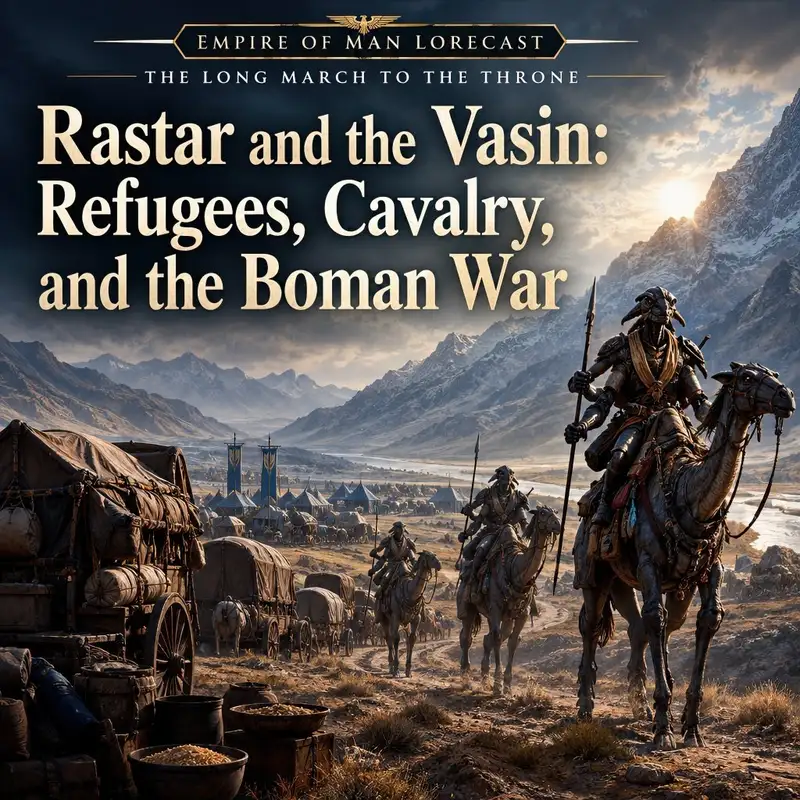
They were not arriving as a fresh reserve from a secure homeland. Rastar Komas Ta’Norton and Honal C’Thon Radas brought roughly one hundred fifty riders into that fight, but behind those riders stood a displaced community. Their people had lost cities, soldiers, supplies, and security in the northern collapse. Many of the Vasin traveling with them were women, children, and men who had never been trained for war. Their food was nearly gone. Their mounts required forage. Their armed strength was important precisely because it was one of the few remaining means by which the rest of the community might survive.
Rastar was a Vasin leader and Prince of Therdan, but his title alone could not feed a camp or defend a refugee column. His northern world had been shattered. Therdan and Sheffan had been destroyed in the Boman advance, and the League of the North had ceased to function as a dependable political and military system. Rastar’s original troop had been badly cut down during the escape. Much of the surviving armed strength around him came from other northern households, including forces associated with Honal and the displaced people of Sheffan.
The collapse created a problem familiar to military history, even if the setting is not. A defeated army can sometimes retreat intact. A population can sometimes flee ahead of an invasion. The Vasin had to do both at once. Their soldiers could not simply abandon dependents and seek a safer employer. Their civilians could not simply move without armed protection through a region becoming more dangerous by the day. Every decision about movement, food, or combat therefore carried two meanings. It was a military decision, and it was a decision about whether a fragment of northern society would endure.
Rastar’s authority rested partly on lineage. As Prince of Therdan, he embodied a political identity larger than his personal household. But in the aftermath of defeat, lineage needed to be made credible through conduct. A prince who escaped while his people starved would retain a title but lose the substance of leadership. A commander who spent his remaining riders in a futile gesture of revenge might satisfy anger and still doom the refugees. Rastar’s achievement was to keep political status, military utility, and civilian obligation connected when circumstances urged him to sacrifice one for another.
Honal represented a different but equally real pressure within the northern survivors. He was Rastar’s cousin, a commander from Sheffan, and a man whose people had suffered directly from the destruction of the northern city-states. His anger at the Boman was not decorative. It was the anger of a soldier and a displaced leader who had watched established communities break apart. But Honal was not merely a reckless advocate of vengeance. He understood combat, leadership, and the practical need to preserve what remained. The tension between his appetite for striking back and Rastar’s broader responsibility gave the Vasin leadership depth.
Before the caravan battle, the Vasin appeared in the mining valley of Ran Tai as an armed refugee community living close to starvation. Their condition was not that of a standard cavalry regiment waiting for orders from a state that could still pay, feed, and replace it. They had weapons and skilled riders, but those military assets were tied to a camp full of dependents. Their demographic imbalance revealed the cost of the northern defeat. There were many more women than men among the group, because so many northern fighters had already died in the struggle to escape.
The Vasin had reached a point where they needed employment, supplies, and a destination. Yet Rastar resisted the temptation to solve that crisis through predation. He drew a distinction between being armed refugees willing to sell military service and becoming bandits who lived by stripping weaker people. That distinction was not simply moral language used for human benefit. It was part of the Vasin claim to remain a people with obligations, not merely the surviving remnant of a defeated army. If they became indistinguishable from the forces that had destroyed their homeland, they might live a little longer at the cost of the political identity Rastar was trying to preserve.
When Roger’s people first encountered the Vasin at Ran Tai, neither side saw the other as a natural ally. The humans had entered the valley pursuing their own urgent problem. The Vasin were armed, suspicious, hungry, and connected to a community that had taken shelter in contested ground. Roger’s nighttime operation captured Rastar and gave the humans control of the immediate situation. The episode showed the human force at its most intimidating. Bravo Company possessed discipline, advanced weapons, communications, and a capacity for controlled violence that few local forces could match.
But the outcome also mattered because the humans did not simply destroy the Vasin or reduce them to captives. They allowed the group to withdraw with its weapons. The promised gold shipment that had helped shape the situation was not found, and the immediate confrontation ended without turning the refugee camp into a massacre. That restraint did not erase suspicion. The Vasin had been expelled. Their leader had been captured. Their people had been forced to move again under conditions they could barely sustain. No sensible commander would confuse that experience with trust.
Still, Rastar had learned something important about the strangers. They were overwhelmingly dangerous in a direct confrontation, but they had not treated his people as disposable plunder. For Pahner and Roger, the Vasin had demonstrated another useful fact. They were armed, organized enough to withdraw rapidly, and led by men who understood command responsibility. In a campaign where every local group might be a threat, an opportunity, or both, that was a more valuable basis for future dealings than sentiment would have been.
Rastar’s responsibility during the expulsion was the responsibility of a commander under defeat. He could not hold the mining valley. He could not compel the humans to recognize his title. He could not guarantee food for his people. What he could do was preserve the community’s remaining weapons, keep it moving, and avoid a final battle that would leave women and children without protection. There are moments in military history when holding ground is the only honorable option. There are others when the honor lies in refusing to spend the last trained soldiers on a position that no longer serves the people behind them.
The Boman advance turned that retreat into a wider operational crisis. Travel toward Diaspra had become more dangerous because the normal routes were filling with people fleeing violence, merchants trying to save movable wealth, guards seeking employment, and armed groups looking for easy targets. The caravan near the Chasten River was not simply a collection of travelers headed in the same direction. It was a response to insecurity. Larger groups could pool guards, supplies, and information. They could present a harder target. But they also became more visible, slower, and more difficult to control when attacked.
The Boman threat was broad but not uniform. The expedition encountered outriders and raiders associated with the greater Boman movement, but it did not possess complete intelligence about every tribe, commander, or formation involved. Rastar could distinguish groups within the threat, including the Wespar, from the larger Boman mass. That distinction matters. A coalition or migration of violent forces may share objectives without operating as a perfectly uniform army. Different groups may possess different equipment, local knowledge, discipline, and reasons for joining the larger advance.
What the refugees knew was that the north had not merely been raided. It had been broken. Rastar described Therdan and Sheffan as destroyed, not simply looted and abandoned. He also reported that northern stores had been poisoned, weakening the ability of defenders and civilians to withstand the crisis. He attributed that sabotage to agents connected with the Tyrant of Sindi. That claim was politically charged, and the expedition had no independent intelligence system capable of proving every part of it at the time. Yet it offered a serious explanation for why established northern polities had fallen so quickly and why their survivors carried both rage and suspicion southward.
The human expedition could see the immediate result even without knowing the full chain of responsibility. The road had become a battlefield before any formal campaign plan had been drawn. Bravo Company was trying to reach the coast and the spaceport that offered its only realistic route home. But the company could not move through a destabilized continent as though it were crossing empty terrain. It needed food, guides, interpreters, trade, shelter, and security. Each of those requirements placed it inside Mardukan political conflicts it had not caused and could not simply ignore.
At the Chasten River, the Boman attack demonstrated why the caravan’s normal guards were inadequate. Armed individuals can be brave and still be tactically ineffective when the fight becomes confused. The caravan guards met attackers where they found them. Some protected wagons. Some defended animals. Some fought beside relatives or employers. But without reliable formation, common command, or a coordinated reserve, their courage became dispersed. The Boman could exploit gaps, overwhelm small knots of resistance, and keep the entire column reacting rather than controlling the engagement.
Bravo Company responded differently. Its Marines were badly constrained by numbers, a protection mission, and the need to conserve advanced equipment, but they understood how to hold a threatened front. They could concentrate fire, maintain cohesion, and turn their position into an anchor around which others might rally. Their advantage was not that every Marine was individually stronger than every opponent. It was that they could remain a unit when panic and terrain encouraged everyone else to become a separate fighter.
That discipline bought time, but it did not resolve the tactical problem by itself. The Boman had numbers and momentum. The caravan was vulnerable on more than one side. The Marines could not be everywhere at once, especially while protecting civilians, baggage, and the royal principal who remained central to their mission. A company designed as an elite protective force had become the spine of an improvised field defense. It could prevent collapse at the front, but without help it risked being fixed in place while the rest of the caravan came apart around it.
Rastar and Honal changed that calculation by striking from the rear. Their cavalry used the methods available to them. Pistol fire at close range disrupted the enemy, then riders closed with swords and lances. The sequence was not an antique imitation of some distant Earth battle. It was the practical use of Mardukan weapons in a climate where firearms were useful but not always dependable, and where a mounted charge could still produce a shock effect that infantry on foot could not easily match.
The rear attack mattered because it forced the Boman to confront a new threat while already engaged with Bravo Company. Pressure from two directions is not automatically decisive. If either force attacks without timing, communication, or sufficient strength, the enemy may defeat them separately. But here the human defense held long enough for the Vasin strike to matter, and the Vasin strike created enough confusion to reduce the pressure on the human line. The Boman could no longer focus all their force on breaking the front. They had to react to mounted enemies appearing where their attention was weakest.
Roger and Patty also contributed an improvised shock action involving a heavy beast. It was significant because it added disruption at a moment when the enemy’s cohesion was already under strain. Roger’s growing willingness to act under danger mattered to the men and Mardukans around him. But the larger operational point is that his intervention worked within a battle whose decisive structure had already been shaped by converging pressure. It should not eclipse the Vasin. The human prince’s boldness helped create an opening. Rastar and Honal’s cavalry made that opening part of a broader defeat for the attackers.
Their weapons also reveal a larger truth about sustainable combat power. A wheel-lock pistol could deliver devastating close-range force, but it was not a replacement for every other weapon in the Vasin arsenal. Powder had to be kept dry. Mechanisms had to function. Ammunition had to exist. The pistol volley could unsettle an enemy before contact, but the charge still depended on riding skill, lances, swords, discipline, and the willingness to close. The Vasin were not fighters caught between primitive weapons and human weapons. They were soldiers using a mixed system suited to what their society could sustain.
The immediate result was a defeated Boman attack and a caravan that survived to continue its movement. But the more important outcome came after the fighting. The Vasin had demonstrated that they were not merely another hungry group seeking relief. They could guard a column, scout, fight mounted, and act with enough cohesion to alter the course of an engagement. At the same time, the humans had demonstrated that they could hold under pressure and deal with Rastar as a commander rather than a captive. The battle made an agreement possible. It did not make the agreement inevitable.
Captain Armand Pahner understood that the true alliance-forming event was the negotiation that followed. He commanded Bravo Company. He did not command the Vasin through an Imperial chain of command, and he did not need to pretend that he did. Rastar remained the commander of his own people. The task was to determine whether their interests could be joined without either side losing the ability to act. The caravan needed guards who could move beyond the immediate reach of the Marines. The Vasin needed food, pay, and security for their dependents.
The resulting arrangement was materially specific. The Vasin would be employed as guards. Food would be shared. Fighters would receive enough priority to remain capable of performing their military duty, but the agreement did not treat the rest of the refugee community as expendable mouths. No one was to be left to starve. That condition is easy to overlook if one sees the Vasin only as cavalry. It was central if one understood them as a society under arms.
Food was strategy. A mounted formation without food and forage becomes a burden almost immediately. Riders weaken. Animals fail. Weapons may remain, but mobility disappears. Conversely, a refugee population without an effective protective arm becomes prey for raiders, hostile authorities, or stronger military forces. The employment agreement addressed both problems at once. It did not solve the Vasin’s displacement. It did not restore Therdan or Sheffan. But it turned military capability into a source of sustenance and turned civilian survival into a reason to preserve that capability.
The bargain also preserved Vasin dignity. Rastar did not surrender his people into human service as if they were captured auxiliaries. He negotiated terms under pressure, but he negotiated as a leader with assets the other side needed. Pahner’s side brought food, disciplined protection, and an expedition with resources beyond any local caravan. Rastar’s side brought mounted manpower, local knowledge, political standing among displaced northerners, and the ability to operate in Mardukan society without every conversation being mediated by a human outsider.
Roger’s royal status mattered, but it did not replace the practical work of negotiation. His presence gave the expedition political weight and made it impossible for local leaders to regard the humans as merely another wandering mercenary band. Yet Rastar was not taking orders from a prince simply because the prince bore an impressive title. He was making a calculated alliance. That distinction would remain important as the relationship deepened. Military cooperation is stronger when each side understands what it is receiving, what it is giving, and what authority it retains.
The human contribution to the alliance was substantial. Bravo Company brought disciplined formations, advanced weapons, communications, technical knowledge, and a command structure capable of functioning after repeated losses. Sergeant Major Eva Kosutic and the enlisted leadership helped keep that system coherent in conditions that would have broken less prepared troops. The Marines could organize defense, concentrate fire, maintain watch, and apply skills that local armies often lacked. Their equipment could overmatch many immediate threats, even though ammunition, power, maintenance, and environmental exposure placed severe limits on how freely it could be used.
But those strengths did not allow the Marines to solve every problem alone. A small, exhausted company could not scout every road, protect every wagon, negotiate every passage, care for every casualty, and fight every hostile force across a continent. It could not casually detach Marines for routine reconnaissance if each loss also meant losing a trained specialist, a trusted leader, or a bodyguard essential to Roger’s protection. The more the company moved through Mardukan territory, the clearer it became that advanced equipment was not a substitute for local relationships.
The Vasin supplied what the expedition lacked. They had mounted mobility. They understood the roads, the dangers of the region, and the likely behavior of Boman forces. They could provide reconnaissance and route security beyond the immediate range of the Marine line. They brought a culturally credible armed presence. A Mardukan ruler might distrust human armor and impossible weapons, but he understood what a northern prince, a cavalry leader, and a household force represented. The Vasin could translate not only language but military and political meaning.
They also brought manpower, though manpower should not be confused with an unlimited reservoir of soldiers. Every Vasin rider was tied to a fragile community whose survival depended on that rider returning from patrol or battle. Their value did not lie in being expendable local substitutes for Marines. Their value lay in being a force with its own reasons to fight and a leader who could connect those reasons to the expedition’s need for movement. This was partnership under necessity, not annexation.
The command relationship remained deliberately separate. Pahner commanded Bravo Company and set the expedition’s operational priorities. Rastar commanded the Vasin. Cooperation depended on planning, trust, shared danger, and repeated proof that each leader would honor the practical terms of the alliance. That arrangement could be slower than issuing orders through one chain of command. It also made the coalition more durable. Rastar’s authority over his riders was stronger because it remained his own. Pahner’s authority over his Marines was clearer because it was not diluted by pretenses about ruling allies.
Diaspra transformed the political meaning of the Vasin survival. Reaching the city did not mean that the refugees had reached safety in any simple sense. Diaspra had its own political structure, its own limited resources, and its own arguments about how to face the Boman threat. It was a water-centered priest-kingdom with major hydraulic works and reasons to be cautious about absorbing large numbers of displaced northerners. Refugees brought skills and military experience. They also brought mouths to feed, unresolved loyalties, memories of defeat, and the possibility of dragging a distant war directly into the city’s calculations.
Yet Diaspra also contained a concentration of northern survivors. Several thousand troops from Therdan, Sheffan, and other League cities had reached it. They had not arrived as one unified army waiting for a rightful commander. They carried different local loyalties, losses, and expectations. Some had survived with units more intact than others. Some had lost homes, families, or patrons. All had reason to question whether the northern political order could be rebuilt at all. In that environment, Rastar’s arrival carried unusual weight.
He had survived, which mattered. More importantly, he had brought women and children out of the northern disaster. He had arrived with an armed force that had proved its usefulness in battle and had found a way to feed itself without abandoning its dependents. For soldiers who had watched city-states collapse and commanders fail, those facts could become stronger claims to leadership than inherited title by itself. Rastar gained political representation and a larger base of legitimacy because he had demonstrated the responsibilities that title was supposed to entail.
That did not make him the uncontested master of every northern survivor. The League’s collapse had created too many separate interests for any one prince to command them automatically. Rastar’s authority expanded through recognition, negotiation, and military credibility. It remained dependent on whether he could provide direction without treating every displaced northerner as a personal follower. His strength was not that he could erase division. It was that he could give fractured groups a credible focus around which to organize.
Diaspra’s rulers had to make their own calculation. Welcoming Rastar and other northerners could strengthen the city against the Boman. The refugees included soldiers, officers, artisans, and people with hard experience of the enemy. But their arrival also placed pressure on food supplies and local political arrangements. A city facing invasion may need allies desperately while still fearing what those allies will demand after the immediate danger passes. Diaspra’s internal debate was therefore not cowardice against courage. It was a debate about survival, resources, and the risks of choosing resistance over accommodation.
The Vasin cavalry became important in that debate because it offered more than a set of riders for hire. Rastar and Honal brought a military tradition that could be taught and adapted. Diaspra could use mounted forces for reconnaissance, flanking movement, pursuit, communications, and shock action. But cavalry alone would not stop a major Boman force. Its effectiveness increased when it worked with infantry that could hold ground, pike formations that could deny an enemy easy access, shields that could preserve cohesion under pressure, and commanders able to coordinate those elements.
The proposed Diaspran force therefore moved toward combined arms. Shielded infantry, pikes, and civan-mounted cavalry would each perform different tasks. Infantry could occupy ground and absorb pressure. Pike formations could make direct attack more dangerous for opponents dependent on momentum. Cavalry could exploit openings, threaten flanks, observe beyond the line, and pursue an enemy whose cohesion had failed. This was not a matter of importing a finished human doctrine and handing it to passive local soldiers. The Vasin already possessed mounted experience. Diasprans possessed their own manpower, resources, political institutions, and knowledge of their terrain.
The humans could contribute organization, training methods, and an outside perspective on how separate arms might reinforce one another. But no military reform survives because a visitor gives an impressive demonstration. Diaspra had to supply food for troops and animals, time for training, workshops capable of producing and repairing weapons, officers who could enforce discipline, and political approval for changing established practices. Local fighters had to accept the new arrangements. Local leaders had to decide who controlled them. Local communities had to bear the burden of sustaining them.
Rastar and Honal’s role as teachers also changed their position within the coalition. As hired riders, the Vasin had been useful but vulnerable. Their employment depended on immediate military demand and the ability of others to feed them. As trainers and carriers of northern military knowledge, they became harder to replace. They could help Diaspra understand mounted operations and could connect local defense planning to the wider experience of the Boman war. That did not eliminate suspicion of them. It made their survival more relevant to the survival of the city that had received them.
There was a cost to that usefulness. Every time Vasin cavalry rode out, the community behind it remained exposed. If food distribution failed, if camp security broke down, or if an enemy bypassed the fighters to strike dependents, the military force could not protect the society it existed to defend. Rastar’s leadership depended on remembering that the cavalry was not separate from the refugees. It was their protective arm. The riders’ weapons carried political meaning because they were wielded on behalf of people who could not all fight for themselves.
Revenge remained part of the calculation. The destruction of Therdan and Sheffan was not an abstract strategic loss. It was a human catastrophe for the people who had escaped it. Honal’s anger and the desire to strike back could motivate courage, recruitment, and persistence. But anger alone could not sustain a military community. It could lead cavalry into battles chosen by the enemy. It could tempt leaders to spend irreplaceable riders for emotional satisfaction. Rastar’s restraint was not lack of feeling. It was the discipline of a commander who understood that the dead could not rebuild a people.
Diaspra, too, had reason to worry about what a powerful refugee military community might become. The Vasin could be allies against the Boman. They could also become a political bloc with claims rooted in northern lineage, battlefield experience, and the loyalty of displaced troops. They required food. They possessed weapons. They had suffered enough to distrust easy assurances from southern rulers. Any host city would see both the utility and the danger. Alliance meant accepting help from people whose interests were aligned with yours now, but not necessarily forever.
Institutionally, the alliance began creating something larger than a caravan escort but not yet the later force it would become. It was the start of a coalition in which human Marines, Mardukan cavalry, Diaspran soldiers, rulers, artisans, and refugees would all have different roles. The important word is start. No single battle erased cultural divisions. No contract made scarcity disappear. No training plan instantly created a unified army. The strength of the emerging coalition lay in its ability to connect different capabilities without pretending that all its members were the same.
Rastar’s greatest achievement was not converting helpless civilians into cavalry. Most of the people under his protection could not and should not have been treated as soldiers. His achievement was preserving the remaining cavalry as the shield of a displaced society. That required him to see food, pay, dependents, military discipline, political recognition, and future settlement as parts of one problem. A lesser commander might have separated them. He might have kept the riders fed by abandoning the civilians, or protected the civilians by disarming the force that made their protection possible.
The alliance endured because it was built on material survival and political dignity as much as battlefield success. Rastar did not become useful by forgetting that he was a refugee leader. He became useful because he refused to separate refugee protection from military purpose. At the Chasten River, the cavalry charge proved that a defeated people could still fight. The agreement that followed proved something harder: that they could choose the terms on which they would return to history.