Q’Nkok: Conspiracy, Intelligence, and Urban Regime Defense
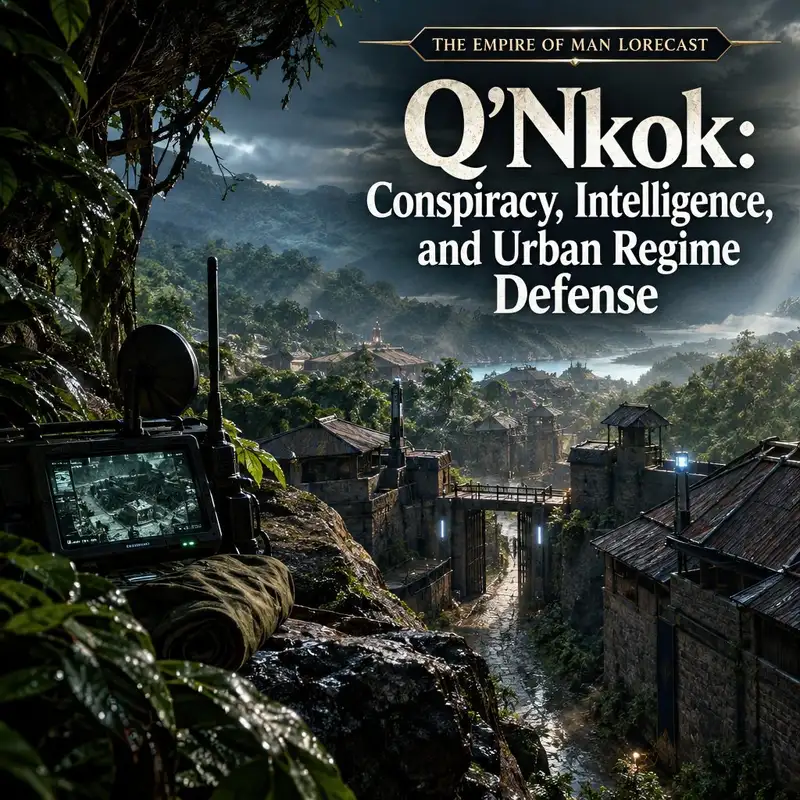
Imperial Marines placing listening devices inside the compounds of Q’Nkok’s great houses were not conducting a normal diplomatic visit. Officially, Bravo Company needed food, equipment, local information, and permission to continue its march. Unofficially, Captain Armand Pahner had begun to suspect that the city’s political crisis could become an immediate threat to the expedition. The company could not govern Q’Nkok. It lacked the numbers, the supplies, the legal authority, and the time. But if King Xiya Kan lost control of his city, the Marines could lose their best chance at a secure alliance before entering still more dangerous territory.
That made Q’Nkok an intelligence problem before it became a combat problem. Bravo Company had landed on Marduk after the destruction of its original mission plan, far from the spaceport that represented its only realistic route home. Its advanced weapons, armor, medical systems, and computers gave it an advantage over many local threats. They did not provide replacement ammunition, unlimited power, spare parts, maps, or a functioning base. Every engagement consumed resources that could not easily be recovered. Every delay increased the strain on the wounded, the equipment, and the political mission of keeping Prince Roger alive.
The company’s real strategic requirement was movement. It needed to cross a vast and poorly understood world, find allies where it could, avoid wars where possible, and retain enough military capability to seize or use the spaceport at the far end of the journey. That meant each city, tribe, river crossing, and commercial relationship had to be judged by a difficult standard. Would this contact provide food, intelligence, transport, equipment, or passage? Or would it create a new enemy and consume resources the expedition could not replace?
Q’Nkok mattered because it offered the possibility of a functioning urban ally. It had authority, markets, workshops, guards, trade connections, and knowledge of the region ahead. It was not merely a place to buy supplies. A stable city could become a source of information and a political anchor. An unstable city could become a trap, especially if its internal factions decided that the newly arrived humans were a threat, a weapon, or an opportunity.
The company’s path into Q’Nkok began not with an invitation from its king, but with a grievance carried by the X’Intai. D’Nall Cord, an X’Intai religious figure and intermediary, brought the humans into contact with a dispute that had been building between his people and the city. Cord was not simply a wilderness guide attached to the expedition. He represented a society with its own interests, losses, memory, and political claims. The X’Intai had an agreement with Q’Nkok governing the cutting of timber in their forests. It was a practical arrangement, but not a simple one.
Q’Nkok received controlled access to valuable forest resources. In return, the X’Intai received manufactured goods, including metal spearheads. Such an agreement tied together people with very different economies and ways of life. The city needed timber and trade. The X’Intai needed reliable goods and protection against being stripped of the resources that sustained them. The treaty therefore involved more than commerce. It involved boundaries, status, trust, and the ability of each side to enforce obligations over distance.
By the time the humans encountered the X’Intai, that agreement was failing. Q’Nkok’s woodcutters had pushed beyond the limits that the X’Intai believed had been accepted. At the same time, the goods supplied in exchange had declined in quality. Inferior spearheads were not an abstract commercial complaint. They could fail when a hunter or fighter depended on them. The death of Cord’s nephew, Deltan, gave the dispute a personal and political force that no merchant’s ledger could contain.
The X’Intai had reason to see the treaty breach as evidence that Q’Nkok’s promises no longer carried weight. From the city’s perspective, however, the misconduct did not necessarily prove that every official, merchant, guard, or noble house supported it. A city-state is not a single actor. Some people may profit from a bad bargain. Others may be ignorant of it. Still others may be too weak to stop it without triggering a wider political struggle. The difficulty for Bravo Company was to determine which of those conditions existed before the dispute became a local war.
That was why Cord’s presence beside the expedition was both dangerous and useful. Dangerous, because the humans arrived with an aggrieved X’Intai representative and enough firepower to make any city government nervous. Useful, because Cord made the grievance impossible to dismiss as a vague rumor from the forest. He gave the company access to the real political pressure behind the city’s external relations. The Marines did not create the dispute. They entered a situation in which the dispute had already become a test of Q’Nkok’s authority.
For Prince Roger, this was a diplomatic opportunity and a personal responsibility. His identity gave the expedition an importance that ordinary travelers would not possess. He could make a request sound like a proposal between rulers rather than a demand from stranded soldiers. But Roger’s dynastic status did not make him the commander of a Mardukan city. Nor did it replace Captain Pahner’s responsibility for security. Pahner had to protect Roger while ensuring that Roger’s presence did not pull the company into a conflict it could neither control nor afford.
When Bravo Company entered Q’Nkok, the city faced a disturbing sight. Armed foreigners had appeared alongside a representative of a forest people with serious claims against the city’s conduct. In another context, that could look like the opening move in an invasion or an attempt to impose an external settlement. The Marines’ response was not to hide their capabilities completely. A limited demonstration of their weapons helped establish a simple fact. Attempting to coerce or attack the expedition would be costly.
That demonstration was deterrence, not a blueprint for rule. Pahner understood that the company’s high-technology weapons had two values. One was their destructive capacity. The other was the uncertainty they created in the minds of opponents who had never encountered such weapons before. Used carefully, that uncertainty could prevent a fight. Used recklessly, it could persuade every faction in the city that the humans intended to decide Q’Nkok’s future by force. The second outcome would have been strategically disastrous.
Bravo Company could not occupy Q’Nkok even if it wanted to. It was a company-sized protective force, not a colonial administration or an army of conquest. Its Marines had to maintain security around Roger, care for casualties, preserve weapons and power, manage equipment, and prepare for the onward march. An urban occupation would have required checkpoints, interpreters, supply depots, patrol schedules, intelligence networks, detention systems, and enough manpower to control a population whose language and institutions the company only partly understood. None of that was available.
The question was therefore narrow but urgent. Was King Xiya Kan responsible for the abuses against the X’Intai, or was he constrained by people within his own political structure? The difference mattered. If the king was the source of the problem, cooperation with him could compromise the expedition and provoke the X’Intai. If he was attempting to control misconduct by stronger interests, then he might be the company’s most useful local partner. Before choosing either course, Pahner and his advisers needed information.
Xiya Kan’s authority was genuine, but it was not unlimited. Q’Nkok was governed through a king and a council of great houses. Those houses possessed wealth, status, armed retainers, commercial interests, and influence over the city’s politics. Their support could strengthen a king. Their opposition could make routine policy difficult or turn a dispute into a challenge to the regime itself. A ruler in that position could not simply issue an order and assume it would be carried out faithfully in forests, workshops, markets, or private compounds.
The council provided the company with its first real assessment. By observing how the king and the great houses responded to the X’Intai grievance, the humans could distinguish performance from conviction. The important finding was that Xiya Kan was angry about the treaty misconduct. His reaction did not solve the problem. It did, however, separate him from those who were benefiting from the violations or treating them as politically useful. The king was not the same thing as the faction behind the abuse.
That intelligence finding changed the company’s options. It meant the expedition could attempt to support the existing government without endorsing every action ever taken by the city. It also suggested that the treaty dispute might be part of a larger struggle inside Q’Nkok. If the king’s authority was being undermined through economic misconduct and external provocation, then the issue was no longer just bad trade goods or illegal logging. It might be a deliberate effort to make the king look weak, dishonorable, or incapable of protecting the city’s interests.
Eleanora O’Casey was central to understanding that distinction. Her value was not that she possessed instant cultural mastery over every Mardukan society. No translator, historian, or adviser could achieve that after a brief encounter. Her value was the ability to ask better questions. Who benefited from inferior goods? Who had authority over the woodcutters? How did the city’s political elites understand treaty obligation? What did Cord’s complaint mean in X’Intai terms, and how would Q’Nkok’s council interpret it? Those questions turned raw observation into analysis.
The company could have confronted the great houses directly. It could have accused particular elites of corruption, demanded redress for the X’Intai, or used its weapons to force an answer. That would have been quick, visible, and probably counterproductive. Public accusation could unite rival houses against the king and the foreigners. It could also force Xiya Kan to choose between appearing weak before his council and acting before he had evidence strong enough to justify a dangerous internal crackdown. A premature move might save no one and destabilize everything.
The alternative was clandestine collection. Bravo Company arranged to place surveillance devices in the residences or compounds of the great houses. This was not a casual act of curiosity. It was an intelligence operation with a specific purpose. The company needed to know whether the treaty violations were isolated misconduct, whether several houses were coordinating their actions, whether violence was being prepared, and whether the king faced an imminent challenge. It also needed to distinguish between a political opponent, a profiteer, and an active conspirator.
The operation carried obvious legal and ethical ambiguity. Under ordinary Imperial conditions, secretly monitoring the homes of allied political leaders would raise serious questions of authority, privacy, jurisdiction, and abuse. Pahner’s justification rested on the operational realities of Marduk. The expedition was isolated, threatened, and moving through territory effectively shaped by hostile human influence and local instability. In his view, it was operating in a war zone, not conducting a properly accredited embassy mission.
Pahner’s restraint mattered as much as his willingness to collect intelligence. The purpose was not to build a permanent human secret-police system inside Q’Nkok. The company did not have the manpower, the time, or the right to supervise every faction in the city. The purpose was narrower. It was to identify a threat precisely enough that the company and the king could prevent a larger and more destructive conflict. Intelligence, in this case, was intended to reduce the need for indiscriminate force.
The surveillance confirmed that the danger was larger than ordinary corruption. Three great houses were conspiring against King Xiya Kan. Their objective was regime change. The exact roster of conspirators, the full chain of command, and every private motive are not established clearly enough to treat them as a complete intelligence chart. What matters is the core finding. Several powerful political actors were coordinating against the king and were prepared to use the city’s existing grievances and tensions to weaken or remove him.
The political logic was recognizable even across the cultural distance. Disorder at the edge of the city’s authority could be used to discredit the center. A broken treaty with the X’Intai could provoke retaliation, embarrass the king, disrupt trade, and make the government appear unable to protect either its subjects or its interests. Elite factions could then present themselves as defenders of order while exploiting the disorder they had helped create. That was not merely a local criminal scheme. It was a method of political warfare.
Still, Pahner could not assume that every house which disliked the king was part of the conspiracy. A council government naturally produces rivalry, resentment, and competing interests. Intelligence becomes dangerous when suspicion is treated as proof. The company had enough information to identify a coordinated threat, but not enough to erase the distinction between opposition and treason. That distinction was essential if Xiya Kan was to emerge from the crisis with authority rather than as the client of foreign soldiers settling his domestic disputes.
The discovery created an immediate command dilemma. If Bravo Company acted alone, the operation could confirm every fear that the humans intended to control Q’Nkok. The Marines might remove the conspirators, but they would also inherit responsibility for whatever followed. If they waited too long, the conspirators could seize the initiative, isolate the king, and create chaos that endangered Roger and the expedition. The solution had to combine speed with legitimacy. It had to be forceful enough to stop the coup, but limited enough to preserve Q’Nkok’s own political order.
That required several kinds of authority to work together. Roger possessed royal status and diplomatic weight. Pahner commanded the company and determined how its military capability could be used. Sergeant Major Eva Kosutic represented the practical discipline that kept a small force functioning under pressure. O’Casey interpreted political and cultural evidence. Cord remained a reminder that the city’s internal crisis had consequences beyond its walls. Xiya Kan held local sovereignty. His guards held the legal and visible responsibility for defending the government of Q’Nkok.
The distinction between those roles was the foundation of the operation. The king could authorize action against a threat to his government. His guards could provide access, local knowledge, manpower, and the public face of lawful security action. Bravo Company could contribute what the local forces lacked. It had intelligence from the surveillance operation, advanced communications, highly trained small-unit leaders, controlled shock power, and the ability to protect Roger if the crisis spread. Neither side could achieve the same result alone.
Local legitimacy was not an ornamental political concern. It was a combat multiplier. Q’Nkok’s guards knew the city, its compounds, its social boundaries, and the personalities whose support or neutrality mattered. They could enter the operation as defenders of their king rather than as foreign intruders. They could hold ground after the Marines moved on. They could identify which actions would look like lawful regime defense and which would look like an attempt to punish a rival house.
The Marines, meanwhile, were not asked to become the city’s police force. Their role was to help the king’s government act before the conspiracy could organize open resistance. In that sense, the operation resembled a security-assistance mission conducted under extreme expeditionary constraints. Intelligence identified a limited enemy. Local forces supplied political standing. The outside force supplied specialized capability at the decisive point. The goal was not to remake the city. It was to preserve enough order for the existing government to survive the immediate threat.
The action against the conspirators’ residences or strongpoints was therefore not a conventional battle between two field armies. It was an urban internal-security operation. Surprise mattered. Access mattered. Communications mattered. So did speed, because delay would give conspirators time to rally retainers, spread false reports, seize key officials, or turn scattered resistance into a citywide factional conflict. The company’s intelligence advantage had value only if it could be converted into timely action.
Urban terrain imposed severe limits. Q’Nkok was a living city, not an empty training ground. Political compounds stood near trade, labor, households, and ordinary daily life. Dense streets and buildings could conceal armed retainers or civilians. A poorly controlled assault could damage property, kill bystanders, disrupt commerce, and create grievances that the conspirators’ supporters could exploit. The Marines’ weapons were powerful, but power was not the same as discrimination. A weapon capable of breaking resistance could also make a political problem worse.
That was why the local guards remained essential. They could identify the relevant sites and assert the king’s authority as the operation unfolded. They could secure areas after contact, separate rumor from fact, and make clear that the action was directed against a specific conspiracy rather than against Q’Nkok’s great houses as a class. The presence of the guards also gave the operation a path toward ending. Once the immediate threat was contained, the city’s own institutions could resume responsibility.
Bravo Company’s high-technology systems provided controlled shock power. They could deter a counterstroke, protect key personnel, and overcome resistance that might otherwise cost the guards heavily. But those capabilities had to be used with discipline. The company could not spend irreplaceable ammunition as though it were conducting a demonstration for its own sake. It could not rely on armor and bead weapons to solve questions of loyalty, legitimacy, or public belief. Firepower could open a moment. It could not govern what happened after that moment passed.
The operation succeeded sufficiently to preserve Xiya Kan’s government and disrupt the three-house conspiracy. That outcome was important, but it should not be mistaken for the total solution to Q’Nkok’s political problems. Elite rivalry did not vanish because a conspiracy was exposed. Resource pressure did not disappear because the king survived. The X’Intai treaty still required enforcement, credible goods, and some settlement of the underlying conflict. The city’s population still had reason to wonder what it meant that armed foreigners had influenced the balance of power.
For civilians, regime defense is rarely an abstract constitutional event. It may mean armed guards in streets that normally belong to merchants and families. It may mean interrupted labor, disrupted trade, fear near political compounds, and uncertainty about which powerful people will survive the crisis. It may also prevent worse violence. A successful limited operation can stop a coup from developing into a wider struggle among houses. But short-term stability does not automatically prove that every interest was served or that every grievance was addressed.
The company’s achievement was mission-level success, not moral perfection or permanent political settlement. It prevented the expedition from being caught between a hostile Q’Nkok government and an aggrieved X’Intai population. It helped preserve a city authority that could negotiate rather than collapse into factional warfare. And it did so without requiring Bravo Company to establish an occupation. The company remained what it had to be: a protective force trying to keep Prince Roger alive and move toward the spaceport.
That stability had immediate logistical value. Q’Nkok could provide provisions, locally useful equipment, trade connections, and information about the country ahead. In a long expedition, supply is not just a matter of food carried in packs. It is also the willingness of local people to sell, guide, repair, inform, and permit movement. A city that sees the expedition as a destabilizing threat may close its markets and mobilize its guards. A city that sees the expedition as a useful, if unsettling, partner can make the next stage of the march possible.
The proposed exchange of selected human tools and knowledge strengthened that relationship. Such exchanges were valuable because they offered Q’Nkok access to techniques beyond its existing capabilities. But they did not mean that the humans could create an industrial revolution on command. A useful idea still required artisans, raw materials, workshops, labor, measurement, training, political support, and time. A prototype was not a production system. A demonstration was not a permanent institution. Pahner’s company could offer leverage and expertise. It could not simply manufacture a new economy.
The city’s own people would decide what could be adopted, who controlled it, and how it would affect existing power. That was another reason the company needed a government capable of acting. Technology transferred into a fractured political environment might become another source of competition, hoarding, or violence. Technology exchanged through a functioning alliance could support trade and local capacity, though it would still change the balance among merchants, rulers, artisans, and military institutions. There was no neutral intervention. There were only choices with different consequences.
T’Leen Targ, the Voitanese veteran and arms merchant encountered in Q’Nkok, added to the expedition’s understanding of the wider military environment. His importance lay in information and commercial perspective. He was not the architect of the anti-conspiracy operation, and Q’Nkok’s crisis should not be reduced to a prelude for later campaigns. But the intelligence he could provide helped the company understand that the road ahead would be shaped by stronger regional threats, including the Kranolta-controlled territory toward which the expedition would eventually move.
For Pahner, that made the value of Q’Nkok especially clear. The company had avoided consuming scarce resources in an unnecessary urban war. It had gained supplies and information without having to seize them by force. It had established a relationship with a ruler who had demonstrated a reason to cooperate. And it had learned that political intelligence could matter as much as a weapons demonstration. A company that listens carefully can sometimes prevent the battle that would otherwise drain its strength.
The intervention nevertheless altered Q’Nkok’s internal balance. Xiya Kan survived in part because human intelligence and military assistance helped him act against a defined threat. That could strengthen his authority by showing that the conspiracy had failed. It could also create the perception that his position depended on outside support. His rivals, surviving supporters of the conspirators, and ordinary citizens might interpret the events differently. Some could see the humans as useful allies. Others could see them as dangerous outsiders who had become entangled in the city’s politics.
That risk was one reason Bravo Company had to leave. Remaining in Q’Nkok indefinitely might turn the human presence into the central political issue. Every dispute could become a question of whether the Marines favored one house, merchant interest, or treaty interpretation over another. The company would then be forced to choose between escalating its authority and abandoning people who had come to depend on it. Neither option served the expedition’s mission. The disciplined choice was to secure the alliance, accept the support available, and continue the march.
The operation’s tactical result was the disruption of an immediate coup threat. Its operational result was secured movement, supply, and access to local intelligence. Its intelligence result was a demonstration that targeted collection could reveal threats hidden behind public political ritual. Its political result was more complicated. The king’s government endured, but it endured in a changed environment. The relationship between Q’Nkok and the expedition had become one of reciprocal obligation. The city had received assistance. The humans had received a lifeline.
The institutional result for Bravo Company was equally significant. The company’s formal mission remained the protection of Prince Roger. Yet survival on Marduk repeatedly forced it to perform tasks far beyond the narrow image of royal bodyguard duty. It became an expeditionary force, a diplomatic instrument, an intelligence organization, and at times a security-assistance mission. That expansion did not mean its Marines had become experts in every form of government or culture. It meant that protecting Roger required understanding the political terrain through which he moved.
Later events provide evidence that this calculation produced more than a temporary transaction. Q’Nkok’s leadership continued to protect the expedition’s movements when the company faced dangers that could not have been foreseen during the original crisis. That later cooperation should not be treated as inevitable. At the time, Pahner and Roger could not know how durable the relationship would become. They could only judge whether the city had reasons to honor its new bargain. The later record suggests that it did.
Q’Nkok demonstrates that the march across Marduk was never only a contest between advanced weapons and local resistance. It was a contest between limited resources and expanding obligations. The Marines survived by recognizing that food, information, legitimacy, and safe passage were forms of combat power. They could not carry enough supplies to ignore politics. They had to make alliances, and alliances required more than fear of human weapons.
Bravo Company defended Xiya Kan’s regime successfully because it made itself the king’s temporary enabling force rather than Q’Nkok’s new ruler. Covert intelligence identified a specific danger. Local guards and institutions provided the authority to act. Human firepower supplied controlled force at the critical moment. The result gave the expedition supplies, passage, and a durable ally while preserving the distinction between assistance and occupation. On Marduk, the most useful city was not one that had been conquered, but one that retained reasons to defend its own bargain.