Marduk: Climate, Ecology, and the Logistics of Survival
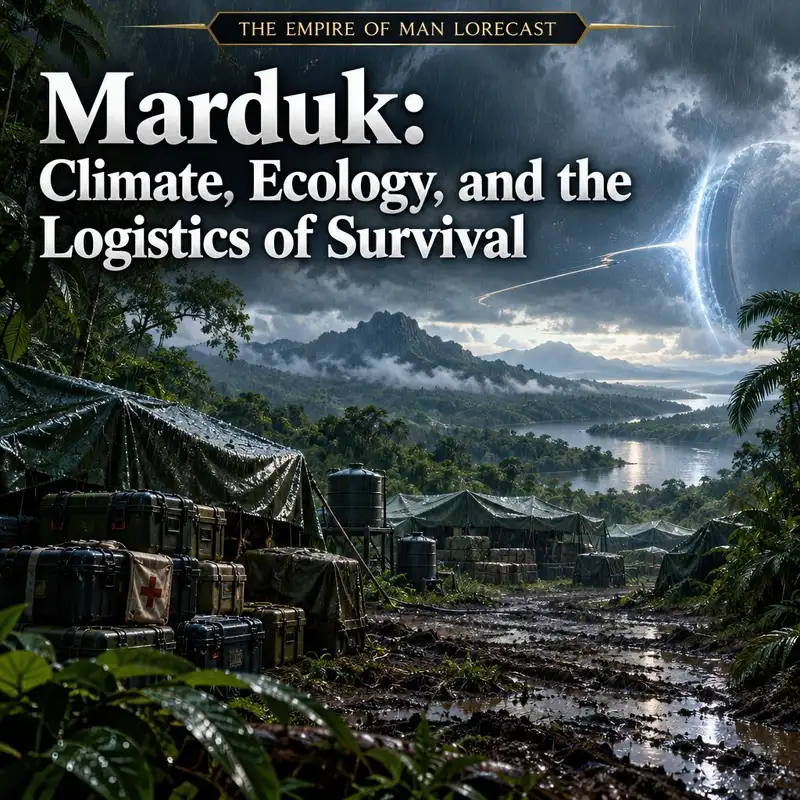
The first useful description of Marduk was also a warning that the expedition did not yet understand its problem. The survey brief described a world with a median temperature near thirty-three degrees Celsius, humidity close to ninety-seven percent, slightly heavier gravity than Earth, and relatively little seasonal relief. On paper, that meant heat, rain, and difficult marching. In practice, it meant that almost every human system arrived with an enemy already inside it. Armor trapped heat. Electronics faced damp and corrosion. Food stores had to bridge an uncertain biological gap. Weapons consumed ammunition and power that could not be replaced. Water was everywhere, but safe and controllable water was not.
That distinction became decisive after the destruction of the Charles DeGlopper mission. Bravo Company had begun as part of an elite protective force. Its duty was to keep Prince Roger MacClintock alive while he traveled under Imperial protection. After the sabotage, that duty did not disappear. It became harder. Roger remained a dynastic asset whose death could alter the politics of the Empire, but the force responsible for him had lost its ship, its base, its supply chain, and any reasonable expectation of quick rescue.
The new objective was brutally simple to state and difficult to execute. The survivors had to cross an unfamiliar world to reach a distant spaceport, seize or secure the means to leave, and do it before their supplies, people, and options ran out. Captain Armand Pahner commanded Bravo Company’s military response. Sergeant Major Eva Kosutic translated broad intent into load plans, discipline, and field readiness. Eleanora O’Casey provided scientific and cultural interpretation. Kostas Matsugae brought skills that would prove as necessary to survival as any weapon. Roger was the person they had to protect, but he was not the expedition’s sole source of judgment or labor.
This was not a conventional deployment to a difficult planet. A conventional force expects reinforcement, evacuation, intelligence updates, spare parts, and some line of retreat. Bravo Company had none of those in reliable form. It was stranded inside its own area of operations. Every step forward had to serve two purposes at once. It had to preserve the company today, and it had to preserve enough of the company to reach the spaceport later. Marduk’s climate and ecology turned that balance into the central military problem of the campaign.
The Type Three classification in the initial briefing conveyed that Marduk belonged to a known category of difficult inhabited worlds. It was not a complete planetary atlas, and the expedition could not treat it as one. The classification did not tell a Marine where a river could be crossed, which food was safe, who controlled a valley, how a local city managed floodwater, or what an animal would do when startled near a camp. It described conditions. It did not solve the consequences of operating inside them.
That gap between data and understanding is one of the most important facts about the march. Intelligence failure is often imagined as total blindness. More often, it is partial vision. Commanders know enough to recognize danger, but not enough to assign reliable probabilities, make detailed maps, or predict what an apparently minor obstacle will cost. Marduk did not surprise the expedition because no one had warned them about heat or predators. It surprised them because heat, predators, water, food, terrain, and local politics did not arrive as separate problems. They arrived together.
The planet’s climate imposed its demands first. Heat slows movement even when no one is sick. High humidity makes the body’s normal cooling process less effective. Rain turns ordinary ground into mud, obscures paths, fills depressions, and complicates the search for dry camp sites. Slightly heavier gravity adds a modest but persistent tax to every load carried uphill, through brush, or across unstable footing. None of those conditions is dramatic by itself. Together, they turn a company’s daily routine into a calculation of exhaustion.
Heat also changed the meaning of equipment. Advanced armor and weapons gave the Marines a formidable advantage over many immediate threats. Yet equipment that is highly capable in a controlled military system must still be carried, powered, cleaned, inspected, and repaired. In Marduk’s wet heat, the force could not think of armor merely as protection. It had to think of it as a heat burden, a maintenance burden, and a reserve asset. There were times when carrying a system made better sense than wearing it continuously. There were times when preserving power mattered more than enjoying the temporary advantage power offered.
O’Casey’s warning about electronics was therefore not a technical footnote. Hot, saturated conditions threatened reliability. Moisture, dirt, corrosion, contamination, and repeated physical shocks created different kinds of risk. A computer might still function while becoming harder to trust. A weapon might remain effective while requiring more careful maintenance. A sensor might provide useful information without offering certainty. The point was not that human technology suddenly stopped working. The point was that its performance could no longer be assumed, and its upkeep now consumed time, skill, and attention that could not be spent elsewhere.
Kosutic’s adjustments to the company’s load logic reveal how quickly this changed field priorities. She did not respond by declaring the equipment useless. She treated power capacity as a serious operational reserve and discarded or reduced what could no longer justify its carriage. That is the unglamorous core of expeditionary command. A unit survives not because it carries everything it might want, but because it identifies what it cannot do without. On Marduk, a power pack was not a convenience. It was potential communications, protection, medical support, and combat effectiveness, measured against weight, risk, and the certainty that no depot waited over the next ridge.
The company also had to make time for maintenance when time itself was scarce. Weapons had to be cleaned. Armor had to be inspected. Wounds had to be treated before heat and moisture made them worse. Clothing and gear needed drying when drying was possible. Camps needed to be chosen not only for tactical defensibility but for drainage, water access, concealment, and some chance of rest. A force that marched all day and ignored those tasks might gain a few kilometers, then lose the ability to fight or move at all.
Rain complicated this problem because abundant water is not the same as usable water. It can be tempting to see a wet world and assume that thirst is solved. The actual question is more demanding. Can water be collected without contamination? Can it be stored? Can it be carried? Can it be distributed to people who need it? Can a camp remain dry enough that the water outside does not become a threat inside? Can a route remain passable after floodwater cuts it, reshapes it, or turns it into a channel of mud?
Mardukan societies had answered those questions long before the humans arrived. Their answers were not merely engineering details. They were woven into political authority, religious practice, agriculture, trade, urban life, and war. Diaspra offers the clearest example. Its people did not simply try to hold water back with a single wall and hope nature respected the arrangement. Their system used channels, holding pools, canals, dikes, and selective inundation. It worked with floodwater, directing it, storing it, and accepting that some ground would flood so that other ground could remain productive and inhabited.
When Diaspra’s aqueduct was cut during the Boman attack, the city did not instantly face a simple choice between drinking water and death. Rain still fell. Water remained abundant in the broader environment. But the destruction of controlled supply disrupted far more than thirst. It damaged routines of distribution, placed strain on rationing, unsettled religious and civic practices, and weakened confidence in the institutions expected to manage a flooded, crowded city. Waterworks were therefore military targets because they were social systems. To damage them was to attack endurance, order, and legitimacy at the same time.
For Bravo Company, Diaspra offered a lesson larger than that particular conflict. The planet’s people were not living on a hostile landscape by accident. They had constructed institutions capable of making that landscape livable. The expedition could observe a canal or an aqueduct, but observation alone could not reproduce the labor network, local knowledge, political authority, and accumulated experience behind it. To survive on Marduk, the humans would need access to such systems. Access, in turn, depended on negotiation, trust, leverage, and the choices of Mardukans who had their own interests.
The ecology posed a second kind of threat. The survey briefing suggested that Marduk’s warmth supported a high proportion of cold-blooded dominant fauna. In the expedition’s initial interpretation, this could permit a greater density of large predators than a comparable environment dominated by large mammalian hunters. Cold-blooded animals require less energy to maintain body temperature, and that difference may allow a large carnivore to occupy a smaller territory than an Earth analogue of similar size. It was a useful field explanation, not a complete science of the planet.
The damnbeast became the obvious example. It was large enough to demand serious attention, closer in scale to a rhinoceros than to a familiar terrestrial predator. Its danger lay not in mystery but in ecology. A large territorial animal does not need a political grievance to attack. It does not send scouts who can be observed, negotiate a boundary, or retreat because a commander has made a persuasive argument. It may be hungry, startled, defending territory, or simply responding according to instincts the humans have not yet learned to read.
That made security a continuous duty rather than something performed only before a battle. A military unit normally studies hostile forces, assesses their motives, identifies likely routes of approach, and anticipates enemy objectives. On Marduk, some threats had no objective beyond survival or predation. Camp security had to account for creatures moving through the dark. March security had to account for brush, water, and terrain that concealed hazards without any human intention behind them. Reconnaissance could reduce risk, but it could not convert the wilderness into a known battlespace.
Other hazards reinforced the point. Vampire moths, crocodilian predators, and dangerous wildlife in different environments could inflict casualties, disrupt movement, damage transport, or simply force the expedition to alter its routine. Such threats should not be treated as a parade of exotic creatures. Their military importance was cumulative. A wounded Marine required treatment and protection. A damaged vessel required repair. A disrupted camp cost sleep. A delay consumed food and power. A wildlife encounter might not decide a campaign, but a campaign made of many small losses can be changed by exactly those events.
Roger’s hunting experience gave him a limited practical role in this environment. His personal rifle was better suited than the Marines’ bead weapons for some encounters with very large animals. That mattered. A protected principal who could recognize a dangerous animal, handle an appropriate weapon, or contribute useful observations was more than dead weight. But it did not make Roger the company’s tactical commander, and it did not transform hunting into a substitute for professional fieldcraft. Pahner and Kosutic still had to organize security for an entire expedition, not merely bring down one dangerous beast.
The ecological problem also exposed the limits of the distinction between enemy action and accident. A soldier killed by a predator is not a casualty of enemy strategy, but the loss is no less real to the unit. Expertise disappears. A friend is gone. Someone else assumes the dead person’s duties. The remaining people carry more weight, stand longer watches, and make decisions while tired. Attrition does not need hostile intent to reshape combat power. Marduk’s wildlife contributed to the campaign because it reduced the margin for error that the company had brought ashore.
Food was another margin the expedition could not afford to misunderstand. A world rich in living things is not automatically a world that can feed humans. Biomass is not nutrition. A plant or animal may contain calories and still lack essential components of a human diet. It may be difficult to digest, unsafe without preparation, seasonally unavailable, politically controlled, or too costly to obtain in the quantities a moving force requires. The Marines could not simply look around at a lush landscape and assume they had entered a well-stocked pantry.
Their own supplies included dietary supplements intended to bridge the biological distance between human needs and alien ecosystems. Those supplements were valuable precisely because local food compatibility could not be assumed. But supplements were finite. They did not create an endless reserve of vitamins, amino acids, oils, and other necessities. They bought time. As the expedition moved deeper inland and farther from resources that had helped support it, including coll oil and accessible coastal food supplies, diet became a logistical problem with strategic consequences.
Matsugae’s contribution belongs at the center of that story. He was not merely responsible for making unfamiliar food tolerable. Preparation, preservation, ingredient selection, and an understanding of what could be turned into usable sustenance are military skills when an expedition has no reliable resupply. A cook who can help convert local resources into food the force can safely use is extending operational endurance. A specialist who understands stores and rationing is helping commanders decide how far they can move, which alliances are worth securing, and when a promising route may become unsustainable.
Advanced medicine could assist with many problems, but it could not simply manufacture a missing diet. Medical support could treat injuries, manage some consequences of exposure, and reduce risks that might otherwise become fatal. It could not turn every alien plant into a balanced human ration. Nor could it restore exhausted stocks by force of technological optimism. The farther the expedition moved, the more clearly food became a matter of route selection, local trade, political access, and the willingness of communities to share, sell, or produce what the humans needed.
That had civilian implications. Food systems are not neutral terrain features. A field, market, fishing ground, oil source, storage house, or herd belongs within a network of labor and authority. People depend on it. Rulers tax it. Merchants transport it. Families survive through it. When an armed expedition needs supplies, even an agreement that appears mutually beneficial may redistribute risk among people with less voice than the rulers making the bargain. Bravo Company could not survive without local support, but its needs could still impose pressure on local communities.
Movement turned all these constraints into one continuous calculation. An observer might imagine that an elite company, equipped with advanced weapons and armor, could simply cover ground faster than the people around it. That image ignores what the company was carrying and whom it was protecting. It had weapons, power systems, medical goods, food, communications equipment, and other supplies that could not be casually discarded. It had wounded when casualties occurred. It had to establish camps, post security, maintain gear, and preserve the ability to fight after arrival. And it had Prince Roger, whose survival remained central to the mission.
The pace of such a force is set by the slowest essential element, not the fastest person. A scout may move quickly. A fit Marine may carry a heavy load. A local guide may know a shortcut. None of that means the expedition as a whole can move at that speed. The wounded, baggage, security needs, terrain, weather, and political requirements of passage all establish the real pace. When a route demanded negotiation, the company could not simply race through it. When rain made ground impassable, discipline could not transform mud into pavement.
This is why detours mattered so much. A detour was not only a change on a map. It meant more food consumed, more power expended, more opportunities for injury, more maintenance, more dependence on guides, and more time for political conditions elsewhere to change. Battles imposed similar costs even when they were victories. Ammunition used in a successful engagement was ammunition unavailable later. A damaged weapon required repair. A casualty evacuation slowed the column. A local alliance won through combat might help solve one movement problem while creating new obligations in another region.
Pahner’s command problem was therefore not merely finding the shortest line to the spaceport. It was finding a route the expedition could survive. The fastest route on a map might demand too much food, cross hostile ground, lack water control, expose the company to ambush or predators, or require equipment the force could no longer afford to wear out. A longer route with allies, transport, workshops, and secure rest points could be operationally superior. Expeditionary warfare often rewards that kind of patience, even when it feels dangerously slow to people who know their supplies are diminishing.
Local knowledge became indispensable because no database could replace lived familiarity with Marduk. Translation systems and language kernels made communication possible. They reduced the first barrier between humans and Mardukans. But translating words is not the same as understanding a landscape or the society that inhabits it. A translated place name does not tell an outsider when the river rises. A rendered title does not explain who truly controls labor. A conversation about food does not reveal which supplies can be spared without endangering a village’s next season.
Mardukan guides could identify routes, hazards, local resources, and political boundaries. Artisans knew what local materials could do and where to obtain them. Sailors understood waters, winds, vessels, and the practical demands of movement by sea. Soldiers understood the terrain in which they had grown up and the rivals they expected to face. Rulers and merchants knew which agreements could actually be enforced. Laborers knew how long a task would take when the work left the drawing board and entered the mud, the workshop, or the dockyard.
None of those people assisted because they had become Imperial subordinates. They had political, commercial, military, familial, and civic reasons of their own. Some saw opportunity. Some sought allies against rivals. Some benefited from trade or access to new techniques. Some judged that cooperation with the humans was safer than opposition. Their choices could align with Bravo Company’s immediate route, but alignment was not obedience. The expedition’s survival depended on recognizing that local partners had agency and that their support could not be demanded as if Marduk were an Imperial colony.
This is where the campaign’s military and diplomatic dimensions became inseparable. A ruler who granted passage might also require military aid. A city that provided food might expect protection. An artisan who helped produce equipment might gain new influence within local politics. A guide’s advice could pull the expedition toward one regional conflict and away from another. Such arrangements were not distractions from the march. They were the means by which the march became possible. Every mile traveled through inhabited territory rested on some form of negotiated relationship.
As high-technology stores declined, the expedition also had to revise its definition of firepower. A bead rifle or plasma weapon might deliver extraordinary immediate effect. Yet a weapon’s military value does not end with what it can do in the first engagement. It includes whether ammunition can be carried, whether power can be conserved, whether the weapon can be repaired, whether trained personnel remain to maintain it, and whether it can be replaced after loss or damage. On Marduk, those questions steadily became more important than raw technical superiority.
The company could not spend its most capable systems as if rescue were guaranteed. It had to preserve enough high-technology capability for crises in which local alternatives could not substitute. That meant discipline in expenditure. It meant deciding when an overwhelming response was justified and when a locally sustainable method was strategically wiser. It meant accepting that a weapon which was less impressive in immediate effect might be more useful over months because its ammunition, components, and training could be supported by Mardukan industry and labor.
This was not a story of human weapons failing and local weapons magically replacing them. The transition was more demanding. Local arms and gunpowder systems had their own limitations. They required materials, skilled labor, storage, training, and doctrine suited to weather and terrain. Rain could affect powder. Manufacturing quality could vary. Artillery and firearms required crews who understood more than the act of firing. But they could be produced, repaired, and supplied within the world the expedition now occupied. Their strategic value lay in sustainability.
The same logic applied to every item of equipment. A piece of advanced gear could be tactically superior yet operationally fragile. A locally made tool could be less sophisticated yet more useful because an artisan could repair it. A human design might improve performance, but a design that local workshops could not reproduce would remain a scarce curiosity. The expedition’s task was not to make Marduk resemble an Imperial arsenal overnight. It was to combine what it had with what Mardukan societies could actually sustain.
Water management revealed why the assumption of human technological monopoly was so misleading. Marduk’s hydraulic demands had encouraged practical specialization. Pumps, aqueducts, flood-control works, canals, and systems of distribution required craftsmen who understood materials, moving parts, pressure, repair, and the organization of labor. A society might not possess every feature of advanced human industry, yet still maintain sophisticated capabilities in the fields its environment made essential.
That local capacity mattered when the expedition sought to adapt and manufacture. Human knowledge could suggest methods, redirect existing skills, or accelerate experimentation. It could not replace workshops, raw materials, labor, local measurement practices, or the political authority needed to assemble all of them. A proposal for improved production remained only a proposal until someone acquired the material, made the tools, trained the workers, inspected the results, and protected the process from disruption.
Technology transfer was therefore not a simple gift from advanced humans to passive recipients. Mardukan artisans had to understand, adapt, and apply what they learned. Local rulers had to decide which projects deserved resources. Laborers had to build and maintain the systems. Soldiers had to train with new equipment. Merchants and administrators had to fit new demands into existing networks. The humans could introduce ideas, but local institutions decided whether those ideas became durable practice or one-time expedients.
There were costs to that process. Workshops and hydraulic projects could shift authority toward the people who controlled skilled labor or access to raw materials. New weapons could strengthen an ally while intensifying local war. New transport capacity could enrich merchants, empower a ruler, or make a city more vulnerable to seizure. The expedition’s immediate need for survival did not erase those consequences. It simply meant that Pahner and the others often had to make decisions before they could know the full political price.
The transition toward maritime movement demonstrated both the possibilities and limits of adaptation. Water transport could expand carrying capacity far beyond what individuals and animals could move overland. It could alter the relationship between distance, cargo, food, equipment, and wounded transport. For an expedition burdened by supplies and constrained by exhaustion, a ship was not just a vehicle. It was a way to move the logistics problem onto a different medium.
The schooners used in this phase were not simply human vessels dropped into an alien setting. Their construction drew upon human design input and Mardukan engineering, labor, materials, and practical knowledge. They had to account for local winds, available timber, cargo requirements, the needs of Mardukan mounts, and the capacities of the people who would crew and maintain them. That combination is important. The ships were products of cooperation under pressure, not proof that one side alone had solved the problem.
Expeditionary urgency imposed compromises. At least one major vessel was built quickly with timber that had not been adequately seasoned. The decision made sense in the immediate context. Waiting for ideal materials could mean losing the opportunity to move at all. But green timber carries risks for durability and maintenance. This is a familiar military tradeoff, whether the setting is a jungle, a desert, or an ocean. A commander may have to choose between a system that is available now and one that would be better later, knowing that later may never arrive.
The sea did not remove Marduk’s ecological danger. It changed it. A large aquatic predator attacking a schooner made the point with painful clarity. Maritime movement reduced some burdens of overland travel while introducing new vulnerabilities involving navigation, weather, hull integrity, crew skill, cargo concentration, and the threat environment of the water itself. A vessel can carry more than a marching column, but it can also lose more in one disaster. A port can provide access, but it can also become a political choke point.
The expedition still depended on local crews, local construction, local waters, and local access. It still had to protect people and supplies. It still had to maintain equipment in a wet environment. The maritime phase was not an escape from Marduk’s logistical logic. It was an adaptation to it. The force had learned that survival required changing methods without surrendering the larger objective of reaching the spaceport.
By this point, the central transformation of Bravo Company was clear. Its elite status remained real. The Marines possessed discipline, technical skill, combat experience, and an initial advantage in equipment that many local forces could not match. Those qualities allowed them to survive the first shocks of the campaign. They gave the expedition time to learn, bargain, reorganize, and respond. But they did not make the company self-sufficient.
Tactically, the force survived through vigilance, disciplined firepower, careful maintenance, and the willingness to adapt. Operationally, it became something larger and more complicated than the unit that had landed. It depended on routes, guides, food systems, workshops, boats, local transport, and allies whose interests could not be reduced to loyalty toward the humans. Strategically, it had to conserve scarce high technology for decisive requirements rather than spending it to maintain the illusion of effortless superiority.
Politically, every alliance and every transfer of knowledge created obligations. Mardukan rulers, artisans, soldiers, merchants, and civilians were not scenery along a human route home. Their decisions shaped what the expedition could build, eat, carry, repair, and defend. Their societies absorbed the effects of war, disrupted labor, altered trade, hydraulic damage, new weapons, and sudden demands for resources. The march could not proceed without entering those systems, and entering them meant influencing them.
Marduk’s greatest military effect was therefore logistical and institutional. Its heat, rain, predators, rivers, food chains, and coastlines steadily stripped away the illusion that superior equipment made a force independent. Bravo Company endured because it learned to manage finite resources, respect environmental limits, and work with Mardukan societies whose knowledge, labor, and political choices governed every mile toward home.