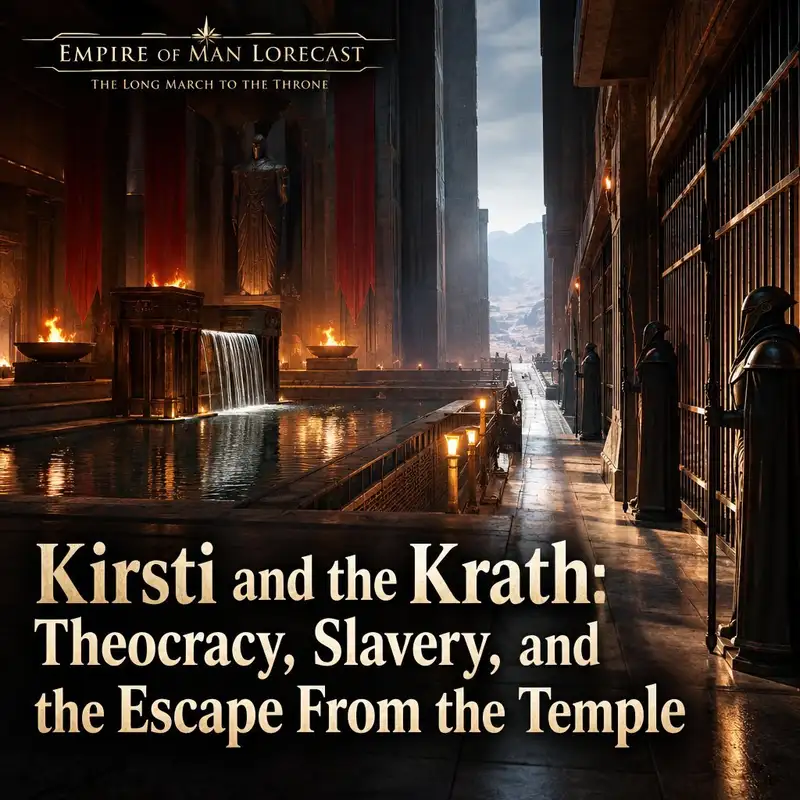
Kirsti and the Krath: Theocracy, Slavery, and the Escape From the Temple
The word on the translator first appeared harmless. The High Priest of Kirsti wanted a Servant of God. In another setting, that might have meant an attendant, a ritual representative, a hostage to guarantee good conduct, or a demand for labor in the temple precinct. Prince Roger MacClintock, appearing under the lesser identity of Seran Chang, Baron of Washinghome, had come to ask for passage. His party was deep within the High Temple. The Krath had soldiers outside, guards close at hand, and control of the city beyond the walls. Then Pedi Karuse heard the demand and reacted with a terror the translation system could not explain.
The problem was not that Pedi misunderstood the Krath. She understood them far too well. The problem was that the humans’ translation kernel had supplied a word that sounded familiar while concealing the institution behind it. A Servant of God was not a religious employee. It was a captive selected for ritual death. The Krath intended to kill the offering, butcher the body, and consume it as part of worship. The request for one person was not tribute. It was a demand that the expedition surrender a human being as temple property.
That realization ended the negotiation. Roger could not trade away a member of his party to buy safety, and Captain Armand Pahner could not permit the protection mission to become a process of selecting which protected person would be abandoned first. The delegation was surrounded in a hostile capital. Their larger force waited near the docks. The Krath had overwhelming numbers, organized armed institutions, and every advantage that came with fighting inside their own city. But the central question had changed. The expedition was no longer trying to obtain permission to move onward. It was trying to avoid becoming captives in a state system built to turn conquered people into resources.
The expedition had reached Kirsti by sea after difficult maritime operations and cooperation with the Lemmar communities. That movement had solved some immediate problems of terrain and distance, but it had not produced a secure strategic base. The survivors of Bravo Company and their Mardukan partners still needed passage, supplies, information, and access to routes they did not control. They were moving through a world of independent powers, local wars, religious authorities, and political systems that had existed long before humans arrived.
A depleted expedition cannot simply decide to bypass every hostile port. Avoiding Kirsti would have meant giving up access to maritime infrastructure, local intelligence, trade, and a practical route forward. It might also have meant moving into less familiar country without food, transport, or reliable knowledge of who controlled the next stretch of coast. The city was dangerous, but it was dangerous in the way that ports, passes, bridges, and river crossings often are. The expedition needed what the place could provide, and the people who controlled the place knew it.
The Krath admitted the visitors, but not as equals with unrestricted freedom of movement. The expedition was kept in a controlled area near the docks while Kirsti’s authorities decided what to do with them. That arrangement gave the humans a temporary foothold and denied them a secure rear area. It also allowed the Krath to observe them, assess their equipment, measure their political value, and decide whether the strangers should be traded with, contained, exploited, or destroyed.
The human force possessed advantages that were real but limited. Its Marines had superior discipline, sophisticated weapons, armor, communications, and a capacity for rapid coordinated action. Yet none of those advantages gave them control of Kirsti. They lacked numerical parity. They lacked a friendly garrison. They did not know every street, gate, guard post, temple corridor, or factional allegiance. Their high-technology ammunition and power reserves were finite. A bead rifle could win a short fight. It could not supply an occupation force, replace a missing platoon, or make an entire hostile city disappear.
Kirsti’s rulers did not govern through one undifferentiated army or a simple priesthood standing apart from the machinery of coercion. Krath authority rested on a partnership, and often a competition, among religious office, military force, internal control, and access to captive labor. The High Priest stood at the symbolic center. He was the formal voice of the Fire Lord and the figure whose office gave sacred legitimacy to the state. But day-to-day power was exercised through institutions with armed men, political interests, and leaders of their own.
The first of those institutions was the Scourge, commanded by Sor Teb. The Scourge was responsible for slave raiding. That description should not be softened into routine border security or simple warfare. Its purpose was the capture of people. It brought prisoners into Krath control, fed the state’s labor system, provided political spoils, and supplied the captive population on which temple ritual depended. The Scourge was therefore both a military arm and an economic instrument. It made the expansion of Krath power materially useful to the people who commanded it.
The second institution was the Sere, led by Lorak Tral. The Sere was the conventional field-army structure. It represented the capacity to fight open campaigns, defend Krath interests, and project force against neighboring powers. Its concerns were not identical to those of the slave raiders. A field army required status, supplies, obedience, and strategic direction. It had its own commander, its own stake in succession, and its own reasons to distrust a rival whose prestige came from raiding, terror, and temple favor.
The third institution was the Flail, associated with Werd Ras. The Flail was the internal-security apparatus. It policed, enforced, watched, and helped maintain the coercive order within Krath territory. In a state dependent on slavery, hierarchy, religious obedience, and elite competition, internal security was not a secondary duty. It was the mechanism that kept fear organized. It protected the ruling structure from dissent, controlled the consequences of factional rivalry, and made certain that sacred authority had practical force behind it.
The commanders of these institutions formed a high council around the aging High Priest. That arrangement gave the Krath considerable strength. They were centralized enough to mobilize force, control a major port, conduct slave raids, and impose their religious-political order on those under their power. But it also created fault lines. Each armed pillar had its own leader, its own followers, and its own interests. A crisis could unite them against an outsider. It could also become an opening for one faction to discredit another.
For the expedition, the most important of those armed institutions was the Scourge. Sor Teb’s raiders exposed what the phrase Servant of God actually meant. A slave system depends on more than individual cruelty. It requires capture, transport, confinement, guards, records or procedures, buyers or users, and people who can profit from the victims’ loss of freedom. The Krath had built such a system into their political order.
The Scourge preyed particularly on neighboring peoples such as the Shin. Raiding did more than collect laborers. It weakened rival communities, disrupted families, reduced the ability of neighboring polities to resist, and advertised Krath power. A captured person could become labor, status property, a bargaining object, or a temple offering. Those categories overlapped because the system was designed to make the captive’s identity irrelevant. A prisoner was no longer treated as a citizen, a noble, a parent, a soldier, or a member of a people with rights and obligations. The prisoner became available to the institutions that held power.
The term Servant of God concealed that transformation. It gave sacred language to a process of political erasure. A captive could be described as serving the Fire Lord, but no meaningful consent was involved. The phrase did not indicate religious vocation. It identified a person who had been stripped of protection and placed at the temple’s disposal.
The horror of the Krath practice lies partly in its organization. The temple did not rely on random violence carried out in secrecy by one isolated priest. There were guards, captive enclosures, priests, elite worshippers, and a structure in which the sacrificial population could be supplied and controlled. Sofu’s escape from the temple slave pens makes this clear. The pens were physical places, guarded places, places from which flight was difficult. The theology had walls, chains of command, and armed protection.
That system had consequences beyond the temple district. Every raid meant communities living under the possibility that people might be taken and never return. Every successful raid rewarded the commanders who carried it out. Every captive integrated into labor or ritual strengthened the institutions that had captured them. The victims were not abstract resources, and the Krath’s neighbors were not simply enemies on a campaign map. They were societies forced to organize their lives around the threat of being harvested by a stronger power.
No one in Roger’s party understood that more directly than Pedi Karuse. Pedi was Shin royalty from Mudh Hemh. She was also a former Krath captive. Her status gave her political importance, but it did not protect her from the system that had taken her. In Kirsti, her identity was dangerous. If the Krath recognized her as Shin nobility, she would become both a security liability and a political prize.
The expedition therefore concealed her in Shadem-style clothing. This was not costume play or a casual disguise. It was a practical attempt to keep a known target from being recognized in the heart of enemy-controlled territory. Her presence could have triggered immediate attention from Krath officials, slave raiders, or temple authorities. It could also have endangered the Shin cause by demonstrating that a royal captive was traveling with the human expedition.
Yet Pedi was not merely someone the Marines had to hide and protect. She was one of the expedition’s most valuable sources of knowledge. She knew what Krath captivity looked like from the inside. She knew the fear behind certain terms and rituals. She understood that the Krath did not use religious language in the same way the humans expected. Her experience was intelligence, but it was intelligence that had to be heard, translated, and believed.
That last requirement mattered. People often imagine that intelligence failures begin with the absence of information. Sometimes they begin with information that is present but does not fit the listener’s categories. Pedi’s alarm was immediate, but the humans initially trusted the translation system’s rendering of Servant. The word sounded comprehensible. It seemed to establish a diplomatic problem that might still be negotiated. Her reaction seemed larger than the apparent demand.
The device was not useless. It had enabled the expedition to communicate across Marduk in circumstances where no human could have learned every language from first principles. But translation is not cultural understanding. A kernel can match vocabulary, grammar, and common usage while failing to carry the full meaning of a political or religious institution. A title can be rendered into a familiar human term and still point to something fundamentally different.
Pedi’s knowledge did not come from an abstract linguistic model. It came from surviving the Krath system. In that moment, her testimony mattered more than the confidence generated by technical translation. Kirsti demonstrated a hard lesson for any expeditionary force operating across cultural boundaries. The person who knows what a word costs may understand more than the machine that can pronounce it.
Eleanora O’Casey and Julian had already done important work in assessing the Krath. Their analysis identified a society that was regimented, politically ambitious, dependent on slavery, and convinced of its own central importance. They understood that the rulers of Kirsti did not see themselves as one local power among many. They expected deference. They expected subordinate peoples to recognize the Krath order as natural, sacred, and authoritative.
The expedition also recognized factional strains inside the ruling structure. Sor Teb was powerful. Lorak Tral and Werd Ras had reasons to distrust him. The High Priest was old and failing. These were significant findings. They meant that the Krath could not be treated as a single mind. A clever diplomat might hope to exploit divisions, gain time from rivalry, or avoid becoming the target of a unified response.
Roger’s response was a small technical act with large consequences. He stopped accepting the Krath translation baseline and used another language reference to test the meaning of the disputed term. Once the semantic frame changed, the demand became clear. The Krath were not asking the foreigners to demonstrate piety. They were asking them to choose a victim for ritual killing.
That correction altered every calculation in the room. Negotiation over passage, payment, or ceremonial obligation might have remained possible. Negotiation over the surrender of a person to be killed could not. The party had delayed long enough for the Krath to choose the ground, gather guards, and shape the situation. But it had also finally identified the threat. The mission had become an escape operation.
Sor Teb had helped make that transformation inevitable. He was more than a temple official with armed retainers. As commander of the Scourge, he was a feared slave raider, a member of the high council, and a contender in the approaching succession struggle. The failing condition of the High Priest created a political opening. Whoever could claim favor, demonstrate strength, and present himself as the defender of sacred order might gain decisive advantage.
The arrival of humans gave Sor Teb an extraordinary opportunity. These strangers were not merely rare captives. They were visibly different, heavily armed, and associated with stories of exceptional power. If he could bring them before the Fire Lord as offerings, he would gain prestige as the man who had delivered an unprecedented gift to the temple. If he could force them to submit, he would show that even such outsiders could be absorbed into the Krath order.
His offer of a choice was therefore coercive theater. Give up one member of the party, he implied, or all of you will be taken. The proposal was designed to make the expedition participate in its own subordination. If Roger selected a victim, the Krath would have demonstrated not only their power to kill but their power to compel foreigners to recognize that power as legitimate.
Sor Teb’s motives were both religious and political. That combination made him dangerous. He did not have to be a simple fanatic to believe in the value of sacrifice. Nor did he have to be insincere in order to use the ritual for personal advancement. In a system where sacred authority, slave-raiding, and succession politics reinforced one another, an act of worship could also be a bid for office.
The volcanic eruption over Kirsti sharpened the pressure. Ash and darkness transformed the city’s atmosphere and gave religious leaders a visible sign they could interpret as the Fire Lord’s anger. The eruption did not create the Krath system, but it intensified a crisis already present within it. For an aging High Priest and ambitious council members, the omen could not be ignored. The arrival of strange foreigners at such a moment became politically combustible.
Lorak Tral and Werd Ras were not friends of the expedition simply because they distrusted Sor Teb. Their rivalry with him reflected their own institutional interests. Tral commanded the Sere and could see opportunity in any event that weakened a slave-raiding rival. Ras, responsible for internal security, had to consider the danger of disorder, blame, and elite fragmentation. The human delegation was not outside Krath politics. It had become an object over which Krath leaders could compete.
Once the party understood the actual meaning of Servant of God, Captain Pahner’s preparations became decisive. Pahner had responsibility for Bravo Company’s operational command and for the protection of Roger. That did not mean he replaced Roger as the political figure in the temple audience. Roger had to refuse the demand. He had to make clear that no member of his party would be surrendered. But Pahner had to prepare for what refusal would produce.
The expedition’s tasks divided naturally. Roger confronted the political ultimatum. Pahner managed the wider problem of extraction, movement, and reunion with the force near the docks. Sergeant Major Eva Kosutic and the Marines assessed immediate threats, maintained discipline, and translated danger into action. Mardukan allies brought manpower, local knowledge, and their own combat experience. They were not Imperial subordinates, and their reasons for fighting were not identical to those of the humans. But their survival and political future were now tied to the breakout.
The mission was not to conquer Kirsti. It was not to destroy the Krath state, seize its port, or liberate every captive in the temple district. A small, depleted expedition could not accomplish those tasks, and attempting them would have consumed the resources needed to reach the spaceport. The mission was narrower and more urgent. Preserve Roger. Recover the delegation. Rejoin the main body. Open a route out of the city. Get into ground where the Krath’s numerical advantage would be less decisive.
The plan accepted that people might be wounded or killed. There was no clean option. Remaining inside the temple meant captivity, sacrifice, or destruction. Attempting a breakout meant fighting through a city controlled by a hostile state. Pahner’s task was not to make the danger disappear. It was to choose the danger that preserved a chance of continuing the mission.
Inside the High Temple, the delegation saw the institutional reality hidden behind the translated word. The place revealed a system of systematic ritual murder and consumption. The sight mattered because it removed any remaining possibility that the Krath demand had been misunderstood as merely harsh ceremony. The temple was not asking for symbolic submission. It had prepared a real human being to die.
The response was immediate. Roger’s bodyguards and the accompanying Mardukan troops engaged the temple guards. The Marines used their remaining high-technology firepower where it could break resistance quickly, but close combat became unavoidable within the complex. Confined spaces reduce some of the advantage of superior ranged weapons. They also compress confusion, fear, and command decisions into seconds.
Pedi reached the High Priest and killed him. Her action had a personal dimension, because the Krath system had enslaved her and threatened to consume others as it had consumed so many captives before. But it was not merely revenge. By killing the High Priest, Pedi removed the formal religious head of the Krath state at the instant when succession was already uncertain. Her act turned a dangerous extraction into a political rupture.
It did not, however, destroy the Krath system. The Scourge, the Sere, and the Flail remained. Their commanders retained their followers, weapons, rivalries, and ambitions. The priesthood had lost its highest visible figure, but the institutions that enforced Krath rule had not vanished with him. In some ways, his death made the situation more dangerous, because it created a vacuum that armed factions would race to fill.
Sor Teb escaped. That mattered more than any simple count of guards killed in the temple corridors. A surviving commander of the Scourge could still mobilize troops, control captives, influence the narrative of the crisis, and direct revenge against the expedition and its allies. He could present himself as the man betrayed by foreigners, endangered by rival incompetence, or denied the sacred victory that should have been his. The human force had escaped ritual captivity, but it had not removed one of the Krath state’s most capable and ambitious coercive leaders.
The temple, moreover, was not the exit. The expedition still had to leave Kirsti. City gates had been closed or secured against them. The main operational challenge became movement through an urban environment where hostile guards could block routes, crowds could complicate action, and every delay increased the risk of encirclement.
The objective was the gatehouse. The expedition did not need to annihilate Krath forces throughout the city. It needed to reach, seize, open, or otherwise overcome the mechanism that controlled its escape route. That is a different kind of urban fight. Success depends less on clearing every building than on maintaining momentum, keeping the force together, preventing pursuers from fixing it in place, and holding the route long enough for the wounded and slower elements to pass.
The Marines’ cohesion and speed of decision partly compensated for their inferior numbers. They could concentrate force at critical points, communicate rapidly, and exploit the confusion caused by the temple crisis. But no amount of discipline erased the city’s size or the Krath’s local advantage. Every blocked street, armed guard, or panicked movement threatened to slow the withdrawal. Every casualty imposed a burden on medical capacity, transport, command attention, and future combat strength.
Cord’s severe wound while protecting Roger illustrates the cost of the mission. The protection duty was not an abstract statement of loyalty. It meant that individuals took physical risks to keep the prince alive when the situation collapsed around them. A serious wound was more than a reduction in headcount. It required care, slowed movement, consumed supplies, and removed experience from a force already shaped by attrition. The expedition could not afford to treat wounded people as numbers, but neither could it ignore the operational consequences of carrying them onward.
The Mardukan allies were essential in this phase. Their contribution was not decorative support for a human action scene. They had their own reasons to fight. Some faced the Krath as enemies of their peoples and communities. Some understood the local terrain and political stakes better than the humans did. Some were bound to Roger’s force by alliances formed in earlier campaigns. Their willingness to stand in the breakout expanded what the expedition could do, but it did not make them mere extensions of Bravo Company.
The fight also unfolded among civilians. Kirsti contained priests and guards, but also worshippers, workers, merchants, captives, and families. The record does not establish a precise civilian casualty count, and no responsible reconstruction should invent one. But neither should the city be treated as empty terrain. An urban breakout passes through a living population, including people who may support the regime, fear it, profit from it, endure it, or simply be trying to survive the day.
The expedition used fire to create the separation it needed. White-phosphorus grenades, burning oil, and spreading flames delayed pursuit through the temple district. Their tactical purpose was clear. Fire could block routes, disrupt coordination, force guards to choose between pursuit and containment, and buy time for a force carrying wounded personnel toward the gates.
But incendiaries are not clean instruments. The fire threatened more than armed pursuers. It spread through a district that included sacred buildings, property, enslaved people, and civilians whose relationship to Krath rule could not be assumed from a distance. The expedition had not liberated Kirsti. It had opened a gap in a hostile city and used that gap to survive.
Once the expedition reached the hills beyond Kirsti, the immediate encirclement had been broken. The Krath could no longer use city walls, temple authority, and dense urban control to hold the humans in place. But the escape did not end the crisis. It moved the crisis outward, into Krath succession politics and the wider conflict with the Shin.
The death of the High Priest created a vacancy at the center of the state. Sor Teb had been damaged by the disaster. He had failed to control the human delegation, failed to secure the sacrifice that would have elevated his status, and allowed the High Priest to be exposed at the moment of confrontation. His rivals had every reason to blame him. Yet he remained dangerous because he still commanded the Scourge. A disgraced leader with armed followers and access to a slave-raiding institution is not a finished political actor.
Lorak Tral saw opportunity in the disorder. As commander of the Sere, he could use the crisis to weaken Sor Teb and direct attention toward the Shin. The human escape and the death of the High Priest were not simply embarrassments. They were events that could justify broader military action, settle internal accounts, and reshape the regional balance of power. A regime under stress often looks outward for enemies, especially when its leaders need to turn uncertainty into mobilization.
Werd Ras and the Flail faced a different but related problem. Internal security had to manage fear, blame, rumors, and the possibility that elite competition would become open fragmentation. The flight of the human expedition demonstrated that the Krath state could be challenged in its own sacred center. The death of the High Priest demonstrated that the office was vulnerable. The escape of captives and outsiders threatened the image of total control on which such systems depend.
The breakout therefore became a catalyst for wider war. It did not overthrow the Krath. It did not end the Scourge’s raids or empty the temple pens. It did not settle the succession. What it did was expose a contradiction inside the system. The Krath claimed an order so sacred and powerful that foreign strangers could be converted into offerings. Instead, their attempt at coercion killed their High Priest, damaged a leading contender, and set competing armed institutions in motion against one another.
Pedi Karuse was central to the escape for that reason. Her knowledge did not come from superior equipment, formal command, or a political briefing. It came from being a survivor of the system the expedition was trying to understand. Her warning exposed the limits of the humans’ technology. Her presence revealed the political danger of Kirsti. Her action against the High Priest transformed the city’s crisis into a succession emergency.
The expedition escaped not because advanced weapons made it invulnerable, but because it recognized the real demand before surrender became possible. Roger refused the moral and operational premise of the Krath ultimatum. Pahner coordinated withdrawal rather than chasing an impossible conquest. Kosutic and the Marines preserved discipline in a collapsing situation. The allied Mardukans fought as partners with their own stakes in the outcome. The force conserved irreplaceable power where it could, accepted close combat where it had to, and chose a costly escape over the illusion of safe accommodation.
That was the meaning of Kirsti. On Marduk, survival depended on more than defeating immediate enemies. It depended on recognizing the systems that made those enemies dangerous, and refusing to let the language of power disguise what power was asking people to become.