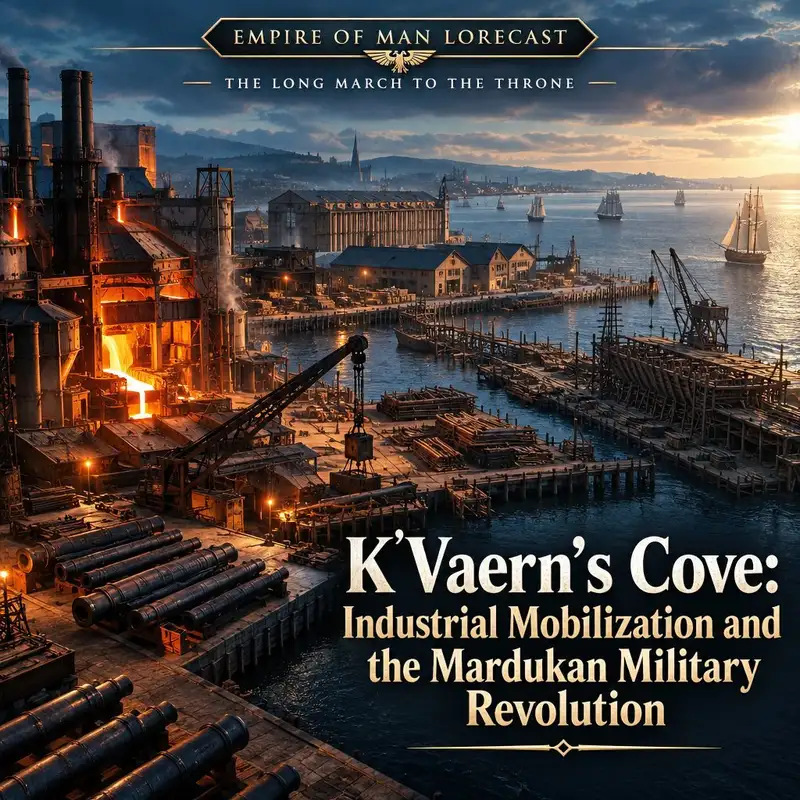
K’Vaern’s Cove: Industrial Mobilization and the Mardukan Military Revolution
An interstellar Marine expedition found itself preparing for war with tools that would have been familiar to any city threatened by siege: guards at granaries, fixed food prices, labor rolls, workshops, riverworks, pack animals, and men drilling with pikes. The apparent contradiction is the point. Bravo Company still possessed weapons beyond anything Marduk could manufacture, but those weapons were finite. Power packs ran down. Ammunition disappeared into training, hunting, accidents, and combat. Equipment suffered from water, heat, mud, corrosion, and battle damage. The expedition’s strategic problem was no longer how to display technological superiority. It was how to remain militarily useful after that superiority became impossible to replace.
The distant spaceport remained the route home, but the route now ran across an ocean. That made K’Vaern’s Cove important long before the Marines reached its docks. The city was one of the strongest maritime and commercial powers available to them, with shipyards, workshops, trade connections, and the political habits of a place accustomed to turning material resources into advantage. But K’Vaern’s Cove was not waiting at the end of a clear road. Boman-controlled territory lay between the expedition and the coast. Before the Marines could use K’Vaernian ships or manufacturing, they and their Mardukan allies had to survive the war that made those assets necessary.
The first laboratory for that survival was Diaspra. To outsiders, a Mardukan city could look preindustrial, even static. That impression missed the systems already operating beneath its walls. Diaspra possessed productive agriculture, managed water, organized religious institutions, workshops, specialists, and a labor force that could be identified, assigned, and directed. Its farming benefited from turom, crop rotation, nitrate distribution, and repeated harvests. That agricultural productivity supported a substantial urban population and created labor beyond the immediate needs of planting and harvesting.
Yet abundance was not the same as readiness. Diaspra’s systems had evolved to sustain civic life, temple life, and hydraulic maintenance. They kept canals clear, dikes sound, fields productive, and religious institutions functioning. They were not designed to support a sudden field army facing a major invasion. A city can have food, workers, tools, and skilled artisans, and still lack the means to turn them quickly into military power. The conversion required political authority, administrative information, trusted local leaders, and a willingness to accept costs that would otherwise be unthinkable.
Captain Armand Pahner understood the immediate problem with professional clarity. A force that cannot eat cannot drill, march, build, or fight. Food is not merely a civilian concern that armies inherit from someone else. It is one of the first inputs of military power. When the Boman threat tightened around Diaspra, the city faced pressures familiar to every threatened market. Merchants could hold supplies for higher prices. Households could hoard. Bulk vendors could favor private customers. Panic could turn stored grain and preserved food into private insurance rather than public survival.
The response was direct and coercive. Granaries required guards. Prices required control. Rations had to be organized, and the movement of bulk food had to be watched. These measures were not glamorous, and no one should mistake them for a technical triumph. They imposed hardship on consumers, limited merchants’ freedom, and placed armed authority inside the market. But the alternative was worse. Inflation and hoarding could dissolve the city’s capacity to field a defense before the Boman ever reached its prepared positions.
The most dramatic labor decision involved the Laborers of God. Diaspra had more than four thousand workers organized through district responsibilities and religious service. That organization mattered as much as the raw number. A city cannot make useful soldiers simply by gathering thousands of people in a square and handing them weapons. It needs a way to identify who is available, who has relevant skills, who belongs to which neighborhood, who can be supervised, and who can be supplied. The Laborers of God already existed within such a structure.
They could therefore be redirected into the Warriors of God with a speed that would have been impossible in a less organized society. General Bogess and Sol Ta helped convert existing authority, guard experience, and labor discipline into military organization. The result was not a professional army in the Imperial Marine sense. It was a force assembled under emergency conditions, using local social structures to create units that could receive training, occupy positions, carry supplies, and hold together under pressure.
The cost of that mobilization was real. The workers taken from temple and civic duties did not stop being necessary because the Boman were approaching. Dikes still needed repair. Canals still required attention. Agricultural systems still depended on labor. Religious institutions lost personnel and routine. Deferred maintenance has a habit of returning later as flood damage, food losses, disease, or political resentment. Diaspra’s leaders accepted those risks because invasion presented a more immediate danger. But wartime mobilization did not make the underlying work vanish. It shifted risk from the battlefield into the city’s future.
Pahner’s initial force design reflected those constraints. The Marines could not hand Diaspra an advanced human arsenal, nor could they train an entire army to Marine standards in the available time. The practical question was simpler and harder: what force could Diaspra actually build, train, feed, and sustain before the enemy arrived? The answer was a layered formation built around weapons and roles that local workshops could support.
Shields and assegais remained useful because they could be produced in quantity and employed by troops with limited training time. Pikemen offered a disciplined response to mounted threats and massed assaults. Civan-mounted cavalry added mobility, reconnaissance, pursuit, and the ability to exploit opportunities beyond the reach of foot formations. Existing firearms were retained where they could be used well. This was not a rejection of firearms, and it was not nostalgia for older weapons. It was a recognition that a weapon only matters when it fits the terrain, the climate, the supply system, and the training base.
The resulting army was neither ancient in some simple Earth sense nor modern in the way a listener might imagine from the word mobilization. It was a wartime combined-arms force, assembled from what Mardukan society could provide and what the Marines could help organize. Different weapons covered different problems. Pikes stabilized a position. Shields protected troops during movement and close action. Mounted forces extended reach. Firearms and artillery could concentrate lethal force where terrain and preparation allowed. None of those elements was sufficient alone. Together, they gave Diaspra a defense more flexible than a mass of untrained levies and more sustainable than a small group armed entirely with irreplaceable human weapons.
The limitations of the local firearms were especially important. Diaspran matchlocks could be effective from prepared positions. A protected firing line with dry powder, disciplined crews, and a known field of fire could inflict serious damage. But Marduk’s climate punished any weapon system dependent on exposed black powder, vulnerable ignition, and meticulous maintenance. Rain, humidity, mud, and corrosion all worked against reliability. Powder fouled weapons. Dampness spoiled it. A matchlock that could serve a defender behind cover was far less useful to a force expected to move quickly through wet terrain, react to ambush, or fight through a long field campaign.
That was not a failure of courage, and it was not proof that Mardukan gunners were incapable. It was a material problem. Black-powder weapons demand dry storage, consistent ammunition, maintained barrels, trained handling, and procedures that account for weather. A weapon that works on a range or from a fortified wall may still fail as a general-purpose infantry arm. The Marines had learned, often painfully, that their own equipment also had environmental limits. Marduk did not care whether a system had been designed by an interstellar empire or by a city workshop. It degraded whatever was not maintained.
The critical intellectual move came from Eleanora O’Casey. She looked past the immediate question of whether a city possessed firearms and asked what it could actually manufacture. Her answer began with pumps. On a rain-heavy world, hydraulic engineering was not a luxury. Water had to be moved, controlled, removed, and managed. That need had produced more than practical irrigation knowledge. It had driven Mardukan craftsmen toward machinery requiring accurate work, durable materials, and repeatable parts.
An impeller pump is not a rifle, but it demands capabilities that can lead toward rifle manufacture. It requires shafts that turn true, housings that fit, components that resist corrosion, moving parts that do not seize immediately, and tools capable of shaping metal with precision. It rewards workers who understand lathes, drills, springs, alloys, and tolerances. It also requires a network behind the workshop: sources of metal, fuel for furnaces, transport, customers able to pay, and artisans accustomed to solving mechanical problems through repeated production rather than one-off craftsmanship.
Marduk did not possess electricity or a complete modern materials science. Its workshops could not simply reproduce every component of an Imperial weapon. But the absence of a modern industrial system did not mean the absence of industrial foundations. Diaspran engineers and artificers had developed machine steel, useful bronze and brass alloys, animal-driven tools, and habits of precision work because their society needed them. The Bishop of Artificers, Rus From, represented an established technical tradition, not a sudden human invention.
This was the deeper significance of O’Casey’s diagnosis. Industrial capacity is not a building called a factory, and it is not a blueprint stored in one person’s computer. It is a web of skills, tools, material knowledge, labor discipline, commercial relationships, maintenance practices, and institutions capable of preserving what they learn. A workshop can produce one impressive prototype and still be unable to arm an army. A city can copy a design and still lack the coal, timber, copper, barrels, powder, transport, or trained operators required to put that design into the field.
Diaspra demonstrated the first half of the problem. It had food, labor organization, hydraulic competence, and a capacity for emergency administration. It could produce an achievable defense. But it was not the ideal place to scale a maritime war economy. For that, the expedition needed K’Vaern’s Cove. The city’s importance came from the combination of its workshops, trade, shipbuilding, capital, and practical willingness to exploit opportunity.
Comparisons to old Earth maritime powers can be useful if handled carefully. K’Vaern’s Cove resembled places such as Carthage or Venice only in the limited sense that it was a commercial and naval center whose influence depended on trade, skilled production, and access to the sea. The comparison should not be pushed further. K’Vaern was a Mardukan polity with its own institutions, interests, rivalries, and material conditions. It was not a human republic in costume, nor was it simply a port waiting for the Marines to tell it what to become.
Its leaders and merchants had reasons to embrace innovation that went beyond gratitude toward the expedition. The Boman threat endangered trade routes, coastal security, workshops, inventories, and political independence. New weapons and military techniques promised survival. They also promised advantage. A merchant who financed production could gain influence. A shipbuilder who mastered new techniques could gain contracts. A guard commander who fielded more effective troops could strengthen his city’s position. Technical knowledge could become a source of leverage in the competition among Mardukan powers.
That made K’Vaern’s Cove an ally, not a subordinate. The Marines could advise, train, and bargain. They could not simply requisition its people, workshops, ships, or wealth as though they were Imperial assets. Prince Roger’s status carried weight, but it did not erase local sovereignty. Pahner remained responsible for the expedition’s survival. K’Vaernian authorities remained responsible for their own city. The partnership worked because their immediate interests overlapped, not because the humans possessed a universal right to command.
The Boman made that overlap urgent. Access to K’Vaernian capacity required movement through a contested region. Industrial policy and operations therefore became inseparable. A city’s workshops could not aid the expedition if the routes to those workshops were cut. Ships could not carry the force across the ocean if the coast fell or if a hostile army prevented the coalition from reaching the harbor. The Marines were not choosing between fighting a war and building an industrial base. They were fighting because the industrial base was part of the route home.
The rifle program that emerged at K’Vaern’s Cove shows how this partnership worked. Its starting point included Roger’s Parkins and Spencer, Marine technical knowledge, surviving electronic components, and the practical requirements of a world that could not reproduce Imperial manufacturing. The goal was not to copy a human weapon component by component. That would have been impossible. The goal was to create a rifle that used Mardukan materials, Mardukan machine tools, Mardukan labor, and Mardukan supply systems while retaining enough of the human design’s advantages to matter in battle.
Dell Mir was central to that work as an inventor and practical adapter. His contribution should not be reduced to a story in which one gifted local artisan suddenly discovers modern firearms. He worked within a collaborative system. The human weapons provided examples and technical direction. The Marines brought their understanding of field use, maintenance, and military requirements. Roger’s weapon offered a reference point. Salvaged electronic firing components could help where they remained available. Mardukan workshops provided the actual ability to shape steel, fit wood, machine components, and make repeated production possible.
The resulting rifle employed a modified bolt action adapted to local capability. It used locally workable steel and wood. It depended on black powder rather than the advanced propellant systems of Imperial weapons. Its design had to account for what workshops could reliably make, what soldiers could maintain, and what ammunition producers could supply. That last point was crucial. A weapon is not truly fielded when it leaves the workshop. It is fielded when units can receive ammunition, clean it, repair it, train with it, and use it without destroying their own effectiveness.
The production challenge extended to the projectile. Imperial ammunition depended on manufacturing methods and materials that K’Vaernian workshops could not simply reproduce. The allies therefore developed compressed copper jackets using techniques related to existing pump manufacture. That solution was not glamorous, but it was historically important. It linked a military requirement to an existing technical tradition. Rather than asking local artisans to recreate an entire alien industrial chain, the program found a method that built on skills they already possessed.
The K’Vaernian rifle possessed a strategic advantage that the Imperial weapons did not. It could be made again. A bead rifle might be far better in a single engagement, but every expended round brought the expedition closer to a point where no replacement existed. A locally produced rifle was less capable weapon for weapon, yet it could be repaired by local artisans, supplied by local powder makers, carried by local soldiers, and expanded across a growing allied force. That made it a military instrument rather than a relic of a lost supply chain.
The distinction applied to more than rifles. Artillery required metal, powder, crews, transport, and doctrine. Pikes required timber, metalwork, training, and discipline. Shields required materials and craftsmen. Cavalry required animals, handlers, forage, and command arrangements. Ammunition required standard measures, storage, transportation, and quality control. Every weapon system drew on civilian labor and civilian resources. The military revolution at K’Vaern’s Cove was not a single invention. It was the creation of relationships among workshops, supply networks, training systems, officers, merchants, and political authorities.
The Marines supplied indispensable expertise, but their manpower was shrinking. They could not personally train, lead, and equip every Mardukan formation required by the widening conflict. Their real contribution was to accelerate the development of local capacity. Sergeant Major Eva Kosutic and the other Marines taught discipline not as parade-ground display, but as a survival tool. Troops had to know where to stand, when to fire, when to hold, when to withdraw, and how not to dissolve into panic or uncontrolled pursuit. Firepower without control merely wastes ammunition and creates confusion.
Local leadership became equally important. Krindi Fain and Erkum Pol illustrate how Mardukan officers and small-unit leaders developed through instruction, responsibility, and combat experience. Their growth mattered because an allied army could not depend forever on human voices at every point of decision. Bistem Kar, the commander of K’Vaern’s Guard, represented another form of local competence. He was not a Marine proxy in Mardukan armor. He was an experienced K’Vaernian officer who embraced useful innovations while retaining responsibility to his own city and command structure.
This was a coalition military system, and coalition systems are never frictionless. Human doctrine had to be translated not only into Mardukan language, but into Mardukan institutions. A command arrangement that made sense to Bravo Company might not fit a local guard, a civic militia, a religiously organized labor force, or a merchant-financed military effort. The Marines could demonstrate why a formation needed reserves, why a firing line required ammunition discipline, or why a retreat could be controlled rather than shameful. But Mardukan leaders had to decide how to apply those lessons within their own societies.
The fighting around Sindi demonstrated what the new system could achieve when its parts worked together. The significance of Sindi was not that a new rifle appeared and settled the battle by itself. The coalition prepared terrain. It established killing zones. It used artillery, mines, disciplined withdrawals, cavalry, rifle fire, and formations capable of holding under pressure. Each element gave value to the others. Artillery shaped movement. Obstacles and mines disrupted attacks. Prepared positions allowed rifle fire to concentrate. Controlled withdrawals drew attackers into unfavorable ground. Cavalry exploited disorder where mobility mattered.
That kind of operation cannot be improvised by issuing weapons on the morning of battle. It requires reconnaissance, engineering, labor, ammunition, command discipline, and confidence between units. It also requires leaders who understand that a withdrawal may be part of the plan, not evidence of collapse. The Boman assault suffered because it confronted a defense prepared to turn material resources into coordinated effects. The decisive force was not simply the projectile, the cannon, the pike, or the mine. It was the system that allowed those tools to be employed together.
Even then, victory at Sindi did not end the wider strategic problem. It did not erase the Boman threat. It did not create unlimited ammunition. It did not transform every Mardukan ally into a unified army under human command. And it did not remove the need to reach K’Vaern’s Cove, secure ships, and cross the ocean. Tactical success opened possibilities. It did not complete the expedition’s mission.
The later presence of K’Vaernian-built rifles and ships confirms that the mobilization produced durable field results. The weapons were not merely experimental devices tested once and discarded. They entered the campaign, with all their limitations intact. Their continued use demonstrated that the key achievement was repeatability. Mardukan workshops had learned enough to make weapons that could accompany an army, not just impress a visiting Marine. K’Vaernian maritime capacity likewise became part of the expedition’s movement toward the sea, though its ships and crews remained products of their own world rather than copies of a human navy.
The tactical consequences were clear. Allied forces gained more effective and more sustainable firepower. They could build defenses around weapons whose ammunition did not depend entirely on Bravo Company’s dwindling reserves. They could combine rifles and artillery with pikes, cavalry, fortifications, and local knowledge. The human Marines remained disproportionately important in reconnaissance, training, command judgment, and difficult combat. But the coalition’s ability to fight no longer rested exclusively on a tiny force carrying technology it could not replace.
The operational consequence was equally important. Diaspra could defend itself more effectively. K’Vaern’s Cove could contribute manufacturing, finance, and maritime resources. The expedition could move through a war zone with allies capable of carrying more of the burden. That did not make the route safe. It made the route possible. A company-sized human force could influence events, but it could not conquer or administer the territory between itself and the sea. It needed allied armies, local supply, regional knowledge, and governments willing to commit their own resources.
Strategically, industrial mobilization created the bridge between survival on land and movement by sea. The spaceport remained far away. The expedition’s long-term objective had not changed. What changed was the coalition’s ability to generate the tools required for the next phase of the journey. K’Vaern’s Cove mattered because it could build ships, sustain trade, manufacture weapons, and assemble the economic resources that an ocean crossing demanded. Without those capacities, the Marines might have reached the coast only to discover that the final barrier was beyond their means.
That process also created risks. Improved weapons could protect Mardukan societies from the Boman, but they could later intensify conflicts among those same societies. A technique introduced for an emergency could spread beyond the original alliance. A merchant who profited from military production might favor continued armament. A city whose guard gained stronger firearms and artillery might seek advantages against neighbors. The humans could help launch the process, but they could not control every consequence after they moved on.
The political effects were similarly mixed. K’Vaernian merchants, military officers, technical specialists, and civic leaders all had reasons to support the new system, but those reasons were not identical. Survival, profit, prestige, local autonomy, and influence could pull in the same direction during a crisis. They might pull apart after the crisis. Diaspra’s emergency controls demonstrated the same problem at a smaller scale. Rationing and labor mobilization could preserve the city, but they also expanded the reach of authorities into food, work, trade, and daily life.
Civilians bore much of the immediate cost. Their food supplies were regulated. Their labor was redirected. Their workshops shifted from ordinary production to military demand. Their roads, animals, stores, and ships became part of a wartime logistics system. Families lived with the consequences of workers leaving normal duties for military training and defense. Cities that survived did so partly because civilians accepted or endured extraordinary demands. They were not spectators standing behind heroic soldiers. They were the productive base from which the soldiers, weapons, and transport emerged.
There is also a moral limit to any celebration of military innovation. The coalition had compelling reasons to defend itself against invasion. The Boman threat was not an abstract policy problem. It was an immediate danger to cities, populations, and the expedition itself. But necessity does not make all consequences benign. The expansion of powder weapons, artillery, organized military production, and wartime administration changed the scale at which Mardukan polities could fight. The same machinery that enabled defense could enable future coercion, conquest, and repression.
That is why K’Vaern’s Cove should not be described as a completed industrial revolution. The available record shows a wartime acceleration, not a settled transformation of every part of Mardukan society. There was no sudden modern state, no universal system of interchangeable parts, and no guarantee that new knowledge would spread evenly or peacefully. Production remained constrained by materials, climate, skilled labor, transportation, financing, and political choice. The alliance created capabilities. It did not solve every social problem behind those capabilities.
It also should not be described as a story of humans modernizing passive Mardukans. The Marines brought pressure, examples, training, standards, and technical insight. Those contributions were vital. But a design held in a Marine’s memory could not feed an army, operate a lathe, cast a barrel, make powder, build a ship, organize a market, or persuade a city to assume the risks of war. Mardukan laborers, artisans, merchants, officers, rulers, and soldiers performed those tasks. They did so for their own reasons, within their own institutions, and with their own lives at stake.
The decisive weapon at K’Vaern’s Cove was therefore not the rifle alone. It was the ability to connect agriculture to rationing, labor rolls to drill, pumps to machine tools, workshops to ammunition, merchant capital to shipbuilding, and local authority to coalition command. A rifle could be copied once. Military power required that it be made again, carried by trained troops, supplied in the rain, integrated with other arms, and supported by a society willing to bear the cost.
That is why K’Vaern’s Cove mattered to the march. It proved that the expedition’s survival could not rest forever on the remnants of Imperial technology. The Marines accelerated a transformation under extreme pressure, but the transformation succeeded because Mardukan societies already possessed the capacity to learn, organize, produce, finance, and fight. Their wartime adaptation opened the road to the sea, while ensuring that the consequences of that adaptation would remain on Marduk long after the humans departed.