Diaspra Builds a New Model Army
Diaspra’s crisis began with a choice that no city wants to make. Its canals, dikes, reservoirs, and sacred public works kept water moving, fields productive, and urban life possible. The people who maintained those systems were the Laborers of God. They were not surplus hands waiting beside a parade ground. They were the workforce that made Diaspra a city. Yet the Boman had tightened pressure around the walls, cut the aqueduct, endangered the agricultural belt, and made the river route toward the sea unusable. To turn the Laborers into soldiers was to weaken the infrastructure behind which those soldiers would fight.
The approaching Hompag Rains sharpened the dilemma. Heavy weather would make campaigning more difficult, complicate movement, and limit what either side could do in the open. But weather could also create time. If Diaspra could use that pause, it might prepare defenses, train recruits, organize production, and force the Boman to attack under less favorable conditions. The rains did not solve the siege. They merely offered a narrow window in which preparation might matter more than mobility.
For Captain Armand Pahner, this was a familiar military truth expressed under unfamiliar conditions. Time was not an abstract calendar issue. Time was a resource measured in meals, weapons, labor hours, working animals, usable roads, and the willingness of civilians to endure disruption. Diaspra had some of those resources. It did not have enough of any one of them to waste. The question was not whether the city could construct an ideal army. It was whether it could create enough organized force to survive the particular enemy already pressing against it.
Diaspra’s government made those decisions unusually difficult because authority was distributed rather than simple. Gratar, the priest-king, possessed the legitimacy to make a citywide decision. General Bogess commanded the Guard of God and represented Diaspra’s existing military authority. Rus From, the Bishop of Artificers, stood near the center of the city’s technical and civic capacity. Merchant interests held wealth, influence, and a powerful argument that commerce and stability were inseparable. The Laborers of God, meanwhile, were organized through institutions built around public service, religion, and infrastructure, not military duty.
The city was not politically inert. It was full of people who could identify the costs of mobilization because they would have to pay them. If laborers left canal work for drill fields, canals could fail. If dikes received less attention, flooding could damage the very ground intended to defend the city. If artisans shifted into weapons production, civilian needs and commercial contracts would suffer. If merchants funded war instead of tribute or trade, they risked both their fortunes and Diaspra’s old habits of neutrality.
General Bogess had soldiers, but not enough. The surviving Guard of God could provide a nucleus of trained personnel, especially for roles requiring discipline and local military experience. It could not alone fill the walls, secure the approaches, and stand against the Boman’s pressure. The available answer was the Laborers of God. Their organization, physical conditioning, and familiarity with coordinated work made them more useful than an untrained urban mob. But usefulness was not the same as readiness.
Gratar’s authorization to place those laborers under Bogess’s control was therefore more than a recruitment order. It was an emergency transfer of social function. Men who had maintained water and sacred works would now learn to march, carry weapons, sleep under military discipline, and stand in formation while enemies came toward them. Diaspra was not expanding a peacetime army. It was converting part of its civic body into a defensive instrument because the alternative might be the destruction of the city itself.
Prince Roger had influence in that decision, but it is important to define the kind of influence he possessed. He was not the professional commander of Diaspra’s new army, and he was not its principal instructor. He did not replace Bogess’s local authority or Pahner’s operational judgment. His importance was political and symbolic. As a human prince whose expedition had arrived in a moment of crisis, he could reinforce the argument that Diaspra faced a military problem, not merely a commercial inconvenience. He could help force a decision when delay itself had become dangerous.
Once Gratar gave the authorization, however, the problem changed. Diaspra now had manpower. It still did not have an army. Men and women placed under orders do not become soldiers because a ruler has declared them so. They need weapons they can use, officers they trust, drills they can repeat, positions they understand, and a purpose that makes sense when fear and confusion begin to break apart a formation. Pahner’s next task was to decide what kind of force could be created in time.
Diaspra did not have the time to build a complete firearms system. It would have needed reliable powder production, standardized components, workable ignition mechanisms, trained armorers, stocks of ammunition, troops taught to load and fire safely, and officers able to employ those troops under field conditions. A few prototypes would not have solved the city’s problem. A weapon that can be demonstrated is not yet a weapon system. Pahner needed a force that could be armed in numbers and taught to survive a charge.
The Boman threat shaped the answer. Their pressure relied heavily on raiding, intimidation, throwing axes, and massed foot assaults. They were dangerous not because they possessed a single miraculous weapon, but because they could bring violent momentum against a city whose normal institutions had not been built for prolonged war. Diaspra needed to break that momentum. It needed troops who could hold ground, absorb the first shock, deny attackers easy access to the walls and approaches, and create opportunities for a counterattack.
The resulting force is called the New Model Army of Diaspra, but the name should not mislead. It was not a copy of a historical Earth army, and it was not a polished professional institution. It was an emergency combined-arms system, adapted to Mardukan bodies, local resources, available leaders, and the immediate Boman threat. Its purpose was not to make Diaspra invincible. Its purpose was to make it difficult enough to conquer that the Boman’s advantages could be blunted and exploited.
The first component was shield-bearing infantry, drawn largely from the surviving Guard of God. These troops carried short assegais and shields. The choice of the assegai was practical. A short spearhead demanded less metal than a sword, could be mounted on shafts produced by local workshops, and gave the soldier a weapon usable in close combat or, if necessary, as a limited missile weapon. It was not a miraculous improvement over every local weapon. It was a tool suited to rapid production and basic training.
The shield troops gave the formation a protective face. Against thrown axes and close assault, a shield was not just an individual defense. In formation, it helped preserve cohesion. A recruit who could stay behind a shield, keep alignment with comrades, and obey a simple command had a chance of remaining part of the unit rather than becoming an isolated target. That was crucial for soldiers whose instinct under attack might otherwise be to scatter, seek personal cover, or rush forward without coordination.
Behind or among them stood the pike formations, recruited heavily from the Laborers of God. The pike was a demanding weapon, especially for inexperienced troops. It required spacing, discipline, attention to the people on either side, and a willingness to hold one’s place when the enemy came close enough to make every natural impulse argue for retreat. But against a massed assault, a disciplined hedge of long weapons could take away the attacker’s freedom of movement.
The pikes mattered because they turned bodies into frontage. A small number of skilled Marines could not cover every approach to Diaspra. A large number of individual fighters armed with short weapons might be brave but still vulnerable to a determined rush. Pike formations allowed Diaspra to make its available manpower count in a structured defensive role. They did not need to become expert maneuver units overnight. They needed to hold prepared ground, keep their weapons pointed outward, and deny the Boman an easy breakthrough.
The third component was mounted cavalry on civans, including the Northern troops associated with Rastar and Honal. This was not human cavalry doctrine painted onto Mardukan animals. The Northerners brought their own military experience, their own relationship with civans, and their own understanding of movement across Mardukan terrain. Their role was mobility, reconnaissance, flank pressure, and the ability to exploit moments when an enemy formation stalled or broke.
Cavalry also gave the defense an offensive edge. Infantry holding a prepared position can stop an assault, but stopping an assault is not always enough. An attacker who can withdraw in order, regroup, and return remains a threat. Mounted troops could move through designated access points, strike exposed forces, pursue when conditions allowed, and turn an enemy setback into something more costly. The mounted force was not subordinate decoration on a human plan. It was a local capability integrated into a new system.
For Marines accustomed to highly trained troops and sophisticated equipment, this was a return to fundamentals. Sergeant Julian and other noncommissioned officers became indispensable. Officers can define a mission and approve a structure. Noncommissioned officers make the structure function by turning broad intent into repeatable behavior. They correct grip, spacing, posture, pace, equipment care, and response to commands. They do it again the next morning, and again after exhaustion, embarrassment, and bruised hands have made recruits question why they enlisted or were drafted at all.
The NCO role was especially important because the Diaspran recruits were learning under conditions no formal schoolhouse would choose. There was little time for gradual progression. The city needed soldiers, but hurried training can create its own casualties and failures. A pike is dangerous before the enemy is anywhere near it. A formation of inexperienced troops with long weapons can become a hazard to itself if people move at different speeds, misunderstand commands, or panic when spacing closes.
Mardukan anatomy made that challenge more complicated. Four arms offered potential advantages, but they did not automatically translate into better military drill. Human manuals of arms assumed two hands, human reach, human movement, and human ways of balancing weapons and shields. Diaspran instructors and Marine trainers had to revise those assumptions. How should a pike be gripped? Which arms carried weight, which controlled direction, and which could manage a shield or secondary weapon? How much interval did one four-armed soldier require beside another?
The recruits’ physical capability helped, but only when matched by discipline. Stronger arms can hold a weapon. They cannot create confidence in a commander, teach a frightened soldier to remain in rank, or make a unit understand the difference between advancing and charging. Diaspra’s new army was learning the social habits of military life as much as its technical skills. It was learning that an order might feel inconvenient, unnatural, or even frightening, and still need to be obeyed because every other soldier depended on it.
In that environment, local leadership began to emerge. Krindi Fain’s development is significant not because one recruit transformed the army by personal brilliance, but because it demonstrated the purpose of training cadres. The Marines could not lead every file, inspect every weapon, or explain every command in every dialect and social context. A new army had to produce people who could carry standards of discipline into their own units. When local soldiers became capable small-unit leaders, the force ceased to be merely a collection of Marines’ students.
Training also revealed what the city needed from its workshops. A pike formation cannot be trained properly with a collection of random poles. Shields need to be durable enough to survive handling and impact. Spearheads need compatible shafts. Armor must fit well enough that soldiers can move and work in it. A force that receives equipment in unpredictable forms becomes harder to drill, harder to repair, and harder to command. Mobilization therefore created a demand for standardization, whether Diaspra used that word or not.
The key industrial achievement was not a sudden leap into modern manufacturing. Diaspra did not acquire vast factories, machine tools, or a comprehensive arms industry in a few weeks. What it did possess was a network of craftsmen, suppliers, laborers, and administrators who understood production in their own fields. Pahner’s military requirements gave that network a new problem. Diaspra’s civic institutions and commercial habits supplied much of the means to solve it.
Chal Thai became important in the production of assegai heads and pikeheads. The metal portions of those weapons were relatively small compared with complete swords or complex firearms, but their production still demanded consistent materials, workable shapes, and timely delivery. A spearhead that fits no shaft, breaks under ordinary use, or arrives after the battle is not military power. The workshop’s role was not glamorous, but it was essential.
Other small shops produced shafts. That division of labor mattered. A city can increase output not only by making each artisan work harder, but by breaking production into tasks that different specialists can perform at the same time. One workshop can focus on metal. Another can shape and season wood. Another can assemble components. Another can transport finished items. The problem becomes coordination: matching quantities, ensuring compatibility, and moving equipment from the workbench to the unit that needs it.
Med Non’s importance in shield production illustrates the same point. He had been a minor woodworking supplier before the crisis. In wartime, his value lay not simply in knowing how to make one shield. It lay in understanding how to organize work so that many shields could be produced quickly enough, with materials allocated sensibly and output scaled to the city’s needs. Emergency production often depends on people who understand flow, bottlenecks, and labor organization better than they understand battlefield tactics.
The city’s artisans were not passive extensions of Marine knowledge. They knew local materials, local tools, local labor practices, and the limits of local supply. The humans could identify a military need. Diasprans had to determine how that need could be met without stopping every other activity on which urban survival depended. That was a negotiated technical process. It required adaptation, not the simple transfer of an outside blueprint.
The pressure on civilian life was real. Workshops making weapons were not making ordinary goods. Timber used for shafts and shields had other possible uses. Leather armor required labor and materials that households and trades might already need. Transport capacity had to carry military equipment while food and water still had to move through a city under pressure. Every shield delivered to a recruit represented work not done somewhere else.
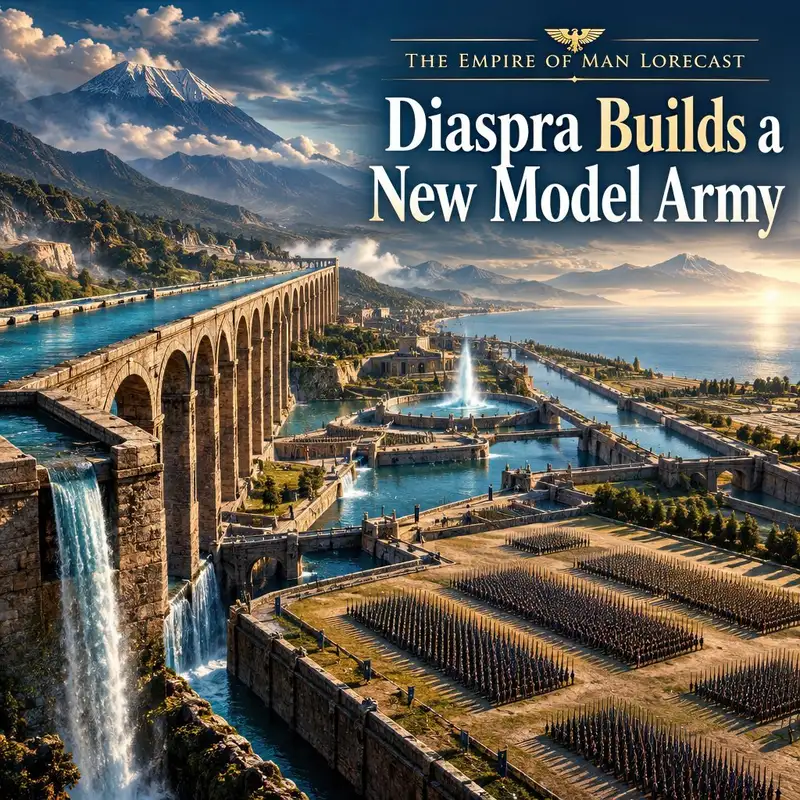
The city’s most impressive existing system was not weapons manufacture at all. It was water management. Diaspra’s canals, reservoirs, dikes, and controlled flows reflected accumulated engineering knowledge and a labor structure capable of maintaining it. The city was not “backward” in any simple sense. It had developed sophisticated solutions to the problems that mattered most to its environment. Those solutions had been built for agriculture, urban life, ritual obligations, and flood control. Under Boman pressure, they became part of the defense.
Water shaped movement. Canals and flooded ground could deny easy approaches, funnel attackers into less favorable routes, and complicate the momentum of a massed assault. Dikes and managed terrain could define where infantry stood, where cavalry could pass, and where an enemy would be exposed. Stakes and prepared positions added another layer of control. Inexperienced soldiers become more effective when the ground tells them where to stand and limits the directions from which danger can arrive.
The same hydraulic expertise that strengthened defense also exposed the cost of mobilization. The Laborers of God understood those canals and dikes because they had maintained them. Pulling them away for military training risked neglect. Controlled flooding can become destructive flooding if works are not watched. Water diverted for defense may affect fields and food supplies. A city under siege can survive a battle and still suffer from damaged infrastructure afterward. Diaspra’s leaders were not choosing between war and normal life. They were choosing which damage they could survive.
The problem was that tribute can change the attacker’s calculation as much as it changes the defender’s. If a hostile force learns that threatening Diaspra produces payment, the city’s wealth stops functioning as a shield and becomes evidence of profitability. Payment may purchase a pause. It may even be necessary in some circumstances. But it does not necessarily remove the incentive for renewed demands. The Boman might take the money as proof that pressure worked, then return once Diaspra had been weakened further.
Roger’s argument against paying off the Boman rested on that logic. A city facing extortion must ask whether it is purchasing safety or financing its own future vulnerability. The answer depends on the enemy, the political context, and the defender’s alternatives. Diaspra’s situation offered little reason to believe that tribute alone would create a durable settlement. The Boman had already demonstrated that they could threaten water, food, movement, and the approaches to the city. Paying them without building defense would leave those leverage points in place.
Still, the merchants’ concerns mattered. War preparation consumed capital, disrupted labor, and threatened the commercial order that had helped make Diaspra wealthy. The humans did not fully understand every relationship among merchant houses, religious offices, labor institutions, and local political factions. They could identify the strategic danger in appeasement, but they could not assume every opponent of mobilization was secretly disloyal or simply afraid. Politics inside a besieged city is rarely that clean.
The argument over tribute was therefore an argument over what Diaspra’s wealth was for. Was it a reserve to be spent on immediate peace? Was it a means to preserve trade at almost any cost? Or was it material that had to be converted into defense before the enemy could dictate terms? Gratar’s decision to support mobilization gave the military program legitimacy, but it did not erase the social strains created by that decision. A ruler can settle a question of authority. He cannot make the costs vanish.
The battle that followed tested whether the hurried system could function under pressure. The important point is not that a newly trained force became equal to veteran Marines. It did not. The important point is that Diaspra’s defenders could occupy prepared positions, maintain enough cohesion to resist, and serve as part of a defensive system rather than dissolving into isolated fights. That was a remarkable achievement for troops trained in weeks, but it was also a limited one. Their effectiveness depended on the system built around them.
Prepared ground shaped the fight. Stakes and obstacles disrupted the direct rush of attackers. Water features and defensive works narrowed approaches. Shield infantry could protect themselves and their neighbors against the pressure of thrown weapons. Pikes created zones that Boman foot soldiers could not enter carelessly. The defense did not rely on every recruit displaying individual mastery. It relied on the formation making individual panic less decisive.
The pike formations were particularly important because they transformed timing. A massed attacker seeks to close quickly, overwhelm defenders before they can coordinate, and turn fear into collapse. Pikes force attackers to slow, hesitate, bunch up, or seek another route. That delay is valuable. It gives commanders time to see what is happening. It gives reserves time to move. It gives cavalry a chance to identify exposed flanks. And it gives Marines the opportunity to use scarce high-technology weapons where they can have the greatest effect.
The Marines remained a decisive reserve because Diaspra could not reproduce their capabilities. Their armor, weapons, discipline, communications, and combat experience represented a level of military power the emergency army did not possess. But the Marines could not be everywhere. Their role was most effective when local troops had already held enough ground to create a problem the Marines could solve. Advanced firepower is powerful. It is more powerful still when used from a position prepared by allies who understand what they must hold and why.
Diaspra’s troops held because they had weapons suited to their task, ground prepared to support them, local commanders who could direct them, and Marine trainers who had taught them enough collective behavior to survive the first test. The Marines could intervene decisively because the defenders had not already been swept away. The Northern cavalry could strike because lanes and opportunities had been created for them. The system worked because its parts were connected.
Mounted forces mattered at the moment when defense could become counterattack. Rastar, Honal, and the civan cavalry brought speed and local military competence. Their function was not to charge blindly into every danger. It was to move through the openings created by the defensive plan, pressure vulnerable enemy elements, and exploit the loss of momentum caused by obstacles and disciplined infantry. A cavalry counterattack is most useful when an enemy is disordered, committed, or unable to respond in several directions at once.
The Boman were not an undifferentiated mass. Their threat included the pressure of their host, the harassment and intelligence-gathering role of outriders, and the ability to make a city feel surrounded even when every approach could not be held at once. Diaspra’s defense did not make those problems disappear. It showed that the city could impose costs, preserve order, and prevent intimidation from becoming automatic collapse. That changed the military relationship.
The immediate tactical achievement was defensive endurance. The new formations could hold prepared ground under conditions that would have overwhelmed an unorganized levy. The mission achievement was broader. Diaspra was not overrun before the expedition could continue toward its larger objective. The city had become an active ally with military capacity, not merely a place where the Marines paused to repair, bargain, and wait for disaster.
Victory did not restore the Laborers of God to their former lives. The city still had waterworks to maintain, food concerns to manage, commercial relationships to repair, and political resentments to absorb. Some of the people who had become soldiers had learned new skills and formed new loyalties. Some civic leaders had gained military influence. Artisans had discovered new forms of production management. A city that has mobilized cannot always return exactly to the assumptions it held before the crisis.
The industrial consequences were equally significant. Diaspra had demonstrated that its workshops could be coordinated around a common military requirement. Chal Thai’s weapon production, the distributed making of shafts, and Med Non’s shield-management role showed the value of specialization connected by planning. The lesson was not that every future need would be easy to meet. The lesson was that local capacity could be organized for war when leaders understood the actual bottleneck.
That knowledge belongs to Diasprans, not just to the Marines. Human advisers could identify a problem and share methods. Mardukan artisans, laborers, officials, and soldiers had to make those methods work with local materials and institutions. This was the beginning of a military and industrial adaptation, not the completion of one. Its future consequences would depend on who controlled production, who commanded the new soldiers, how civic labor was reorganized, and whether the city could sustain the changes after the immediate danger passed.
The political consequences were harder to measure. Gratar’s decision had been vindicated in the short term. Diaspra had defended itself rather than relying entirely on payment or hope. Bogess had gained a larger military instrument. Rus From had seen civic and technical capacities become directly relevant to war. The merchants had not been proven irrelevant, because food, transport, materials, and financing remained essential. But their claim that normal commercial practice could simply resume had been overtaken by events.
For civilians, the result was mixed. They had avoided the immediate catastrophe of being overrun. That matters. Yet survival carried burdens. Fields, water systems, workshops, and households had all been affected by the emergency. The city’s labor and resources had been redirected under extreme pressure. A successful defense can save a population from conquest while still leaving it with shortages, repair work, debt, grief, and difficult questions about who will perform the public labor now that so many hands have learned to carry weapons.
The New Model Army did not remain merely a garrison around Diaspra’s walls. Bogess and Rus From moved with the relief force toward K’Vaern’s Cove. That redeployment had operational logic. The city’s new military capacity could assist a wider allied effort rather than sitting idle after the immediate threat had receded. It also preserved the force as something more than a temporary panic measure. Soldiers who had trained, fought, and survived together could now be used where their experience mattered.
The movement also eased some of Diaspra’s internal tensions. A wartime army inside a city can become a political force as well as a military one. Its leaders acquire prestige. Its veterans acquire expectations. Its costs remain visible to merchants, laborers, and religious institutions. Sending Bogess and Rus From onward did not solve those issues, but it reduced the immediate concentration of wartime authority inside Diaspra while helping the broader campaign toward the sea.
Guard veterans supplied a military nucleus. Laborers supplied disciplined manpower, even at considerable civic cost. Northern cavalry supplied mobility and experience that the human expedition could not manufacture. Artisans supplied weapons and shields through coordinated local production. Water engineers transformed canals, dikes, and controlled flooding into defensive terrain. Gratar supplied the authority to make painful choices. Bogess supplied local command. Julian and the Marine noncommissioned officers supplied the patient, unglamorous work of turning recruits into formations.
Pahner’s contribution was to keep the project narrow enough to succeed. He designed for the Boman threat that existed, not for the army he might have preferred to command. He accepted that Diaspra could not become a complete military-industrial power in weeks. He focused on weapons that could be made, drills that could be taught, positions that could be prepared, and reserves that could be used decisively. That was not a compromise with military reality. It was military reality.
The resulting army could not replace Marine firepower. It could not erase Diaspra’s food problems, repair every political division, or guarantee the long-term health of the city’s waterworks and labor institutions. It was not a finished modern army, and it was not a human creation imposed on passive allies. It was a Mardukan defense system assembled under pressure, from Mardukan skills, institutions, animals, terrain, and people, with human advice and a small cadre of irreplaceable professionals.
That was enough to change Diaspra’s position. The city ceased to be a stranded obstacle on the expedition’s route. It became an ally capable of holding ground, producing useful military power, and contributing to a wider struggle. In weeks, Diaspra did not create perfection. It created the minimum organized strength required to deny the Boman an easy victory, and in war, that can be the difference between a city waiting to be consumed and a city deciding its own future.