Charles DeGlopper: Sabotage, Interception, and the Descent to Marduk
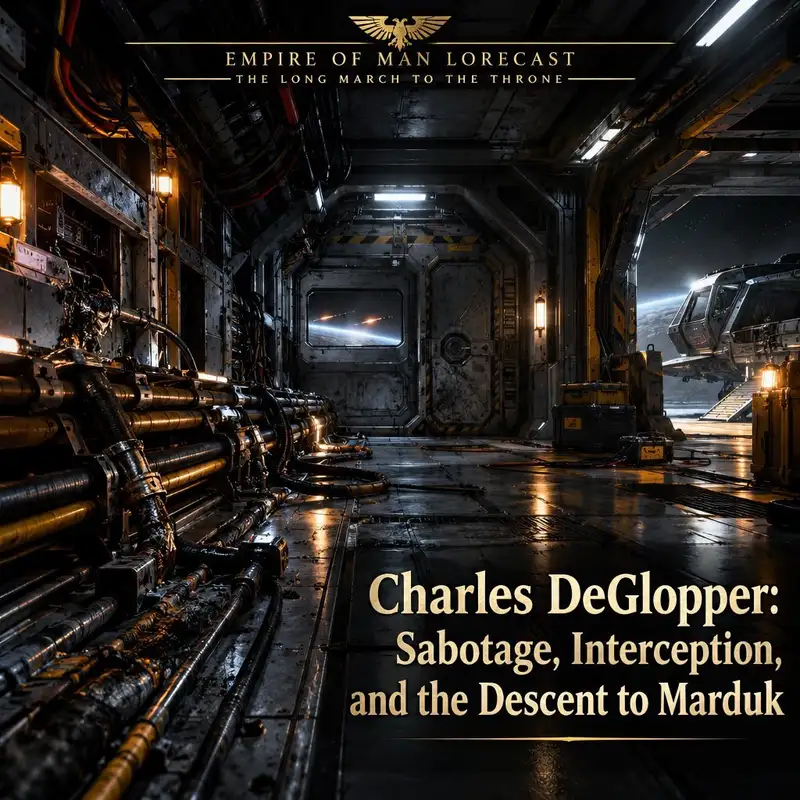
In the engineering spaces of the Charles DeGlopper, plasma was venting through a breach that should have sealed itself. The transport’s automated safeguards were designed to cut the deuterium flow after damage to the main conduits. They did not. The safety interlocks had been compromised, and the machinery continued feeding an expanding disaster. The chief engineer had to stop the flow manually, entering a crisis that the ship’s systems were supposed to prevent. He succeeded in arresting the immediate catastrophe. He did not survive it. By the time the emergency was contained, the DeGlopper was still in space, still carrying Prince Roger MacClintock and Bravo Company, and still technically capable of movement. But it was no longer a secure transport. Someone had attacked its ability to save itself.
That distinction matters. The Charles DeGlopper did not simply suffer an accident, and it was not defeated in a conventional battle before it reached Marduk. It was stripped of redundancy, mobility, information, engineering depth, and time. Then, while its crew struggled to restore enough capability to reach a habitable world, Saint naval forces found it in the Marduk system. The result was a cascading emergency. A royal-protection mission that had begun aboard a heavily equipped assault transport became a forced planetary evacuation. By the time the shuttles descended toward Marduk, Captain Armand Pahner’s Marines were no longer preparing to seize a spaceport from a position of strength. They were preparing to survive for months with supplies measured in days.
The original assignment had appeared far more manageable. Prince Roger was traveling toward Leviathan on a ceremonial mission for his mother, Empress Alexandra the Seventh. He was Heir Tertius, important enough to require exceptional protection but distant enough from the center of Imperial politics to make the trip politically useful. The voyage also removed him from a dangerous court environment. Concerns involving the House of MacClintock and the Earl of New Madrid had made distance seem prudent. That calculation assumed, however, that the Empire could safely move one of its heirs through its own space.
Roger traveled aboard the Charles DeGlopper, a Puller-class assault transport. It was not a line warship built to seek fleet engagements, nor was it a civilian passenger vessel. Its purpose was to carry people, equipment, and combat power into dangerous places. That gave it substantial mass, armor, missile capacity, and internal volume. It also gave it assault shuttles, trained crew, and the ability to support an elite Marine formation. In a crisis, those qualities made it formidable. They did not make it invulnerable.
The ship’s captain, Vil Krasnitsky, commanded the DeGlopper and its crew. Captain Pahner commanded Bravo Company of Bronze Battalion, part of the Empress’ Own Regiment. Pahner’s mission was the survival of the prince. Roger possessed dynastic precedence and a nominal military role, but practical responsibility for the security operation rested with the professionals around him. Sergeant Major Eva Kosutic enforced the standards that kept Bravo Company functional. Eleanora O’Casey, Roger’s former tutor and chief of staff, provided political, social, and linguistic judgment. Kostas Matsugae, Roger’s valet, maintained the practical personal support that court life normally made invisible.
None of them had been sent to conquer a planet. Bravo Company had been assigned to protect a royal principal aboard a secure Imperial vessel, then deliver him to an Imperial ceremony. It was a demanding mission, but it had boundaries. The ship supplied food, medical support, communications, transport, firepower, and repair capacity. It was a moving base, a fortified environment, and a source of institutional order. The Marines could concentrate on guarding Roger because the ship’s specialists handled propulsion, environmental systems, navigation, logistics, and damage control.
That division of labor depended on trust. The people who carried explosives were expected to carry them for legitimate work. The people who entered technical spaces were expected to be authorized. The computer systems that routed power, monitored damage, and protected the crew were expected to obey their design. A major military transport cannot operate if every engineering officer is treated as a likely enemy and every supply locker as a potential ambush site. Security must distinguish suspicious access from necessary access. The DeGlopper’s attacker exploited that necessity.
Ensign Amanda Guha was the ship’s logistics officer. Her position gave her legitimate access to equipment and material that an ordinary sentry would have no reason to possess. She carried six dense explosive charges through a vessel whose normal operations required personnel to move constantly between storage spaces, work areas, and technical compartments. Near Engineering, Private Hegazi challenged her. He was performing the sort of immediate, local security duty that protection units rely upon when larger systems are under strain.
Guha answered the challenge with a concealed bead pistol. Hegazi was killed or mortally disabled before he could stop her. The killing was important, but it was not the whole attack. A single murdered sentry does not explain the DeGlopper’s near destruction. Guha was moving toward a target that had already been selected, using materials acquired through her own authorized access. The attack was designed to damage the transport’s capacity to move, fight, survive, and complete its mission.
The explosives were attached to the main plasma conduits. Their detonation opened the engineering breach, but the physical blast was only one layer of the operation. A worm program had already entered the ship’s systems. The program disrupted or disabled critical safeguards, including the interlocks that should have shut down the deuterium flow after the conduits ruptured. In effect, the sabotage made the ship’s automatic defenses cooperate with the damage. Engineering was not merely hit. Its ability to respond was degraded at the same moment that a human crew faced a lethal emergency.
That combination is the hallmark of a serious insider threat. A guard can challenge a person in a corridor. A security team can search a compartment. Neither action is enough when the attacker has lawful access, technical preparation, and a second attack running inside the ship’s software. The physical sabotage created damage. The software compromise magnified it. The timing ensured that the crew had to fight the immediate emergency before it could fully understand the wider breach.
The available evidence identifies Guha as the physical saboteur. It also suggests that her personal computer or implant had been compromised in a way that limited or controlled her actions. The precise technical and medical meaning of that condition is not fully established by the immediate evidence. More importantly, identifying the person who planted the charges did not identify the person or network that caused the attack. Pahner understood that distinction. A captured weapon tells investigators who fired it. It does not necessarily tell them who selected the target, provided access, applied coercion, or planned the operation.
The damage-control battle in Engineering was therefore fought under conditions of uncertainty. The chief engineer manually stopped the deuterium flow because the automated system could no longer be trusted. That act preserved the ship from a still greater catastrophe. Yet it cost the DeGlopper the officer most qualified to diagnose, organize, and supervise the recovery that followed. In a peacetime personnel report, that would be one death among many consequences. In a damaged starship, it was the loss of specialized knowledge that could not simply be replaced by promoting the next person in line.
The sabotage left the DeGlopper with only one functioning fusion plant. Its tunnel drive and phase drive were disabled or severely damaged. Navigation, fire-control systems, environmental functions, sensors, and tactical networking all showed evidence of compromise or failure. Not every subsystem was destroyed beyond use. That was almost worse in some respects. The crew had to determine what could be repaired, what could be bypassed, what could be trusted, and what might fail again at the worst possible moment.
The DeGlopper spent roughly three weeks in improvised repair. This was not a clean restoration in a fleet yard. The crew rerouted fixed control lines, installed temporary relays, and created workarounds for systems that no longer functioned as designed. The repaired tunnel drive could move the ship, but it did so with severe vibration and noise. Those symptoms were not cosmetic. They signaled that the transport was operating outside normal conditions, with machinery and structure enduring stresses that would matter during future maneuvering or combat.
Bravo Company contributed to the repair effort because the ship’s emergency had become everyone’s emergency. Marines trained for protective work and combat found themselves hauling, carrying, holding, rerouting, and assisting technical personnel. This did not mean that the Marines had suddenly become engineers. It meant that the loss of engineering capacity forced the entire mission to absorb work that would normally belong to specialists. Every available pair of hands became part of damage control.
The repairs were sufficient to make Marduk reachable. They were not sufficient to make the DeGlopper whole. That shifted the meaning of the destination. Marduk was no longer simply a point near the route, or a place from which the mission might continue in comfort. It became the least-bad refuge available to a crippled transport. It offered a habitable planet and, somewhere on that planet, a spaceport that might provide a route home. It did not offer a dependable naval base, a major repair facility, or the assurance of friendly control.
Marduk was nominally an Imperial Class Three world. Nominal status, however, is not the same thing as effective authority. The system possessed limited facilities and an automated refueling post, but no repair base capable of restoring a badly damaged assault transport. Intelligence on the planet was sparse. Its political landscape was fragmented, and the human presence was thin. Reports pointed toward piracy, Dream Spice smuggling, local dangers, and the possibility of Saint activity. For the DeGlopper, Marduk was not a friendly harbor. It was an uncertain theater where a damaged ship might find fuel, concealment, or a final chance to put its passengers down alive.
The planet itself offered no simple solution. Its climate was hot and extraordinarily humid. Planning estimates placed median conditions at roughly thirty-three degrees Celsius and ninety-seven percent humidity. Such conditions affect more than comfort. Heat burdens personnel in armor. Humidity threatens electronics, weapons, food stores, medical supplies, and any material that depends on dry storage. The terrain and local ecology were only partly understood. The societies that controlled roads, rivers, ports, and territory were not passive scenery. They would become political actors in whatever campaign followed.
The spaceport was the real strategic objective, but it was not a secure landing zone. Reaching it would require information, movement, and probably force. The DeGlopper’s damaged condition made a direct approach increasingly dangerous. And before Krasnitsky could decide how best to approach Marduk, the transport detected an unidentified warship.
Its phase-drive signature resembled that of a Saint parasite cruiser. The Saints were rivals of the Empire, and their presence in the system was strategically alarming. But the immediate evidence did not prove that the cruiser had been waiting specifically for Roger. The DeGlopper’s route and timing had been changed by sabotage and emergency repair. From Krasnitsky’s perspective, a prearranged interception aimed precisely at the transport was unlikely. What the cruiser did prove was that Marduk’s nominal Imperial status did not prevent hostile human naval activity in the system.
The damaged transport had one accidental advantage. Its altered emissions and degraded profile made it look less like an assault ship and more like a damaged merchant freighter. Under ordinary circumstances, the DeGlopper would have presented a recognizable military signature. Now it looked like a limping vessel with limited options. Krasnitsky chose to use that weakness as deception. He kept the ship’s most revealing systems quiet and allowed the cruiser to make its own assumptions.
It was a calculated risk. The Saint cruiser held the initiative at long range. It was faster and more maneuverable than the heavier transport. It could choose its approach, maintain distance, and use that mobility to attack before the DeGlopper could bring its best capabilities to bear. Krasnitsky’s chance lay in persuading the enemy that the transport was less dangerous than it truly was, then activating his remaining systems only when the range had narrowed enough to matter.
The deception did not make the DeGlopper safe. Its tactical network had been degraded by sabotage. Sensors and fire control were impaired. Point defense had been damaged. Missiles that normally depended on a stronger guidance and coordination system had to operate with reduced support. The transport still carried powerful weapons, but it could not employ them with the confidence or efficiency expected of an undamaged assault vessel.
The first Saint cruiser attempted to exploit precisely that weakness. It fired from outside the DeGlopper’s effective energy range, using distance as protection and trying to destroy the larger ship before it could close. The tactical problem was straightforward. The cruiser needed to stay mobile, strike repeatedly, and prevent the transport from bringing its missile capacity and armor advantage into the fight. The DeGlopper needed a brief moment in which the cruiser would expose itself, commit to targeting, and come close enough for Krasnitsky to transform apparent helplessness into a firing solution.
That moment came when the cruiser used lidar to paint the transport. The Saint ship needed a more precise picture of its target. Krasnitsky had been waiting for that commitment. The DeGlopper activated its systems and launched. The first cruiser was destroyed by missile fire before it could reach energy-weapon range. The transport had won the immediate engagement, but the victory was expensive.
The DeGlopper suffered further hull breaches and lost additional defensive capability. It had spent a significant portion of the missile inventory that made it dangerous. Its already damaged systems were placed under renewed stress. A tactical success had not restored operational endurance. The ship was still crippled, still near a planet without meaningful repair facilities, and now more obviously identified as something far more valuable than a merchant freighter.
The battle produced several different outcomes at once. Tactically, Krasnitsky destroyed the first cruiser. Operationally, the DeGlopper had less defensive capacity, fewer missiles, and less ability to survive another exchange. Strategically, Roger had still not been delivered to safety. Intelligently, the encounter confirmed hostile Saint presence in the Marduk system, but it did not reveal the full network behind the original sabotage. The crew knew that the ship had been attacked and then intercepted. They did not yet possess a complete explanation for either event.
Then a second Saint cruiser began accelerating toward the DeGlopper. The first fight had consumed something more precious than missiles and armor. It had consumed time. The transport could no longer expect to fight a prolonged series of engagements and still preserve the assault shuttles needed to save Roger and Bravo Company. Krasnitsky faced the central command question of the voyage. Was his priority the survival of the ship, or the survival of the protected party?
For a transport commander carrying an Imperial heir, the answer was severe but clear. The ship had become expendable if sacrificing it created an escape window. The DeGlopper’s remaining combat power had to be converted into time. The shuttles needed time to launch. They needed time to separate from the ship. They needed time to begin their descent before the second cruiser could destroy them or force them to remain trapped aboard a dying transport.
The ship’s crew and the Marine guard detail had different responsibilities. Krasnitsky commanded the vessel and the people who operated it. Pahner commanded the force charged with protecting Roger. But both missions converged on the same fact. If Roger died or was captured, the original political purpose of the voyage failed completely. The Marines could not protect him if the shuttles never escaped. The crew could not save the ship if doing so meant abandoning the protected principal to a superior threat.
Later evidence confirms that the DeGlopper’s crew sacrificed itself against the Saint cruisers to cover the evacuation. That understanding belongs to retrospective history. At the moment of departure, Roger and the company did not possess a full accounting of what was happening behind them. They knew the ship was fighting. They knew the shuttles had to leave. They knew that people who had repaired the ship, fed them, transported them, and fought beside them were remaining aboard because the mission required someone to hold the enemy back.
The evacuation began under severe shuttle constraints. Assault shuttles can move troops from ship to surface, but they are not unlimited lifeboats or independent expeditionary bases. Mass, fuel, cargo balance, and atmospheric conditions all mattered. Hydrogen tanks were required for reentry. The shuttles would perform a largely unpowered, dead-stick descent after separation. That meant loading decisions could not be made on sentiment or convenience. Too much cargo could endanger the landing. Too little could leave the survivors without the equipment needed to remain alive.
The company removed nonessential material. It retained armor, weapons, technical equipment, and added power packs where possible. Each item represented an argument about the future. Equipment useful during the first hours on the ground might displace something needed weeks later. A power pack could extend the life of a critical system, but it added weight. Armor could save lives in combat, but it imposed heat, maintenance, and energy burdens. Technical tools might make later repair possible, but only if the expedition still had personnel capable of using them.
Cargo selection became strategy in miniature. The Marines were not simply packing for a landing. They were choosing what kind of force they might be after the ship was gone. An assault company supported by a transport has different options from a small force cut off on an unfamiliar planet. The DeGlopper had provided food, medical depth, communications, maintenance, and heavy firepower. The shuttles could carry only fragments of that system.
The landing plan also had to account for detection. A descent near the spaceport might seem logical, since the port was the route home. It would also risk placing the shuttles directly under observation by whoever controlled or watched that facility. The company therefore expected to land far from the port. The price of avoiding immediate detection was distance. The expedition would survive the descent only to begin a long movement across Marduk toward the objective it had been unable to approach directly from orbit.
Pahner’s revised mission was not to abandon the spaceport. The port remained the strategic objective because it offered the only plausible path off the planet. But the operational requirement had changed completely. Bravo Company now had to preserve Roger, preserve enough combat power to defend him, and move through a world it did not understand. It would have to do this with approximately two weeks of food and roughly one week of armor power, even though the crossing to the port might take months.
Those figures imposed a discipline more demanding than any dramatic speech. The company could not wear powered armor continuously. It could not fire advanced weapons without considering ammunition and energy. It could not expect medical supplies to last indefinitely. It could not assume that every encounter could be solved by force. The Marines would carry their armor rather than wear it whenever possible, saving its power and protection for emergencies, major engagements, and the final objective.
That decision recognized a hard truth about advanced equipment. A suit of armor is only as useful as the power pack behind it, the technician who can maintain it, the environment that allows it to function, and the operational purpose that justifies spending its remaining life. On Marduk, the company’s most sophisticated systems would be precious reserves, not everyday conveniences. A bead rifle, a power pack, or a working communications device could become more valuable when not used.
The expedition would need alternatives. Local weapons could be less capable than human systems in some respects, but they would also be repairable and replaceable within Marduk’s economies. Trade could provide food and information. Diplomacy could secure passage where combat would consume irreplaceable ammunition. Mardukan guides, artisans, rulers, soldiers, and merchants would possess knowledge the humans lacked. None of that made cooperation easy, and none of it made Mardukan societies subordinate to the expedition. It simply meant that survival depended on recognizing local agency rather than treating the planet as empty terrain.
O’Casey’s role became more important because every contact would involve more than vocabulary. Translation could make words understandable without explaining a society’s political interests, religious obligations, status rules, or memories of neighboring enemies. Kosutic’s role became more important because discipline had to survive hunger, heat, fear, fatigue, and the loss of familiar support. Matsugae’s role expanded because Roger’s normal household structure had collapsed into a field environment. Pahner’s command burden expanded because protecting the prince now required preserving the entire force that made protection possible.
Roger’s own position had changed as well. His legal importance had not diminished. If anything, it had become more dangerous. But royal authority could not solve navigation, repair a shuttle, produce food, or substitute for field command experience. The people around him could advise, protect, argue, and act. They could not remove the fact that the mission centered on his survival. The prince was no longer merely a passenger whose presence complicated security. He was the political reason the company would have to attempt an impossible march.
The shuttles descended toward Marduk without the confidence of a planned assault. They carried survivors of a shipboard sabotage, a hurried repair effort, and a naval engagement that had turned their transport into a rear guard. Their landing would not place an organized invasion force on a prepared battlefield. It would place a royal party, an elite Marine company, and limited supplies into a contested world far from the spaceport they needed to reach.
In immediate tactical terms, the evacuation succeeded because Roger’s party escaped the DeGlopper. Operationally, success was far less certain. The force began its campaign far from the port and without enough food or armor power for a direct march. Strategically, the Empire had lost an assault transport and its trained crew while one of its heirs vanished into a system where hostile human forces could operate. Politically, a nominal Imperial world had become the place where the survival of the MacClintock dynasty might depend on people who had never asked to become part of its crisis.
There was also a civilian consequence, although no one in the descending shuttles could yet measure it. Mardukan societies would soon encounter armed off-world survivors carrying advanced weapons, urgent needs, and knowledge that could alter local trade, production, and warfare. The expedition did not arrive as a normal diplomatic mission, and it did not arrive as an occupying army with a stable supply line. It arrived as a force desperate to live long enough to leave.
The Charles DeGlopper’s final success was not that it reached Marduk. It was that its crew exchanged a ship, trained personnel, and any easy route home for one narrow possibility: that Bravo Company could keep Roger alive long enough to turn an evacuation into a campaign.