Across the Mountains: Cold, Attrition, and the Road to Ran Tai
At roughly twenty-three degrees Celsius, the humans of Bravo Company were uncomfortable. After the heat and humidity of the lowlands, the air felt sharp, dry, and badly timed. For D’Nal Cord, the mahouts, and other Mardukans traveling with the expedition, it was far more serious. Cord became nearly unresponsive. Men who had handled huge pack animals, negotiated difficult ground, and endured the long road from the Hadur basin were suddenly threatened by weather the Marines had barely begun to notice.
Warrant Officer Dobrescu could identify the danger without claiming to understand every mechanism behind it. The expedition possessed advanced medical systems, trained personnel, and nanomedical support, but it did not possess a complete scientific account of Mardukan physiology. The company knew that its allies were suffering. It knew that exposure and dehydration were involved. It knew that delay might kill people essential to the column. What it did not know was exactly how far the cold could be pushed before survival became impossible.
That uncertainty mattered because the Mardukans were not simply civilians attached to a human force. They were guides, laborers, animal handlers, traders, interpreters, allies, and participants in their own right. Their knowledge made the march possible. Their condition set limits on the company’s movement. The Marines could not solve the problem by retreating into armor and carrying on. Their armor could protect an individual human under certain conditions. It could not replace the people and animals on which the entire expedition depended.
By the time Bravo Company approached the Tarstens, it had already changed from the force that landed on Marduk. It had survived campaigns among the Voitan and Marshad peoples. It had learned that survival could not rest on endless use of bead rifles, plasma weapons, power packs, and manufactured rations. Trade had become as important as firepower. Reputation had become a form of security. Gifts, captured goods, negotiated passage, and local goodwill had reduced the need to solve every problem with a high-technology weapon.
Those gains were real, but they did not restore what the march had consumed. The company had lost personnel. Its advanced ammunition was badly depleted. Food stocks, salt, dietary supplements, cash, technical supplies, and medical resources all had limits. The long-term strategic objective remained unchanged. Prince Roger and the surviving Marines still needed to reach the distant spaceport and escape Marduk. But reaching it would require more than arriving at its perimeter. They had to preserve enough capability to seize, operate, or exploit whatever route home remained available.
That requirement shaped every decision in the mountains. A bead round fired against an immediate threat might be a round unavailable during the eventual fight for the spaceport. A damaged suit could not necessarily be repaired. A skilled specialist killed on a mountain trail could not be replaced by promoting the nearest survivor. Even money had become military power. Gold, gems, cloth, tools, and weapons could buy food, information, transport, or permission to pass. Once spent, however, they narrowed the company’s choices at the next settlement.
The first great problem was physical carriage. Bravo Company no longer had the manpower to move all its equipment, supplies, wounded, and reserves solely on human backs. The flar-ta carried burdens that the company could not absorb without abandoning essential material. They were not a convenience. They were the practical link between the Marines’ remaining high-technology resources and the ground over which those resources had to travel.
The mahouts understood the danger to their animals better than the Marines did. The flar-ta were suffering in the cold, dry mountain conditions, and the handlers themselves were in danger. The humans could improvise coverings, adjust loads, seek shelter, and manage water as best they could. None of that changed the underlying fact that the animals had been brought into an environment for which they were poorly suited. A pack train is not simply equipment with legs. It is a living system, dependent on handling, fodder, water, rest, and local knowledge.
The company faced an unpleasant set of options. It could abandon equipment and reduce its future combat power. It could press the animals onward, risking their collapse and the loss of both transport and mahout expertise. Or it could purchase the flar-ta from their handlers, accepting the financial cost in exchange for keeping the column mobile. None of those choices was clean. Each shifted risk from one part of the expedition to another.
Captain Armand Pahner remained the professional commander responsible for Bravo Company and for Prince Roger’s protection. He had to judge the military value of every load, every animal, and every delay. Roger’s role was different, but not irrelevant. The prince possessed dynastic standing, access to wealth, and an increasingly practical understanding that royal authority did not make burdens disappear. His support for the purchase mattered because the decision consumed resources that might otherwise have been preserved for later bargaining.
The bargain was expensive because the animals were valuable. The mahouts were not surrendering disposable property to a military force. They were dealing with a foreign armed column under pressure, and they understood the worth of the animals whose care had been their livelihood. The transaction did not erase the unequal circumstances surrounding it. Nor was it simple requisition. The expedition paid because it needed the flar-ta, and because keeping the animals moving required a durable arrangement rather than a temporary promise.
In operational terms, the company converted money into carrying capacity. That may sound less dramatic than a battle, but it was one of the decisive acts of the crossing. A company that cannot move its equipment cannot preserve its combat power. A company that abandons its food, tools, weapons, and technical stores in the mountains may still survive for a few days. It cannot continue a planetary campaign. The purchase kept Bravo Company moving, but it also reduced the financial margin available when the company reached the next market.
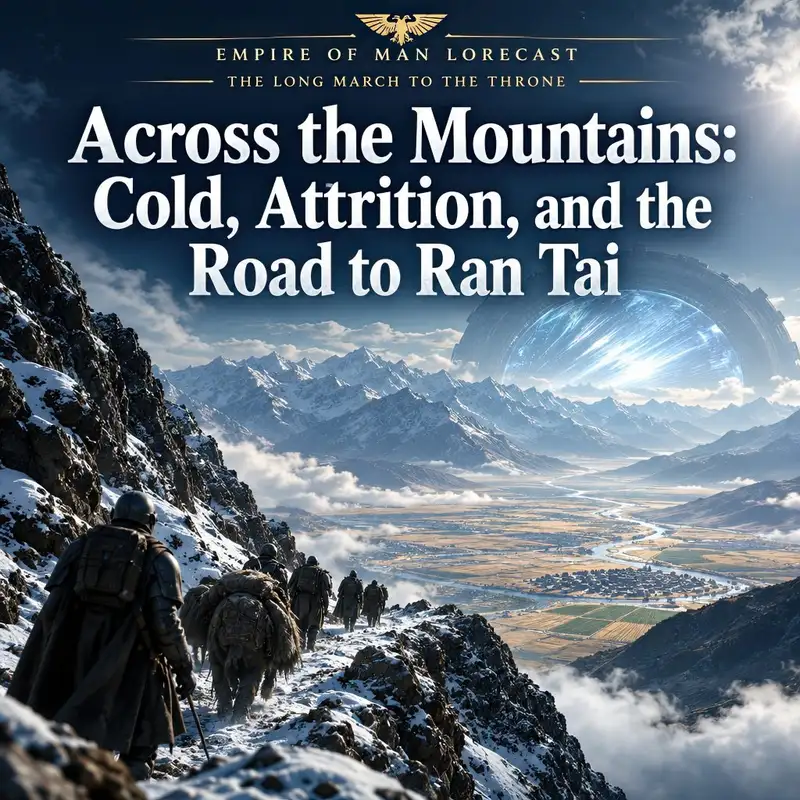
The next task was finding a pass that the column could actually use. This was not a matter of locating the lowest gap on a map. The expedition had no reliable map sufficient for that purpose. A route suitable for a lightly equipped scout might be impossible for loaded pack animals. A trail passable in dry conditions might become a trap beside a glacial stream. A narrow ledge might allow a human to climb through it but deny room for an animal, a casualty, or a burdened formation to turn around.
The search consumed time. Roughly a week and a half went into examining possible routes through the Tarstens. That delay was not evidence of hesitation. It was reconnaissance conducted under conditions in which a bad decision could immobilize the expedition or cost it animals that could not be replaced. Every day spent searching also consumed food and supplies. Yet every day saved by charging into unsuitable ground might have been repaid in injuries, lost equipment, and exhausted personnel.
The discovery of a cairn and a glacial stream provided useful evidence. Someone had crossed this country before. The signs suggested a route, or at least a line of movement through terrain that could otherwise appear impassable. But they did not prove that the route was regularly maintained, safe for a heavily loaded column, or appropriate for the company’s particular mix of humans, Mardukans, animals, equipment, and casualties. In expeditionary warfare, evidence of previous passage is not the same thing as a guarantee of future passage.
Sergeant Major Eva Kosutic understood that distinction. Her authority did not rest on court status or ceremony. It rested on professional judgment, discipline, and a clear sense of what soldiers and animals could reasonably be asked to do. She sent forward reconnaissance parties and made use of people whose background gave them relevant skills. In the mountains, local and personal experience could matter more than the broad training that had prepared Marines for conventional security duty.
Among those valuable specialists was Dokkum, a Marine from New Tibet whose familiarity with mountain conditions gave the company a kind of knowledge it could not download into a computer. His practical instruction was simple. One step per breath. It was not a romantic saying about endurance. It was a doctrine of energy management. A climber who rushes, strains, slips, or exhausts himself turns a difficult route into a casualty problem. Slow movement conserved strength, reduced mistakes, and kept the column from breaking apart.
That method applied to more than individual climbers. A mountain column moves at the pace of the slowest essential element. In Bravo Company’s case, that included injured personnel, overloaded Marines, Mardukan allies vulnerable to exposure, mahouts responsible for animals, and the flar-ta themselves. The fastest scout could not establish the pace. Neither could the strongest armored Marine. The practical tempo belonged to the people and animals who could not safely be left behind.
Once a usable pass had been found, the problem changed from navigation to execution. The company had to move through steep country, manage loads, protect animals, and retain enough order that an accident in one part of the column did not become a general collapse. Glacial terrain narrowed movement options. Dry air increased strain on people already accustomed to humidity. Fodder became a question with military consequences. A pack animal that could not eat or drink properly might fail before it reached the next shelter.
The human Marines endured the cold more effectively than many of their Mardukan companions. That did not make them independent. Humans might carry rifles, operate advanced equipment, and establish security. But they depended on Mardukan handlers to manage the animals. They depended on the animals to move burdens. They depended on local knowledge to distinguish a pass from a dead end, a safe stream from a trap, or a temporary hardship from an approaching disaster.
The expedition’s supplies reflected this dependence. Ammunition and power packs were obvious concerns because they represented high-technology combat capability. But salt, food supplements, cloth, fodder, water, and trade goods could be just as decisive. A company can preserve a plasma weapon and still fail if its people cannot eat. It can conserve bead ammunition and still fail if its pack train collapses. It can retain advanced medicine and still fail if the people who understand local animals and terrain are dead, sick, or unable to move.
Attrition had its own cruel arithmetic. Fewer people meant fewer mouths consuming food, but that was not a meaningful gain. Every death also removed training, experience, friendships, trust, and practical capacity. A dead rifleman was not simply one less ration requirement. He was one less person to stand watch, carry loads, help move casualties, maintain discipline, and share the burden of combat. A dead specialist was even harder to replace, because the skills lost might be exactly those the expedition needed for the next obstacle.
The far side of the pass offered a striking reward for that endurance. From a high overlook, the expedition could see a broad U-shaped valley shaped by ice and mountain water. A large lake lay within the basin. Beyond it stood a substantial city. After the harshness of the crossing, Ran Tai was visible not as a vague promise but as a real place, with walls, structures, fields, routes, and the accumulated labor of a settled society.
Ran Tai did not exist because the mountains had somehow spared it from hardship. It existed because its people had adapted to the mountain environment and made it productive. High-altitude agriculture supported crops including nearpeppers and other spices. Mineral deposits provided gold, silver, iron, and gems. Those resources supported trade, craft production, wealth, and the political institutions needed to protect them. The valley was not empty wilderness interrupted by a miraculous city. It was a working economic landscape shaped by farmers, miners, merchants, artisans, guards, and rulers.
For Bravo Company, the sight of Ran Tai changed the immediate horizon. A city meant potential food, shelter, information, medical help, employment, trade, and access to local networks. It might offer a place to rest and reorganize. It might allow the company to turn goods into supplies and supplies into renewed movement. But the city was still some distance away, and the descent into the valley remained dangerous. Seeing a recovery point was not the same as reaching one.
The mountains imposed one final and expensive lesson before the company could enter that new environment. On difficult ground beyond the pass, the column encountered flar-ke. These were not the flar-ta that carried the expedition’s burdens. The narrative distinguishes them by their size, their heavy armor, their behavior, and the threat they posed. They were a local environmental danger, not an enemy army. But the tactical problem they created was every bit as real as an ambush by hostile troops.
The flar-ke struck a column already constrained by terrain and animals. That mattered. In open ground, Marines with advanced weapons might spread out, establish firing positions, and exploit their superior range and coordination. In mountain country, the column’s movement was limited. The pack beasts restricted maneuver. The animals that made continued travel possible also became obstacles, targets, and potential cover. A sudden attack turned the expedition’s logistics system into part of the battlefield.
The creatures’ frontal armor made the problem worse. Standard fire that might stop another threat did not necessarily work from the angle available. Advanced weapons did not become useless, but their effectiveness depended on geometry. The Marines needed shots into vulnerable flanks, not simply more shots into heavily protected frontal surfaces. They needed position, angle, and time. Under pressure, with animals panicking and the column compressed by terrain, those requirements were difficult to achieve.
Ammunition scarcity made every decision sharper. By this point, Bravo Company could not solve a dangerous encounter through generous expenditure. Its remaining advanced ammunition had to be preserved for the spaceport objective still far ahead. The Marines had only a very limited reserve, on the order of a single magazine per weapon in the immediate crisis. Armor-piercing rounds were particularly valuable. Using them against the flar-ke might save lives now, but it also reduced the company’s ability to meet a later threat that could not be avoided.
That was the central tactical contradiction. The company had weapons far beyond anything most local opponents could manufacture, yet it could not use them freely. A weapon’s value is not measured only by its destructive power. It is measured by the number of rounds available, the ability to replace them, the type of target, the distance, the angle of impact, and the consequences of firing today rather than tomorrow. In the mountains, advanced technology remained formidable. It was no longer abundant.
Pahner remained responsible for the force as a whole. He had to keep the prince alive, prevent the column from breaking, direct the use of scarce ammunition, and ensure that immediate survival did not consume the resources needed for the larger mission. Subordinate leaders had to act quickly within that pressure. Kosutic’s practical authority, Marine discipline, and the experience of the people nearest the animals all became essential. There was no single heroic solution that removed the problem for everyone else.
Prince Roger played an active part in the crisis, including through his growing familiarity with Mardukan animals and field conditions. That contribution mattered. He was no longer merely a protected passenger observing professionals at work. Yet the encounter did not make him the commander of the operation. His personal action occurred inside a system of command maintained by Pahner, Kosutic, the Marines, and Mardukan specialists. The difference is important. A prince can fight bravely and make sound judgments without replacing the chain of command that keeps a company alive.
The response required maneuver toward the animals’ sides, where their protection was less effective. Pack animals became improvised platforms and cover. The very creatures whose presence restricted the column also helped create ways to survive the attack. That improvisation was not elegant. It was the kind of field adaptation that occurs when an expedition has no spare equipment, no reserve force, and no safe place to withdraw. The company used what it had because there was nothing else available.
The herd was defeated or driven off, but the result was not a clean victory. The cost appeared in ammunition spent, people killed or wounded, confidence damaged, and skills lost. The company had reached a point where each engagement had to be judged not by whether it was won, but by what winning had consumed. A force can survive a tactical encounter and still emerge weaker in ways that matter more than the immediate body count.
Dokkum’s death made that point with particular force. He was not valuable merely because he could carry a weapon. His New Tibetan mountain experience had helped the company understand how to move through the Tarstens. He represented an accumulation of practical knowledge, learned before Marduk and applied under conditions no one could have fully anticipated. When he died, Bravo Company lost a fighter, but it also lost a teacher, a source of judgment, and a piece of institutional memory.
Other losses compounded the problem. The exact total need not be forced into a number to understand the effect. The expedition had already been reduced by the long march. Every additional casualty redistributed duties among survivors. Someone else had to carry more. Someone else had to take a watch. Someone else had to maintain equipment, assist the wounded, train an ally, guard Roger, or make decisions in unfamiliar terrain. Attrition did not merely shrink the company. It narrowed the range of tasks the company could perform safely.
The personal cost mattered as well. The Marines were professionals, but professionalism does not erase grief. Repeated loss produces fatigue, anger, restraint, and sometimes an emotional hardening that can be useful in the next emergency and dangerous afterward. The people who continued toward Ran Tai did so carrying more than packs and weapons. They carried the memory of comrades who had not made the crossing, and the knowledge that the road ahead still required more of them.
The first contact with Ran Tai made that immediately clear. Sen KaKai, a mounted guard of the city, did not resemble the people or forces Bravo Company had most recently encountered. His equipment included armor, a wheel-lock firearm, a lance, and a sword. That combination signaled a military culture built around mounted service, metalworking, firearms, and local methods of war. The Marines had not entered a timeless frontier where every society would be awed by human equipment. They had entered a region with its own established military-industrial traditions.
The wheel-lock weapon in particular mattered as evidence of regional variation. Ran Tai’s people possessed gunpowder technology suited to their own materials, labor systems, and military needs. It did not equal the Marines’ bead weapons in every respect. It did not need to. A locally produced firearm that could be maintained, supplied, repaired, and issued through a local system might be strategically more sustainable than an advanced weapon with no replacement ammunition. The encounter reminded the expedition that technology had to be judged in context.
O’Casey’s translation system also encountered its limits. The company had crossed into a linguistic zone not fully covered by its available language tools. That did not mean communication was impossible, but it meant that translation required caution. A familiar title might conceal a different office. A simple question about passage might carry political implications. A gesture intended as courtesy might be read as threat, arrogance, or bargaining. The mountains had limited movement. Language now limited certainty.
Trade helped establish peaceful intent. Dianda cloth and high-quality blades had value beyond their material worth. They were useful goods, recognizable signals that the foreigners wished to negotiate rather than raid, and practical instruments for opening conversation where words initially failed. This was not diplomacy detached from logistics. The same items that could purchase goodwill might also be needed later for food, transport, or information. Every gift was both a political act and a reduction in the expedition’s remaining reserves.
Ran Tai’s authorities had their own concerns. A foreign column arriving from the mountains included heavily armed humans, unfamiliar Mardukans, valuable animals, unusual equipment, and a royal figure whose importance was not immediately obvious to local people. The city’s guards, merchants, and officials had no reason to treat the expedition’s survival as their responsibility. Peaceful contact had to be earned through restraint, exchange, and careful interpretation of local interests.
For Bravo Company, Ran Tai offered the closest thing it had seen in some time to an operational base. It was not an Imperial garrison, and it was not under Pahner’s command. But it could provide the functions an expeditionary force needed most desperately. There were markets. There was food. There were craftsmen, medical knowledge, shelter, trade networks, and people who understood the surrounding country. There was also the possibility of earning money rather than merely spending it.
The value of that recovery was easiest to see in the shortages the company carried with it. Barleyrice was running low. Salt and dietary supplements remained concerns. Advanced ammunition could not simply be purchased from a market stall. Cash reserves had been reduced by the flar-ta bargain and by the long costs of moving a company across an inhabited planet. The Marines had survived because they had become better at using local systems. But they still needed access to those systems, and access depended on the willingness of local people to deal with them.
Ran Tai could help stabilize some of those problems. It could not restore Bravo Company to its original strength. It could not replace the dead. It could not manufacture new bead ammunition, repair every damaged Imperial system, or erase the spaceport mission’s strategic demands. It could offer a pause in immediate collapse. That distinction matters. A pause may be enough to save an expedition, but it is not the same as security.
The city’s wealth also explains why its inhabitants could negotiate from strength. Nearpepper fields, spice production, mining, and trade gave Ran Tai resources worth defending and markets worth controlling. Merchants had reasons to value unusual cloth, blades, and foreign goods. Artisans had skills that could become important to a company increasingly dependent on repair, adaptation, and local manufacture. Guards had reasons to be suspicious of armed outsiders. Farmers had little reason to welcome disruption. The city was not a supply depot waiting for the Marines. It was a society assessing whether these newcomers were danger, opportunity, or both.
The financial dimension of the crossing continued to shape the expedition’s choices. Purchasing the flar-ta had preserved mobility through the mountains. It had also left less wealth available for later transactions. That was not evidence that the earlier decision had been wrong. It was evidence that expeditionary command is often the management of competing necessities. Money spent on animals could not be spent on food. Goods traded for safe entry could not be traded later for intelligence. Resources retained too carefully, however, might become useless if the company never reached the next town.
Operationally, the crossing demonstrated that movement depends on a system. Pack animals, mahouts, scouts, guides, food, water, shelter, trade, and rest all mattered. A company with outstanding training can still be stopped by an animal problem. A prince’s survival can still depend on whether a column finds fodder. A route can still be blocked by the practical question of whether a burdened flar-ta can negotiate it without falling, freezing, or starving.
The intelligence lesson was equally severe. The expedition had limited knowledge of Mardukan physiology. It had incomplete maps. It relied on traces of earlier travelers, personal expertise, and reconnaissance rather than a prepared mountain route. Its translation tools did not automatically unlock the language of Ran Tai. None of these shortcomings reflected simple negligence. They reflected the reality that the mission had become something it was never designed to be: a planetary crossing through diverse societies and environments after the loss of its original transport.
Institutionally, survival depended on authority that was shared rather than simple. Pahner commanded the military operation. Kosutic translated command intent into disciplined practical action. Dobrescu defined medical limits without pretending certainty. O’Casey interpreted cultures and language. Roger brought royal status, resources, and growing judgment, but not a substitute for professional command. Cord, the mahouts, and other Mardukans possessed expertise the humans could not reproduce. The expedition endured because those roles remained distinct and because the company learned, however imperfectly, to respect them.
Strategically, the mountains made conservation more urgent than ever. The spaceport remained ahead. The company would eventually require enough weapons, enough trained people, enough political leverage, and enough physical endurance to reach and seize a route home. Every casualty in the Tarstens reduced the margin for that future operation. Every round used against the flar-ke was a round unavailable later. Every relationship preserved with local allies and communities increased the chances that the expedition could find food, labor, intelligence, and transport when technology alone could no longer provide them.
Ran Tai mattered because it was the first place after the crossing where those damaged systems could be partly stabilized. It offered food before starvation, trade before insolvency, information before blind movement, and rest before exhaustion became irreversible. It gave the company a place to reorganize its burdens and recover some capacity for choice. That is an operational achievement, not a mere rest stop.
The Tarsten mountains stripped away the illusion that Bravo Company’s advanced equipment could carry it independently across Marduk. Armor could not warm every ally. Nanomedical support could not create missing biological knowledge. Bead rifles could not replace transport animals. Computers could not locate a pass that scouts and experienced climbers still had to find on foot. Royal wealth could buy mobility, but only by reducing other options. The company crossed because it converted trade, local expertise, animal labor, reconnaissance, and disciplined restraint into survival.
By the time the expedition reached Ran Tai, it was no longer an untouched elite Imperial unit moving through an inconvenient wilderness. It was a battered coalition, dependent on people and systems outside its original design. That dependence was not a failure of the Marines’ professionalism. It was the practical truth of the campaign. The road to Ran Tai succeeded because Bravo Company learned that no amount of Imperial technology could replace the people, animals, supplies, and knowledge the mountains had already taken away.